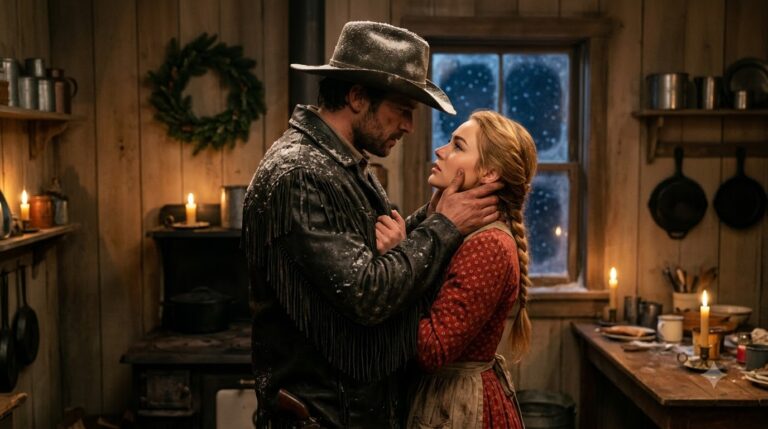
The church was full that night, fuller than Anna had ever seen it. Every family from the creek and the high meadows had come in by sleigh and wagon, and the stove roared, and the cedar boughs at the pew ends gave off their sharp green smell in the heat, and every windowsill held a candle so that from outside, Anna thought, coming up the snowy street, the little church must look like a lantern someone had set down in the dark. Reverend Halloran read from Luke. The Pruett children, in paper wings, forgot most of their lines. Old Mrs. Lassiter played the reed organ with her eyes closed. And when the time came for the candles, every person in the congregation lit a taper from the one beside them and passed the flame along the rows, and the room filled with small gold lights trembling in a hundred hands, and Anna, holding hers, looked across the aisle and saw Cole Garrity looking back at her over his, the light shining up under that rugged jaw and catching in the blue of his eyes, and she thought, with a terror that was very close to joy: oh. Oh, there it is. There it is again.
Afterward there was coffee and cake in the back of the church, and the stove was opened, and people stood in knots talking about the weather and the price of beef and who was sweet on whom. Anna had made the reverend’s wife a new gown of dove-gray wool for the occasion, and she was standing beside Mrs. Halloran accepting compliments on the sleeves when the door opened, letting in a gust of snow, and a stranger came in stamping his boots.
He was a well-fed man of about fifty in a fine black overcoat, with a gold watch chain across his waistcoat and a soft, pleasant, foreign voice. He apologized to the room for his lateness. His sleigh had been held up at the ford, he said. He had hoped to make the service. He was spending Christmas at the Company house up the creek and had thought it only neighborly to come down. Mr. Pruett, who held a mortgage from the Company on his north pasture, hurried to shake his hand and bring him coffee, and the stranger accepted it graciously and looked about the room, and his eyes lit on Cole, who was standing by the stove, and he smiled broadly and crossed to him with his hand out.
“Garrity! I’d hoped I’d find you here. Merry Christmas to you.”
Cole shook his hand. Anna, ten feet away, saw that his face had gone very still.
“Mr. Dunmore.”
“I was just telling the boys in Pueblo,” said Mr. Dunmore, in a voice that carried, as such voices do, through every pause in the room, “that we got the best man on the creek. You’ll be pleased to know the Musselshell outfit is coming along very well. We’ll have you and your herd in Montana by grass, God willing. March first for the papers, eh? You’ll miss this pretty little place, I’ll wager. But there’s no country in the world like that northern range.”
There was a short, peculiar silence in the corner of the room by the stove. Mrs. Pruett, who missed nothing, turned her head slowly from Mr. Dunmore to Cole and then, with exquisite slowness, to Anna.
Anna set her cup down on the edge of the pew. She did it very carefully. She was aware of her own hands as if they belonged to somebody else, a pair of hands in a shop window, holding a cup and setting it down without spilling a drop.
“Montana,” she said.
Nobody answered her. Cole had turned. He was looking at her across the heads of the Pruett children, and his face was the face of a man who has heard the ice crack under him and knows already, before he moves, which way he is going to fall.
“Anna,” he said.
She picked up her shawl from the pew. She settled it around her shoulders. She said, “Thank you, Mrs. Halloran, it’s been a lovely evening,” in a perfectly ordinary voice, and she walked down the aisle between the candles and out the door into the snow.
* * *
He caught up with her at the bottom of the church steps. He did not take her arm. He came around in front of her and stood in her way with his hat in his hand and the snow coming down on his bare head, and the light from the church windows fell across the both of them in long yellow bars.
“I was going to tell you tonight,” he said.
“Were you.” Her voice did not shake. She was proud of that. “When? Before the cake or after?”