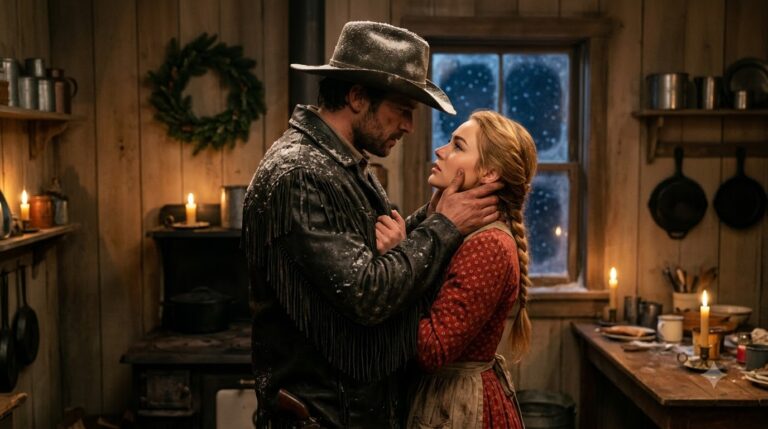
“Sorry, ma’am. I didn’t mean to listen.”
The voice was low and rough, roughened further by cold, and it came from the shadow under the gallery stairs where the lamplight did not reach. She knew it. She would have known it, she thought later, from the bottom of a well. She had heard it say good morning to her across the street a hundred times, and say nothing else.
She rose and turned. He stepped forward into the edge of the light, and the light found him a piece at a time: the boots first, worn and wet with melted snow; then the long sheepskin coat, open over a leather vest and a shirt the color of ashes; then a dark bandana knotted loose at his throat; then the jaw, rugged and square and shadowed with three days’ stubble; and last, because he had taken off his hat and was holding it against his chest in both hands like a man at a graveside, his eyes. They were blue. Not the pale blue of a winter sky but a deep, startling blue, like the inside of a mountain lake where the ice has cracked.
Cole Garrity. Thirty-three years old, if the town gossip had it right, and it usually did. He ran a few hundred head on the high meadow land west of the creek, kept to himself, paid his accounts in cash, and sat in the back pew on Sundays, when he came at all.
“How long were you standing there?”
He turned the hat once in his hands. Snow slid off the brim and spattered on the floor.
“Long enough to hear my name.”
The heat came up her throat so fast she could feel it under her collar. “I never said your name.”
“No, ma’am.” He did not smile, quite. “You said rancher, blue eyes, broken fence.”
She had. God help her, she had. Earlier, before he had made the board creak, before she had got to the part she meant, she had been talking the way a person talks to a ceiling, half joking, listing what she would and wouldn’t have, and she had said a rancher would do, a rancher with blue eyes, a rancher who could mend a broken fence, because hers had been broken since the spring and nobody in this town ever bothered to mend anything that wasn’t theirs.
She lifted her chin. The arched brows went up, sharp as a pair of shears.
“Half the men in town have broken fences.”
“Yes, ma’am, they do.”
“Then you can’t presume.”
“But only one fixed yours this morning.”
The candle leaned. The stove ticked. Somewhere in the walls the wind found a crack and sang through it, one long thin note.
She thought of the fence behind her shop, the one that ran along the alley to the creek path, the one the Hallorans’ mule had knocked flat in April. She thought of how she had gone out that very morning with her egg basket and found the top rail back on its post, the nails new and bright, the broken picket replaced with a raw yellow one that still smelled of the saw. She thought of how she had stood there in the cold and told herself the Pruett boy had done it, or the wind had blown it right again, or she had simply misremembered how bad it was. She thought of how many mornings she had told herself something like that.
“That was you?”
He looked at her for a long moment, and in that moment she saw that his hands on the hat brim were not steady.
“Every week for a year. Now let me stay.”
* * *
She did not answer him. Not then.
What she did, after a silence that seemed to last as long as the whole of Advent, was pick up the candle from the rail and blow it out. The little flame bent away from her breath and vanished, and a thread of smoke went up straight and gray into the lamplight, and she watched it rather than him.
“You don’t know what you’re asking,” she said.
“I believe I do.”
“No.” She set the dead candle down. Her hand, she was pleased to see, was steadier than his. “You heard a woman talking foolishness to the rafters, and you’ve confused it with an invitation. That’s all. It’s late, Mr. Garrity. It’s snowing. You ought to go home.”
He did not move. That was the first thing she noticed about him that night, though she would come to notice it many times afterward: when Cole Garrity did not want to do a thing, he did not argue about it. He simply went on standing where he was, the way a fence post goes on standing.
“I’ll walk you, then,” he said. “It’s dark and the path’s drifted.”