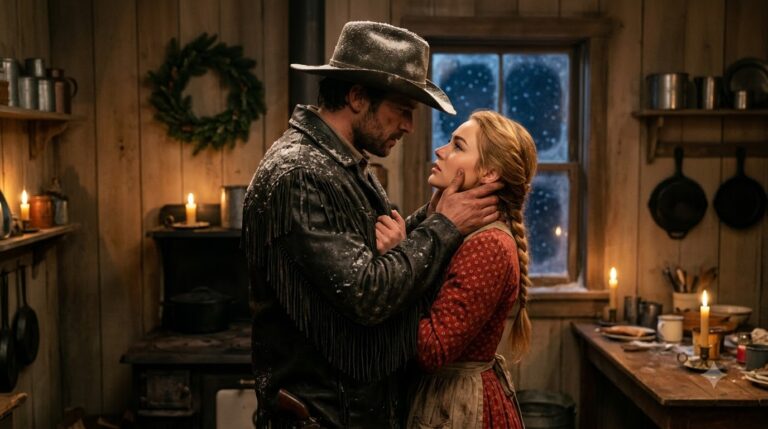
In April the mule knocked her fence down, and she let it lie. He rode past it twice before he understood that she was not going to fix it, and then he understood why, and he went home and sat on his porch until it was dark.
The next Saturday he came in before sunup with a hammer and a sack of nails.
It was penance, if he was honest. He had broken something of hers, and he could not mend that, and so he mended what he could. One rail. One picket. One post set straight. Every week, a little, never asking anything, never saying anything, because what could he possibly say? I’m sorry I ran off your intended. I’m sorry I was right about him. I’m sorry I’ve watched you every Sunday for four years and I can’t stop.
And that was not even the worst of it. The worst of it was the paper in the drawer of his kitchen table, which he had signed in September.
The Laramie Land and Cattle Company, a syndicate out of Cheyenne with Scottish money behind it, had been buying up the high meadows along the creek for two years. Their agent, a polished man named Dunmore with a gold watch chain and a soft Edinburgh voice, had made Cole an offer for his place in the summer, and Cole had turned it down, and Dunmore had come back in August with a better one. The Company was moving herds north to the Musselshell country in Montana Territory, Dunmore said. They wanted men who knew cattle. They would buy his land and his stock outright at a fair price and hire him on as range foreman on the new holdings, at a salary that would have made Cole’s father, who had died owing every storekeeper in Laramie County, sit up in his grave.
Cole had said he would think about it. He had thought about it for a month, every Saturday morning in her alley with the hammer in his hand. And on the last Saturday in September he had looked at the fence, which was finished, really finished, straight and sound from the street to the creek with nothing left to mend, and he had understood that he had run out of reasons to be in that alley. And that she had never once looked out the window. And that he could not go on like this, loving a woman across a church aisle for the rest of his life without a word, while she went on thinking it was the wind that fixed her fence.
He had ridden out to the Company’s office in Pueblo and signed.
He was to deliver the land and the herd on the first of March and leave with the drive in April, as soon as the grass came. A thousand miles north. A new country where nobody knew him and there was no fence on any alley that he had any business standing beside.
And then, three weeks before Christmas, he had gone into the church on a Tuesday night to fix the loose board under the gallery stairs, because Reverend Halloran had asked him to and because it was one more thing to mend, and he had heard the door open behind him, and a woman’s step, and he had stood in the shadow with his hammer in his hand and not known how to announce himself, and then it had been too late. And then she had said rancher. And blue eyes. And broken fence.
And Lord, I just want one man who won’t leave.
He had not planned to speak. He had not planned anything. But the words had been in his mouth before he could stop them, as if they had been waiting there a year.
Now let me stay.
He had meant it. That was the trouble. He had meant it with his whole body, the way he had not meant anything since he was a boy. And the paper was still in the drawer.
* * *
He meant to tell her about the paper on Christmas Eve. He had it all planned, as much as Cole ever planned words. He would walk her home after the candle service, and at the gate he would say, I have to tell you something, and then he would tell her, and then he would tell her he was going to Pueblo after the New Year to see whether the Company would let him out of it. He did not know whether they would. He had looked at the contract by lamplight so many times that the creases had gone soft as cloth, and the forfeit clause was very clear. But he would try. He would tell her that he would try.
He did not get the chance.