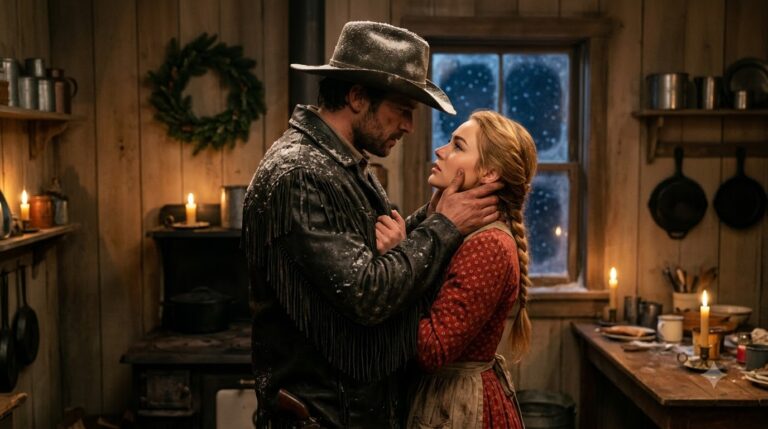
“Read me that,” he said.
Dunmore read it. In the event the Seller fails to deliver the land and appurtenances on the date specified, the Company shall be entitled to the herd as described in Schedule A at the price already advanced, in full settlement of all obligations.
The Company had advanced him eleven hundred dollars in September. The herd was worth close to four thousand.
“Take the herd,” Cole said. “Keep the advance. I’ll keep the land.”
Dunmore stared at him over his gold spectacles for a long moment, and then something in the soft foreign face changed, and he took the spectacles off and rubbed his eyes.
“You understand what you’re doing,” he said. “You’ll have a quarter section of high meadow and not a cow to put on it. You’ll be starting over at thirty-three.”
“Thirty-four in March.”
“Is she worth that?”
Cole thought about it, honestly, because it was an honest question.
“I don’t know that it’s about worth,” he said. “I don’t know that she’ll have me. She may not. She’s got good reason not to.” He picked up his hat. “But I told her I’d stay. I didn’t have the right to tell her that, and I told her anyway. So now it’s true whether she wants it or not. That’s the only part of it that’s mine to decide.”
Dunmore was quiet. Then he said, “My wife is in Edinburgh. I haven’t seen her in four years. The Company keeps promising me one more season.” He put his spectacles back on and drew the contract toward him and picked up his pen. “I’ll have the papers drawn. The herd goes north on the first of March with or without you. God help you, Garrity.”
“He has so far,” said Cole.
He rode home through two days of wind. He did not go to see her. She had told him not to. But on Saturday he rode in before dawn the way he had for a year, and tied his horse at the end of the alley, and walked up to her gate, and stood there.
There was nothing to fix. That was the thing. The fence was sound. He had built it sound. And she had not asked him in. So he stood with his hand on the gatepost in the dark and the cold and looked at her window, which was dark, and he said nothing, and after a while, when the sky began to gray in the east, he went away. He did it again the next week. He did not know what else to do. It seemed to him that a man who meant to stay ought to be where he could be found.
* * *
On the first of March, in a gray thaw with the eaves dripping and the street gone to mud, Cedar Bend turned out to watch the Garrity herd go north.
It came down off the high meadows in the early morning, two hundred and sixty head of red and roan and brindle, bawling and steaming, the Company’s riders whooping on the flanks in their long dusters, and it took most of an hour to pass through town. Children sat on the fence rails to watch. Men stood in the doorway of the Silver Spur with their thumbs in their belts and said that was a fine herd, a damned fine herd, and Garrity must have got a good price. Mrs. Pruett said she had heard he was going with it. Mrs. Lassiter said she had heard so too. The blacksmith’s boy said he had seen Garrity’s horse saddled in his yard at first light with a bedroll on behind.
Anna stood in the door of her shop with her arms folded tight under her shawl and watched them go. She watched every one. She looked for him among the riders, a sheepskin coat, a tall man on a dun horse, and she did not see him, and she told herself that was because the riders were too far off and the mist off the thawing street was too thick. She told herself she did not care. She told herself she was fine.
When the last of the drag riders had gone by and the mud of the street had been churned into a brown ruin and the bawling had faded off up the Denver road, she went inside and shut the door and sat down at her worktable in front of her mother’s made-over coat and did not move until it was dark.
He had gone. Of course he had gone. She had sent him. She had stood in the snow on Christmas Eve and told him to go to Montana if that was where he was going, and he had gone, and wasn’t that what she had asked for? Wasn’t that what she had always known would happen? She had been right. She had been right about all of them. Her father, Thomas, Cole. She had been right since she was nine years old, standing in the yard with a hammer too heavy for her hands.