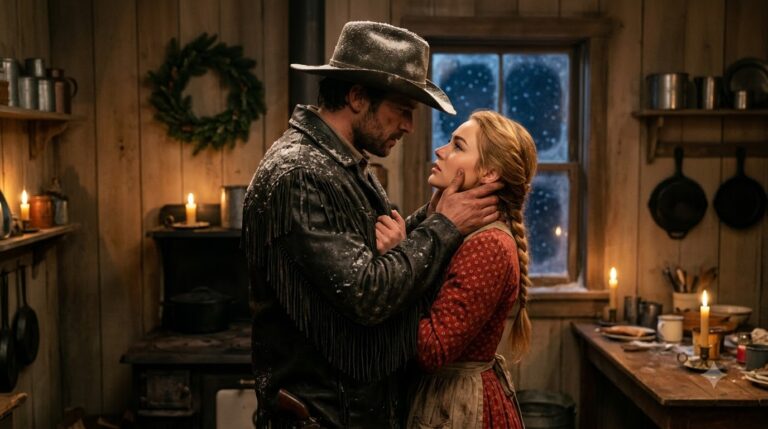
“Anna, I—”
“No. You don’t get to stay,” she said. “Not tonight. Maybe not ever. You go on up to Pueblo and talk to your Scotchman, and you go on to Montana if that’s where you’re going, and you don’t have to wonder about me at all. I’ll be fine. I’ve always been fine.” Her voice broke on the last word, and she turned her face away so he would not see. “That’s what everyone always says about me. Anna’s fine.”
She stepped around him, and this time he let her.
He stood at the bottom of the church steps with his hat in his hand until the singing stopped and the doors opened and the families came streaming out into the snow with their lanterns, laughing, calling Merry Christmas to each other across the street. Some of them looked at him. None of them said anything. After a while Reverend Halloran came down the steps and put a hand on his shoulder, briefly, and went on.
When Cole finally walked home, the snow had already filled her footprints.
* * *
January came in hard and clear. The snow froze into a crust that squeaked under boots and glittered under the moon, and the creek went silent beneath its ice, and the whole valley lay so still in the mornings that Anna could hear the Pruetts’ rooster from the other end of town.
She worked. It was what she knew how to do. She finished Mrs. Lassiter’s quilted petticoat and the Halloran girls’ school dresses and a wedding waistcoat for the blacksmith’s boy, who was marrying a girl from Pueblo in February, and when the work ran out she unpicked an old coat of her mother’s and began, for no reason she could name, to make it over into something new. She sat by the window with it in the short gray afternoons and set stitches so small and even they disappeared into the cloth.
She did not look out the window. She was very careful about that.
On the first Saturday after New Year’s she woke before dawn, as she always did now, and lay listening. She heard nothing. She told herself she had not expected to. When it was light she went out with the egg basket, and the fence stood straight and sound in the snow, with nothing broken and nothing mended, and the gate latch hung as she had left it.
But in the crust of snow outside the gate, on the alley side, there were boot prints.
Not many. They came up the alley from the street, and stopped at the gate, and stood there. She could see where the weight had shifted, heel to toe, toe to heel, the way a man shifts who has been standing in the cold for a long time. Then they turned and went back the way they had come. They had not touched the latch. They had not come in.
She stood looking at them until her fingers went numb on the basket handle.
The next Saturday it was the same. And the next. She did not get up to look. She lay in her bed in the dark, every Saturday, and did not get up, and did not look, and in the morning there were the boot prints in the alley, coming and standing and going away again. Sometimes there was fresh snow over them, and she could see that he had come before the snow stopped. Once, in the last week of January, it had been so cold in the night that the thermometer on the church porch had shown twenty below, and the prints were there anyway, and beside them on the gatepost, where a man might rest a hand, the frost had been melted in the shape of a palm.
She put her own hand over the place. It was cold now. It was only wood.
* * *
Cole went to Pueblo on the fourth of January and sat for two days in the outer office of the Laramie Land and Cattle Company with his hat on his knee, waiting for Mr. Dunmore to finish his correspondence. When at last he was shown in, Dunmore was all kindness. He was sorry for any awkwardness at the church. He had not known. He could see Cole was a man of feeling. But a contract was a contract, and the Company had already sold its Cheyenne buyers on the Garrity herd, two hundred and sixty head of good shorthorn cross, and the Musselshell range needed a foreman who knew water and grass, and frankly, Mr. Garrity, the Company was not in the business of releasing men from their word on account of a pretty seamstress.
Cole sat and listened to all of it. Then he took the soft-creased paper out of his coat and laid it on Dunmore’s desk and put one finger on the forfeit clause.