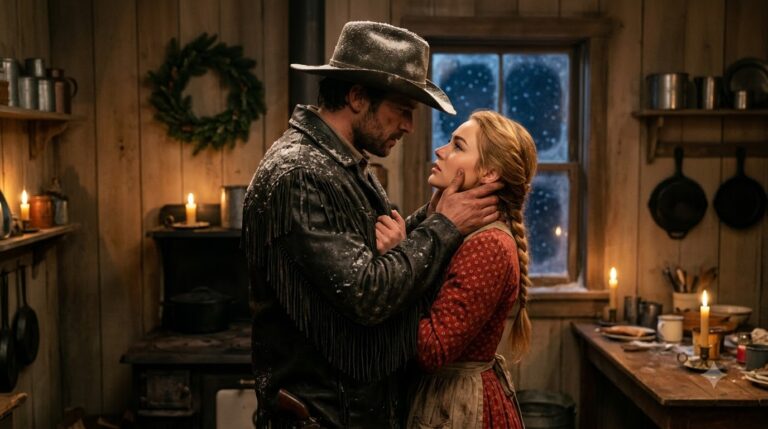
“I’ve walked that path in the dark since I was nine years old.”
“I know you have.” He put his hat on. “I’ll walk you anyway.”
So they walked. Out of the church and down the buried steps, the snow coming slantwise across the lantern he lifted from a nail by the door, the town of Cedar Bend shuttered and dark on either side of the one long street except for the saloon, where a piano was being played badly and with great feeling. He walked a pace behind her and a little to the left, between her and the wind, and he did not try to take her arm, and he did not say anything at all. When they reached the gate of her shop with its painted sign, A. WHITLOCK, DRESSMAKING & ALTERATIONS, half lost under a cap of snow, she turned to say goodnight and found he had already stopped, and was standing with the lantern held low so that the light fell on her boots and not her face.
“Thank you,” she said. It came out stiffer than she meant.
“Ma’am.”
She went in and shut the door and stood with her back against it in the dark, and she listened to his boots go away down the street, and she listened to them for a long time after she could not possibly hear them anymore.
* * *
The trouble was that she had been here before. Not in this exact place, with her back against her own door and her heart going like a treadle, but near enough that she knew the ground.
Her father had been the first. Samuel Whitlock had been a tall laughing man with a red beard and a fiddle, and when Anna was small he used to carry her on his shoulders down to the creek and tell her the names of the mountains as if he had named them himself. He was a carpenter by trade and a dreamer by nature, and in the autumn of 1868, when the silver talk came down out of the high country like snowmelt, he could not hold still. He sat at the kitchen table night after night with a stub of pencil, figuring. Anna remembered the figuring better than she remembered his face. Columns of numbers on the backs of flour sacks. The scratch of the pencil. Her mother sewing by the lamp and not looking up.
“Back by the first snow,” he had told Anna, kneeling in the yard with his pack on, his breath smoking. He had tapped the end of her nose with one cold finger. “You keep the fence mended for me, Annie-girl. Don’t let the cow get out.”
She had kept the fence mended. She had been nine years old and she had gone out every morning with a hammer far too heavy for her and banged at nails that bent, and she had watched the road. The first snow came. The second. A letter came the next summer, from Oro City, saying the claim looked promising. Another came the following spring, shorter, with two dollars folded inside. After that there were no more letters, and no more dollars, and no word, and the not knowing was worse than any word could have been. Her mother had never said he was dead. Her mother had never said he had left them. Her mother had simply taken in more sewing, and then more, and had taught Anna to set a sleeve and turn a collar and cut on the bias, and had died of a winter cough when Anna was nineteen, with the work still in her lap.
Anna had stopped mending the fence when she was twelve. She had understood, by then, that it was not the cow anyone needed to worry about getting out.
Thomas Avery had been the second, and he had been worse, because she had chosen him.
He had come to Cedar Bend three years ago as a clerk for the railroad survey, a slim fair-haired young man from Ohio with beautiful manners and a laugh that made women look up from the dry-goods counter. He had brought her a waistcoat to let out, and then a shirt to mend, and then a coat with a button missing that she suspected he had cut off himself, and by the third visit she had stopped pretending she did not know why he kept coming. He recited poetry. He talked about San Francisco and the opera and the shops on Market Street, and he told her that a woman with her hands and her eye ought to have a shop of her own in a real city, with a plate-glass window and her name in gilt letters. He was the first person since her mother who had looked at her sewing and called it art.