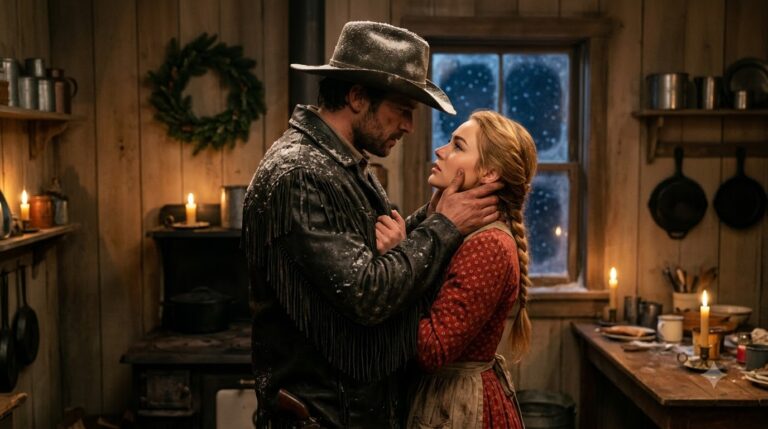
“You didn’t go.”
“No, ma’am.”
“The contract—”
“The Company has the herd. I kept the land. It’s all square.” He said it simply, as he said everything, but she was a seamstress and she knew how to read what was underneath a plain seam, and she understood, standing there, exactly what it had cost him.
“All of them,” she said. “You gave them all of them.”
“I gave them what I’d promised. It just turned out I’d promised it to the wrong people first.” He looked down at the hat. “I’ll be running a few head on shares with Pruett come spring. And I can do carpentry. My father taught me that much before he drank the rest of it. It won’t be much for a while.”
“Cole.” She stood up. Her knees were stiff from the cold boards. “How long were you standing there?”
He almost smiled. It was there, at the corner of his mouth, and gone.
“Long enough to hear you say I could leave.”
“I said you could and don’t.”
“I heard that part too.”
The snow touched the windows. The stove ticked. Anna came out of the pew and stood in the aisle, in the long amber stripe of lamplight, with the candle burning behind her on the rail, and looked at him across the length of the little church, all those pine pews sanded smooth by twenty years of people coming and going, coming and going.
“I need you to understand something,” she said. “I meant what I said at Christmas. You had no right. About Thomas. About any of it.”
“I know.”
“You don’t get to decide things for me. Not ever again. Not to protect me, not to spare me, not because you think you know better. Even if you do know better. Especially then.”
“I know,” he said again. “I’ve had two months of Saturdays to think about it. Standing at a gate I’d built with my own hands and not able to open it, because it wasn’t mine to open.” He lifted his eyes to her. “I’m not asking to stay, Anna. I’m staying. That part’s done. I’m in Cedar Bend for good, whatever you say tonight. I’ll be in the back pew on Sundays and I’ll tip my hat to you in the street and I won’t ever come in your gate again unless you ask me. That’s the truth. You can do what you want with it.”
“And what do you want?”
He was quiet for a long moment. When he spoke his voice was rougher than she had ever heard it.
“I want to stand in your kitchen in the morning,” he said, “and not have to leave before you wake up.”
She walked down the aisle.
She did not hurry. She walked the way she had walked out of this church two years ago in a cream silk dress with eleven people watching, with her chin up and her back straight, except that this time she was walking toward something instead of away. Her green skirt brushed the pew ends. Her shawl slid half off one shoulder and she let it. When she reached him she stopped, close enough that she could smell the snow and the horse and the cold on his coat, close enough that she had to tip her head back to see his face, and her dark lashes were wet and her eyes, lined in their fine dark wings, were shining.
“Ask me,” said Anna.
He looked at her. Very slowly, as if she were something that might startle, he let go of the hat with one hand and lifted it, and touched one chestnut wave of her hair where it had come loose from its pins, and tucked it back behind her ear. His fingers were cold and they were not steady.
“Anna Whitlock,” he said. “May I come in your gate?”
She reached up and took his face in both her hands, the stubble rough against her palms, and she said yes. She said it against his mouth. And the hat fell to the floor of the church between their boots, and neither of them noticed it for a long while, and outside the late snow came down soft and slow over the whole sleeping valley, over the muddy street and the shuttered stores and the alley and the fence and the gate, filling in every footprint that had ever stood there waiting.
* * *
They were married on the second Saturday of May, when the meadows had gone green and the creek was loud with snowmelt. Reverend Halloran performed the service, and this time every pew in the church was full, and nobody watched the door.
Anna made her own dress again. She made it from her mother’s old coat, unpicked and turned and pressed and cut new, a soft dove-colored wool with a row of jet buttons down the bodice, the same coat she had sat with in her window all that long winter without knowing what she was making. When Mrs. Pruett asked her why on earth a woman with her skill would get married in a made-over coat instead of silk, Anna only smiled and said she had learned that the best things were usually made out of what was already there.
Cole wore a new shirt. She had made that too. On the inside of the placket, where he would never see it, she had sewn one extra button, and she did not tell him, and he found it on their wedding night anyway, and laughed until he had to sit down on the edge of the bed, and then he did not laugh, and then she closed the door.
* * *
The fence behind the shop stands there still, or it did the last time anyone in Cedar Bend thought to look. It runs along the alley from the street to the creek path, straight and sound, the posts set deep, the pickets gone silver with weather. There is a gate in it with strap hinges and a wooden latch worn smooth as a river stone by years of hands.
People who remember the Garritys say there was nothing remarkable about the fence except one thing. For as long as the two of them lived in that house, which was a long time, every Saturday morning before sunup Cole Garrity would go out into the alley with a hammer in his hand, though most weeks there was nothing at all to mend. And Anna would wake, and get up, and go to the window, and look out.
She always looked. She never once, after that winter, failed to look.
And he would glance up from the gate and find her there in the gray light with her hair down and her shawl around her shoulders, and he would lift his hand to her, and she would lift hers to him, and then he would come in.