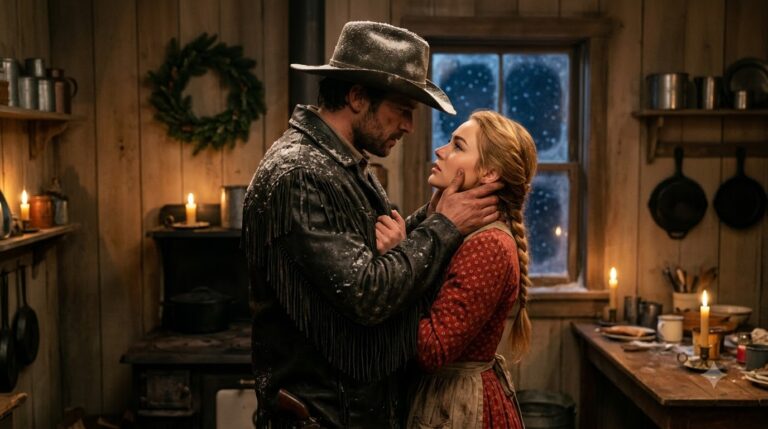
They were to be married on the second Saturday of October, two years ago now. She had made her own dress, cream silk with a bodice of tucked lawn, and she had sat up three nights finishing the hem. On the night before the wedding he had kissed her at her gate and said, “Tomorrow, Mrs. Avery,” and gone off whistling into the dark.
In the morning she found the ring on her doorstep, wrapped in a handkerchief. There was no note. His room at the boarding house was empty, his bed made, his trunk gone. Someone had seen him ride out on the Denver road before dawn on a horse no one could remember him owning.
She did not cry in front of anyone. She went to the church at ten o’clock in the cream silk dress, because she would not give Cedar Bend the satisfaction of a bride who hid, and she stood at the front for one hour by Reverend Halloran’s watch, and when the hour was over she thanked the reverend and the eleven people who had come and walked home with her chin up. Then she took the dress apart, seam by seam, and made it over into a christening gown and a set of collars and sold them all before Christmas.
That was the year the fence fell down, too, though she had not connected the two things until tonight. The Hallorans’ mule had broken it in April, and she had looked at it lying in the mud and thought, let it lie. Let it lie. What was a fence for, anyhow, but to keep in what wanted to stay? And nothing ever did.
Except that it had not lain there. That was what she could not stop thinking about as she undressed in the dark and lay down under her mother’s quilts and listened to the snow. Some time in the spring she had noticed that the rail was back up. She had thought it was the mule’s owner, out of guilt. Then a picket was replaced. Then, after the summer storm, the leaning post was reset and tamped. Then the gate, which had never latched in her lifetime, latched. Every few days some small thing. She had noticed and not noticed, the way a person notices the clock is wound without ever seeing the hand that winds it. She had told herself it was Mr. Pruett, or the boy. She had told herself it was nothing.
Every week for a year.
She thought of Cole Garrity’s hands on the brim of his hat, not steady.
She turned her face into the pillow, and she did not sleep for a long time.
* * *
He came into the shop on Thursday with a shirt.
She knew before she looked at it that there was nothing wrong with the shirt. He laid it on the counter between them, a plain gray work shirt, clean and folded, and stood back from it the way a man stands back from a horse that might kick.
“Button,” he said.
She turned it over. All the buttons were there. She looked up at him with her brows arched as high as they would go, and for the first time since she had known him, which was to say for the first time in the eleven years since he had come down from Wyoming and bought the old Lassiter claim, she saw Cole Garrity’s ears go red.
“I’d have cut one off,” he said, “but it seemed dishonest.”
She meant to keep her face severe. She meant it very much. But something in her chest gave way, the way a seam gives when the thread has been pulled too tight for too long, and she laughed out loud in the quiet shop, and after a moment he laughed too, a short surprised sound, as if he had not heard it from himself in a while.
“Mr. Garrity,” she said, when she could. “Why?”
He knew what she meant. He did not pretend otherwise. That was another thing she would learn about him.
“Because it was broken,” he said. “And you didn’t fix it. And I could.”
“That’s not a reason to do a thing fifty times.”
“It’s a reason to do it once.” He looked down at the shirt. “After that it got to be a habit. Saturday mornings, early, before you were up. I’d ride in for supplies and stop by the alley on the way. Some weeks there wasn’t anything to do but check the latch. Some weeks it was more.”
“And you never said a word. You tipped your hat to me on the street every Sunday and never said a word.”
“No, ma’am.”
“Why not?”
He was quiet for so long she thought he would not answer. Outside, a wagon went by, its wheels squeaking in the packed snow. The stove in the corner ticked.