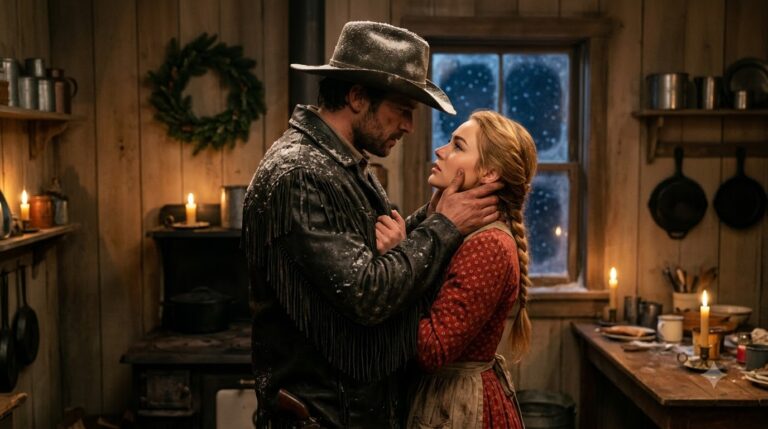
“Because I didn’t figure you wanted anything from a man,” he said at last. “After. I figured you wanted to be let alone. And I figured if a fence got fixed and nobody asked anything for it, that was a thing you could take without owing.”
She looked at him. He was looking at the shirt.
It was, she thought, the kindest thing anyone had ever said to her, and it frightened her more than anything Thomas Avery had ever said, because Thomas had only wanted her to love him and Cole Garrity seemed to want nothing at all, and a woman could not defend herself against a man who wanted nothing.
“I’ll sew on a button,” she said. “Ten cents.”
“There’s no button off.”
“Then I’ll put an extra one on the inside of the placket where you’ll never see it,” said Anna, “and you’ll pay me ten cents for it, and that will make us square for one Saturday. And you can come back next week with another shirt.”
He looked up then. The blue of his eyes in the gray light from the window was so startling that she had to look at the shirt herself.
“Yes, ma’am,” said Cole.
* * *
He came back the next week with a shirt, and the week after that with a pair of trousers whose knee had genuinely gone through, and the week after that with nothing at all, only a sack of dried apples from his root cellar that he set on the counter without explanation and left beside her scissors.
The town noticed. Cedar Bend noticed everything. Mrs. Pruett, who came in to have a mourning dress taken in for the third time since her sister died, remarked that she had seen Mr. Garrity’s horse tied outside the shop twice in one week, and wasn’t that something, a man like that, who never had a word for anybody. Anna said it was a great deal of mending, and Mrs. Pruett said she was sure it was, and they both looked at the pins.
On the Sunday before Christmas, Cole sat not in the back pew but in the fourth, across the aisle from her, and when the congregation rose for the hymn he did not sing but she could feel him not singing, the way you feel a stove you are not facing. When the service ended he waited at the door and walked her home, and this time when they got to the gate she did not turn to say goodnight at once.
“Would you like to see it?” she said. “The fence. In daylight. With me knowing.”
So they went around through the alley in the low winter afternoon, the sky the color of pewter, and she walked the length of the fence with her hand trailing on the top rail as if she were checking a hem. It was a good fence now. It was better than it had ever been, better than when her father built it. The posts were set deep and straight. The pickets were even. The gate swung on new strap hinges and closed with a wooden latch carved so smooth it might have been turned on a lathe.
“You carved that,” she said.
“Evenings get long.”
She lifted the latch and let it fall. It made a small, solid, satisfied sound, like a word said with certainty.
“My father told me to keep the fence mended for him,” she said. She had not meant to say it. “When he left. I was nine. I kept it up for three years, waiting. Then I quit.” She laughed a little, at herself. “So you see, you’ve been doing my chores.”
He did not laugh. He looked at the gate a long time.
“Then I’m glad I did them,” he said.
* * *
What Cole Garrity did not tell her that afternoon, standing by the gate in the pewter light, was why he had started.
He had told her a true thing in the shop. It had been broken and she had not fixed it, and he could. But it was not the whole truth, and he had known that it was not the whole truth when he said it, and the knowledge sat in his chest all the way home that night like a stone in a boot.
The whole truth went back two years, to a Friday night in October, to the back room of the Silver Spur saloon.
Cole did not often play cards. He did not often go into town at all except for supplies and Sunday meeting, and that was by design. He had come down from the Wyoming range ten years before with a little money and a great deal of silence, both of which he had earned the hard way, and he had found that Cedar Bend let a man be quiet if he wanted to be. But that autumn he had sold forty head to the army post at a good price, and the buyer had insisted on standing him a drink, and one drink had become a seat at the table, and at the table had been Thomas Avery.