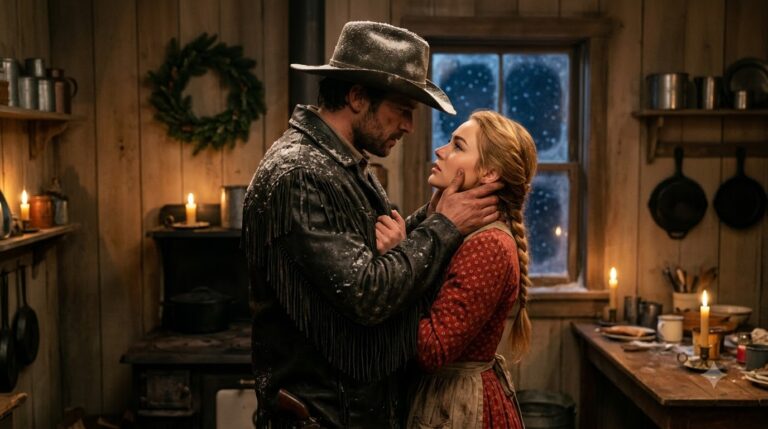
Cole had known who Avery was. Everyone did. He was the bright young surveyor’s clerk who was marrying the Whitlock girl, the seamstress with the dark eyes and the sharp tongue, the one Cole had watched for two years across the aisle on Sunday mornings without once permitting himself to think anything about her at all. He had heard about the wedding. He had told himself he was glad. He had told himself that a woman like that deserved a man who could recite poetry, and that a man who could not even manage to say good morning to her without his throat going tight had no business thinking anything.
Avery was drunk that night, and losing. Cole watched him lose for two hours. He lost with a kind of reckless grace that was almost beautiful, laughing, calling for another round, signing markers with a flourish. By midnight the other players had drifted off and it was only the two of them and a man named Pike who held most of Avery’s paper, and Pike was not laughing.
When Pike went out to the privy, Avery leaned across the table and grinned at Cole with his fair hair in his eyes.
“You know what saves me?” he said. “Tomorrow. Tomorrow I’m a married man. And my bride, God bless her, has three hundred and twelve dollars in a tin box under her floorboard. She told me so herself. Saving for a shop in San Francisco. With a plate-glass window.” He laughed. “Pike gets his money by Monday, and Annie gets her husband, and everybody’s happy. And in a year or two, when things look up, maybe we’ll get to San Francisco after all.”
Cole had sat very still.
“You’d use her money to pay your gambling paper,” he said.
“Our money. After tomorrow it’s our money.” Avery shrugged, and for a moment, under the drink and the charm, Cole saw something else in his face. Fear, mostly. And underneath the fear, something thin and cold. “Don’t look at me like that, Garrity. I’ll be good to her. Mostly. I’m good to everybody, mostly.”
Afterward, in the long nights, Cole had gone over what happened next more times than he could count, and he had never been able to make it come out clean.
He had taken Avery outside into the cold. He had not hit him, though he had wanted to with a force that had frightened him. He had walked him down the dark street to the livery and stood him against the wall and asked him, plainly, how much he owed Pike. Avery had told him: a hundred and eighty dollars. Cole had asked him whether he loved Anna Whitlock. Avery had laughed, and then stopped laughing, and then said, in a small, honest voice that was the only honest thing Cole ever heard from him, “I don’t know. I like her. I like that she thinks I’m somebody.”
So Cole had made him an offer.
He had paid Pike out of his own pocket, the cattle money, that same night. He had given Avery his own second horse, the bay gelding, and forty dollars besides. And he had told Thomas Avery that if he was still in Cedar Bend by sunup, Cole would go to the church at ten o’clock and stand up when the reverend asked if anyone knew a reason, and tell the whole town about the tin box under the floor.
Avery had gone before dawn. He had left the ring on her step. Cole had not told him to do that; he had not thought of it. He had not thought, either, about what it would mean for her to stand alone at the front of that church in a dress she had made with her own hands while eleven people watched the door. He had thought only of the tin box, and Avery’s thin cold face, and the word mostly.
He had stood across the street that morning, under the eaves of the feed store, and watched her walk home in the cream silk with her chin up. And he had understood, watching, that he had saved her money and broken her heart, and that he had done it without asking her, as if her life were a fence of his own to tear down and build up as he saw fit.
He had never told anyone. Who would he tell? Not her. To tell her would be to hand her a second grief on top of the first: not only that the man she loved had left, but that he had been bought, and cheaply, and that he had meant to rob her. Cole had told himself that she was better off thinking Avery merely faithless than knowing him a thief. He told himself that often. Some nights he believed it.