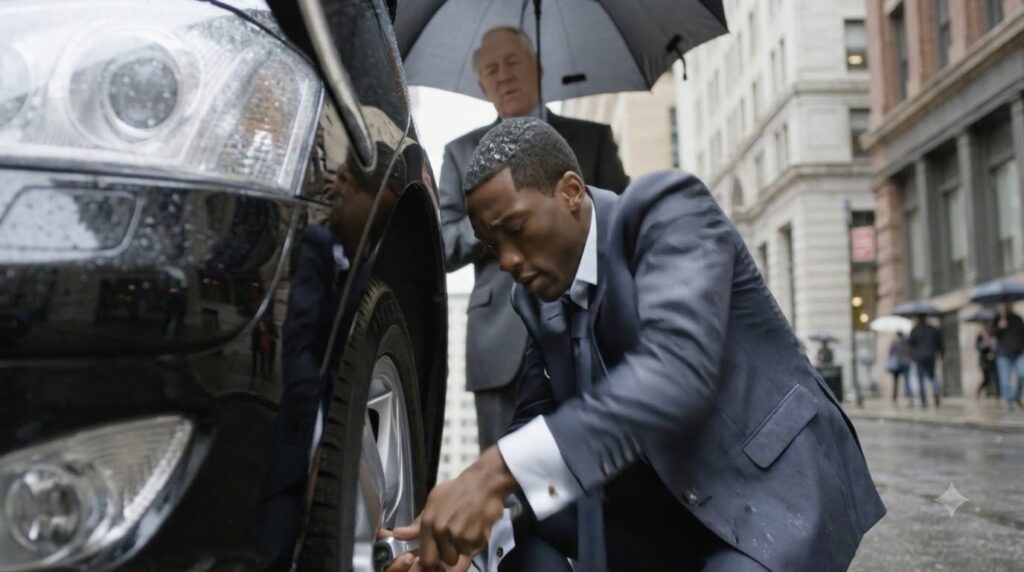
On a rainy morning in Chicago, a black man was rushing to an important job interview when he suddenly spotted an elderly white man struggling with a car jack. The old man was soaked, anxious, and exhausted, trying desperately to fix his flat tire. Even though he knew he’d be late, the young man ran over to help. What he didn’t know was that his selfless act of kindness that morning would change his life forever.
The morning started the way most Chicago mornings did: gray, close, and undecided between drizzle and rain. The light came in dull through the small window of the Southbridge apartment, brushing across the counter where a half-empty coffee mug steamed beside a wrinkled tie. Marcus Reed stood in front of the mirror nailed above the sink, running a comb through his short hair and straightening a navy suit that had seen better days. The jacket pinched at his shoulders. The color faded just enough that the word navy seemed generous. Still, he looked at himself and nodded once.
His mother, Denise, stood at the stove, frying two eggs in a cast-iron pan older than Marcus. “You’re not leaving on an empty stomach,” she said, sliding the eggs onto a plate. “Big day like this, you need something in you.” Marcus smiled, though his stomach was a tight knot. “I’ll grab something on the train, ma. I can’t risk getting this messed up before I even make it there.” Denise turned and gave him the look he’d known all his life, the one that said there was no arguing. She wiped her hands on a dish towel and nodded toward a small box on the table.
Inside, on a square of worn cloth, sat a pair of silver cufflinks. “They were your granddaddies,” she said softly. He wore them when he got hired at the steel mill. Said they reminded him to keep his sleeves rolled down and his chin up. Marcus picked them up carefully. The metal was cool and smooth, the engraving faint but visible: a pair of linked hands. He fastened them on, feeling the weight of memory. “Thanks, Ma,” he said. “I’ll make him proud.” “You already did,” she said, and kissed his cheek.
The train rocked its way north, every seat taken, people pressed shoulder to shoulder. Marcus held his briefcase on his knees, his reflection ghosted against the dark window. He rehearsed what he’d say when he sat across from the hiring manager at Whitmore and Blake Financial. He practiced answers for every question he could imagine: what drew him to finance, what he learned working double shifts at the grocery, and how he handled pressure. Outside, the skyline came into view: gray towers poking through mist. It should have looked promising, but the clouds above them were swelling dark, heavy with something worse than drizzle. A woman nearby muttered, “They said thunder later. Looks early to me.” Marcus checked his watch. Plenty of time if everything ran smooth. He’d left early for that reason. He wasn’t going to let anything—weather, traffic, luck—keep him from getting through that door on time.
But when the train screeched into the downtown station, the city had already changed its mind. By the time he stepped onto the street, the rain had turned mean. It came down in hard sheets, driven sideways by wind. People ducked under umbrellas, newspapers, briefcases, anything. Marcus pulled up his collar and jogged toward the avenue, dodging puddles that were turning into small rivers. He tapped open his ride-share app, watched the screen spin, and spin again. Every driver was unavailable. He cursed under his breath and lifted an arm toward an approaching taxi. It slowed, tires hissing through water. But before he could reach it, a man in a beige trench coat ran from behind, yanked the handle, and slid in without looking back. Marcus froze there, dripping, his hands still raised, as the cab pulled off in a spray of water.
For a second, he just stood in the storm, anger boiling up. Then he took a breath, forced his shoulders back, and looked down the street. He could see the tower that held Whitmore and Blake’s offices, its glass face vanishing into the clouds. Five blocks, maybe six. He could make it on foot if he hurried. “Keep moving. Don’t lose it now,” he told himself. He set off, shoes splashing, suit darkening with every step. The sidewalks were chaos, umbrellas turning inside out, people running for overhangs. The thunder rolled close, loud enough to make the street lights flicker.
Marcus was halfway there when he noticed the car. A black sedan sat angled by the curb, hazard lights blinking, one tire flat to the rim. Next to it stood an older white man, maybe in his 60s, gray hair plastered to his forehead. He was crouched low, trying to fit a jack under the car, his hands shaking. Every few seconds, the handle slipped, clattering against the wet pavement. No one stopped. People glanced, then kept walking. Marcus slowed. The office tower loomed just ahead, glimmering through the downpour. His watch said 8:44. The interview was at 9. He hesitated. The man’s suit jacket was soaked through. He looked miserable, defeated. Marcus thought of his mother’s voice that morning: “You help people not when it’s easy, but when it’s right.” He set his briefcase on a dry patch of steps and jogged toward the car.











