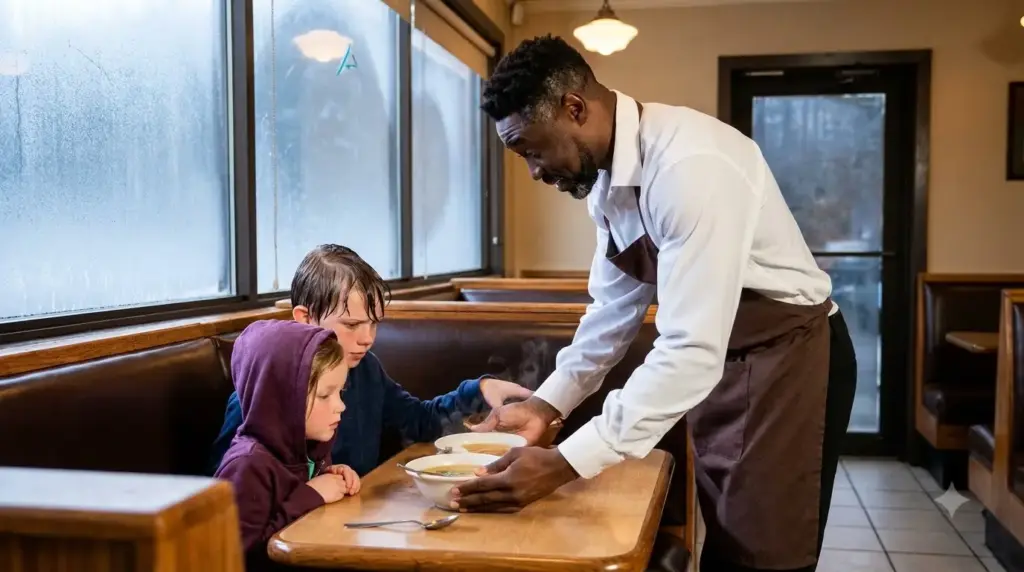
The little boy was so cold that when Daniel Callahan put a cup of warm water between his hands, he could not make his fingers close around it.
His sister did it for him. She was a thin girl with dark hair escaping from a knitted cap, and she wrapped his hands around the cup as carefully as if they were made of glass. The boy watched her instead of the water. He had the fixed, exhausted gaze of a child who believed that if he stopped watching the one person he trusted, she might disappear.
“We don’t have money,” the girl said.
Danny looked at the clock above the grill. Eleven forty-eight. The Blue Lantern Diner had closed eighteen minutes earlier. In the kitchen, his own supper sat in a waxed cardboard box, the first proper meal he had been able to afford for himself in two days.
“I didn’t ask you for money,” he said.
The girl glanced at the door. Outside, snow dragged sideways across River Street. The wind had buried the curb, and the nearest bus had stopped running an hour ago. She was eleven, perhaps twelve, and the boy beside her could not have been more than nine. Neither wore gloves.
“You should,” she whispered. “Everybody else does.”
Danny went behind the counter and lifted the lid from his supper. Chicken pot pie, mashed potatoes, one dinner roll. It was the last hot meal in the building, packed for him by the cook before the burners were shut off. He set it before the children and found two clean plates.
“What’s your name?” he asked the girl.
“Tessa. But my brother calls me Tess.”
“And him?”
“Jonah.”
Danny split the food, gave the larger portion to Jonah, and watched the boy take a cautious first bite. Something in his small face changed. Not happiness. Not yet. Just the astonishment of being allowed to stop enduring the cold long enough to eat.
“My name’s Danny,” the waiter said. “Tonight, this one’s on me.”
He did not know that twenty-two years later the two children would return to Port Addison with fortunes large enough to buy half the waterfront. He did not know that photographs would be taken, lawyers would argue about a building, and the town would learn things it had preferred to forget. He knew only that his wife was waiting at home with their daughter, that his coat had a torn lining, and that the children had nowhere to go when they finished eating.
On the night of December 18, 2003, Port Addison, Ohio, had disappeared beneath the kind of lake-effect storm that gave grown men the foolish idea they could outrun winter. The city lay west of Cleveland, where empty mills backed onto freight yards and streets named for long-vanished industrial families. The lake was invisible after dark, but its wind was always present. It curled under doors, slapped newspaper boxes against lampposts, and found every place a poorly insulated house had given up trying to keep people warm.
Danny was thirty. He had worked at the Blue Lantern for almost six years, starting as a dishwasher after the small furniture factory where he loaded trucks closed without paying its last two weeks of wages. He had a broad, unremarkable face, thinning brown hair, and hands that were always chapped from dishwater. He could remember a regular customer’s coffee order after a single visit, but he could forget a mortgage payment due date while repairing a stranger’s broken bicycle. His wife, Nora, called that both his gift and his problem.
Their daughter, Grace, was four. She had performed in a preschool holiday program that evening, wearing a paper crown Nora had helped her decorate with aluminum stars. Danny had promised to attend. When the roads turned dangerous, his manager told him the early-shift employees needed to leave and that he must remain to close. Danny had not argued. Work was scarce, and the Callahans’ checking account had less than ninety dollars in it until Tuesday.
Now he could still hear Grace’s voice on the kitchen answering machine from the message Nora had left before the recital. She had sung the first four words of her song and then asked whether Daddy would find her in the front row.
The memory made him look again at the two children eating his dinner.
“Where’s your family?” he asked.
Tess did not stop chewing. She had learned, he would later understand, that an adult’s questions could be more dangerous than an adult’s silence.
“We’re going to my aunt’s,” she said.
“Where does she live?”
“Pittsburgh.”
“That’s a long walk from here.”
“We know.”
Jonah lifted his face. “We took the wrong bus.”
Tess gave him a sharp look, not angry so much as frightened by what he might say next.











