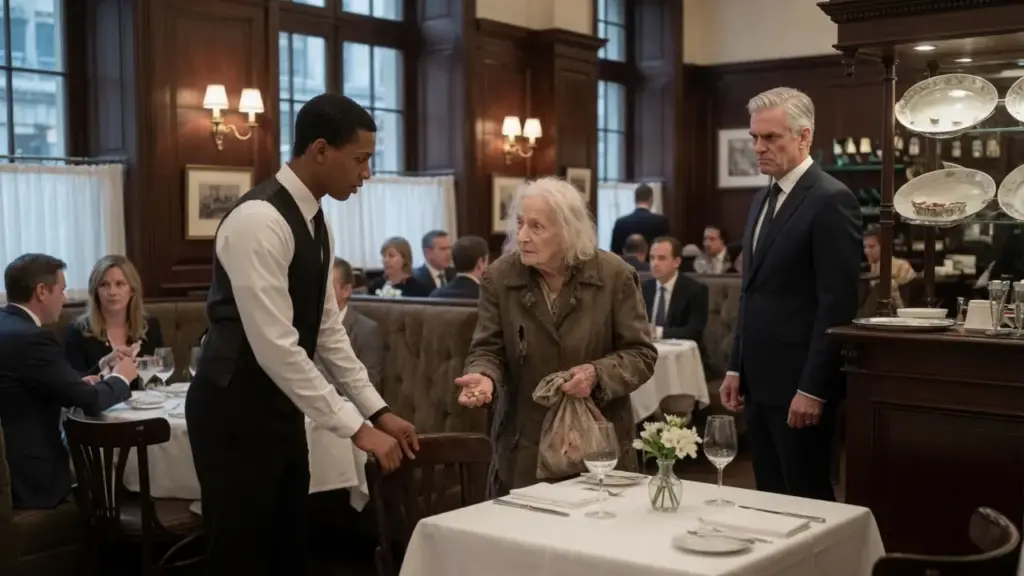
At a high-end restaurant packed with powerful guests, an old woman in a torn coat steps inside clutching a handful of coins. The room falls silent. The staff look away except one waiter. A broke young man with nothing left to lose walks toward her, pulls out a chair, and says, “Welcome.” What he doesn’t know is that she isn’t who she seems and that one small act of kindness will change his life forever.
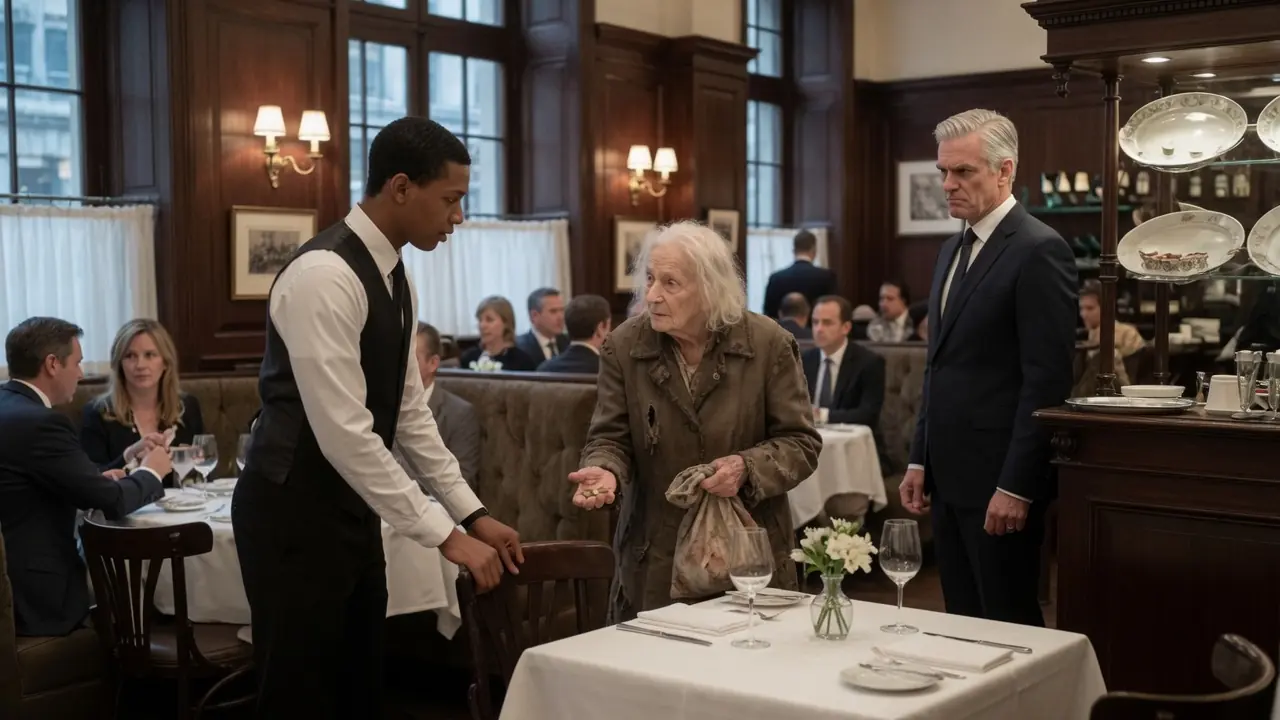
In the heart of Manhattan, where glass towers pierced the clouds and money flowed like water, stood the Grand Pearl. Not a restaurant, but a temple where New York’s elite worshipped themselves. It didn’t serve food, it served status. Inside, the air hung heavy with truffle oil, aged wine, and the faint scent of imported flowers replaced daily, wilted or not. Crystal chandeliers scattered rainbows across linen-draped tables.
Marble floors veined with gold reflected every careful step. Here, silverware was worth a week of groceries, wine bottles a month’s rent, and appearances mattered more than appetite. Through this landscape of calculated excess, moved Elias Grant, a young man of 27 whose dark eyes had learned to see everything while revealing nothing. He wore the standard uniform, crisp white shirt, black vest pressed to knife-edge precision, trousers that never showed a wrinkle.
His shoes were polished to mirror brightness. His posture perfect. His face a mask of professional neutrality that he’d perfected over 3 years of service. Elias had come to the Grand Pearl straight out of college, abandoning his dreams of becoming a social worker when his mother’s cancer diagnosis had transformed abstract ideals into concrete necessities. Health insurance, medical bills, experimental treatments that regular insurance wouldn’t cover.
The mathematics of survival had been brutally simple. Fine dining paid three times what social work did and his mother needed every penny. So, Elias Grant had learned to smile at people he despised, to serve food that cost more than his weekly salary, to be invisible in plain sight. He’d become very good at it, too good perhaps. Sometimes he caught himself in the mirror and didn’t recognize the man staring back.
Someone who’d learned to look away from cruelty, to participate in a system he knew was wrong, to trade his principles for his mother’s medication one shift at a time. The restaurant hummed with its evening symphony. At table seven, a hedge fund manager laughed too loudly at his own jokes while his companion, young enough to be his daughter, clearly wasn’t feigned fascination. At table 12, a group of lawyers celebrated a victory that had probably ruined lives.
Their voices carried the particular arrogance of people who confused legal with ethical. Near the windows, an elderly socialite examined her reflection in a spoon, adjusting her expression before the photographer she’d hired arrived to document her casual dinner. Presiding over this kingdom of vanity was Richard Blackwood, the restaurant’s general manager oversaw everything with meticulous care. At 50, he was a man who had spent his entire adult life serving the wealthy and somewhere along the way he began to mistake their power for his own.
His suits were expensive and his silver hair was always perfectly styled. He moved through the restaurant with quiet authority, noticing every detail, every flaw, as if the place itself were a reflection of him. Richard ran the Grand Pearl with strict control disguised as charm. He believed in hierarchy, in the natural superiority of those who could afford his restaurant over those who could not. To him, the world was divided into two groups, the elite and the help.
He’d already chosen which one he belonged to, no matter what reality suggested. “Grant.” Richard’s voice cut through the ambient noise like a knife through silk. Table 18’s wine needs refreshing, and for God’s sake, look pleasant. You’re not at a funeral. Elias nodded without meeting his manager’s eyes, a skill he’d perfected over 3 years. Direct eye contact with Richard was dangerous, interpreted as either insubordination or incompetence depending on his mood.
Better to keep your head down, do your work, collect your paycheck. That was the bargain Elias had made the price he paid for his mother’s chance at survival. He moved through the dining room with practiced efficiency, refilling wine glasses with precise pours, clearing plates the moment guests set down their forks, answering questions with polite brevity that revealed nothing of the person beneath the uniform. His face had become a tool, pleasant and neutral, showing only what the guests wanted to see, competent service delivered by someone who knew their place.
At the service station, Elias crossed paths with Jennifer Thompson, one of the other veteran servers. She was 32, had been working at the Grand Pearl for 5 years, and had the particular weariness of someone who’d seen too much and couldn’t afford to care anymore. “Table nine is complaining about their steak again,” Jennifer muttered, checking her order pad. “Third time this month. I think he just likes sending food back to feel important.”











