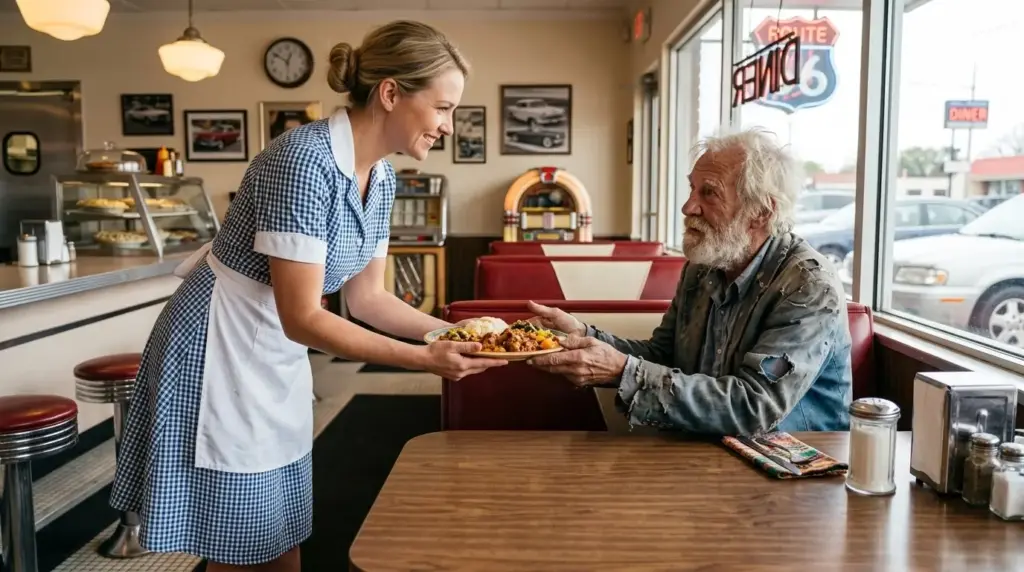
The sharp smack echoed across the restaurant before anyone could pretend not to hear it.
Emily Carter stood frozen, her cheek burning, a half-wrapped plate of food trembling in her hands.
The wealthy guests stared. Some amused, some indifferent, as the old man beside her, barefoot and trembling, lowered his eyes in silence.
“She fed a homeless man with restaurant food,” the manager snapped.
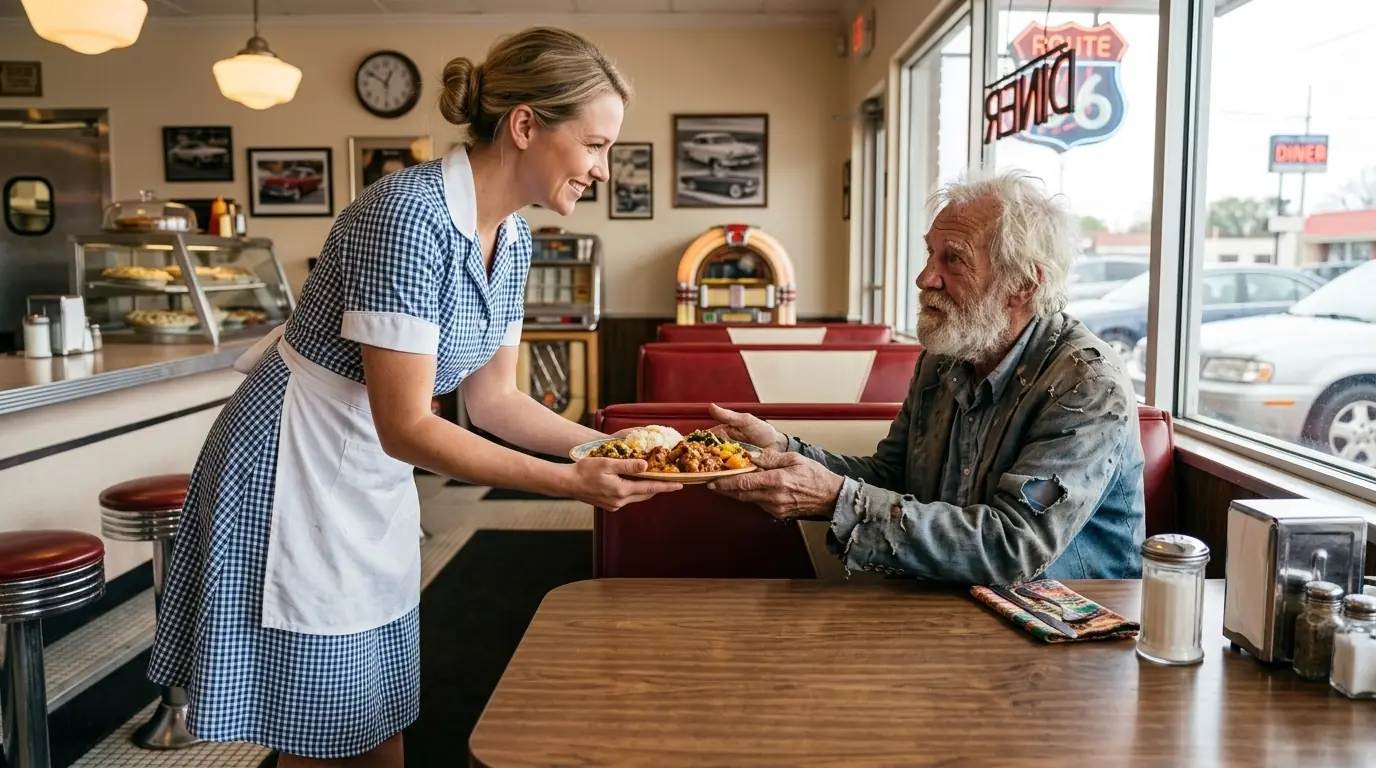
But the old man did not look ashamed.
He looked calm.
And as Emily fought back tears, he slowly lifted his head, his gaze steady, almost powerful, as if this moment, this humiliation, was not the end of her story, but the beginning of something no one in that room was ready for.
In the restless heart of Cleveland, Ohio, where the streets never truly slept and the air carried the weight of both dreams and disappointments, Emily woke before dawn.
Her alarm was not a clock.
It was the quiet, uneven breathing of her younger brother, Noah.
“Noah,” she whispered softly, sitting up on the thin mattress they shared.
The room was barely large enough for two people to stretch their legs, its peeling walls stained by years of damp cold. A small window let in the faint gray of early morning, and through it came the distant noise of buses, delivery trucks, and a city already beginning without them.
Noah lay curled beside her, his chest rising and falling too quickly, as if each breath had to fight to stay.
His skin glistened with sweat even in the cool hour before sunrise.
Emily pressed her hand gently to his forehead.
Still hot.
Her stomach tightened.
She had hoped the fever would break overnight.
It had not.
“I’m okay,” Noah murmured weakly, sensing her touch.
His eyes opened halfway, forcing a small smile that did not reach his tired face.
“You should go to work. Ms. Brooks will be angry again.”
Emily swallowed.
Even in sickness, he worried about her job.
“I’ll bring you medicine today,” she said, her voice steady though her heart was not. “Real medicine. Not just tea and aspirin.”
Noah nodded, trusting her completely.
That trust was heavier than anything she carried.
Emily turned away for a moment, reaching for the small metal box hidden under their bed. She opened it slowly, as if hoping something inside had magically multiplied overnight.
It had not.
A few crumpled dollar bills, some coins.
Not enough.
Not even close.
She closed the box gently, her fingers lingering on its surface.
There was rent due in three days.
There was food to buy.
And now medicine.
For a moment, she allowed herself to feel it, the quiet panic pressing against her chest.
But only for a moment.
Then she stood up, because she did not have the luxury of falling apart.
By the time the sun fully rose, Emily was already walking through the busy streets toward the restaurant where she worked.
Her uniform, orange and white, had faded from too many washes. The seams were worn, and the fabric was thinning at the elbows. She had stitched it herself more times than she could count.
Still, she wore it with dignity, because it was the only thing standing between her and nothing.
The restaurant, Golden Plate Grill, stood in sharp contrast to everything around it. Its glass doors gleamed. Its floors shined. Inside, laughter came easily, especially from people who had never worried about the price of a meal.
Emily paused briefly outside, taking a quiet breath.
Then she stepped in.
“Late again.”
The voice came before she even reached the staff area.
Linda Brooks.
She stood near the counter, arms folded tightly across her chest, her sharp eyes already scanning Emily from head to toe as if looking for another reason to complain.
“It’s five minutes to six,” Emily said respectfully, lowering her gaze.
“Five minutes is still late when I say six means six,” Ms. Brooks snapped. “Or do you think this is your father’s house?”
“No, ma’am.”
Emily bowed her head slightly.
Apologies were part of her daily routine.
Even when she had done nothing wrong.
“Go change, and don’t let me catch you slowing down today. We have important guests coming.”
“Yes, ma’am.”
Emily moved quickly, slipping into the small changing corner and tying her apron with practiced hands.
Her body already felt tired, but her day had barely begun.
The morning rush came like a storm.
Orders shouted. Plates clattered. Customers demanded.
Emily moved from table to table, balancing trays, forcing gentle smiles, apologizing even when the mistakes were not hers.
“Hey, girl.”
A man snapped his fingers at her without looking up.
She walked over immediately.
“Yes, sir.”
“This soup is cold.”
“I’m sorry, sir. I’ll replace it right away.”











