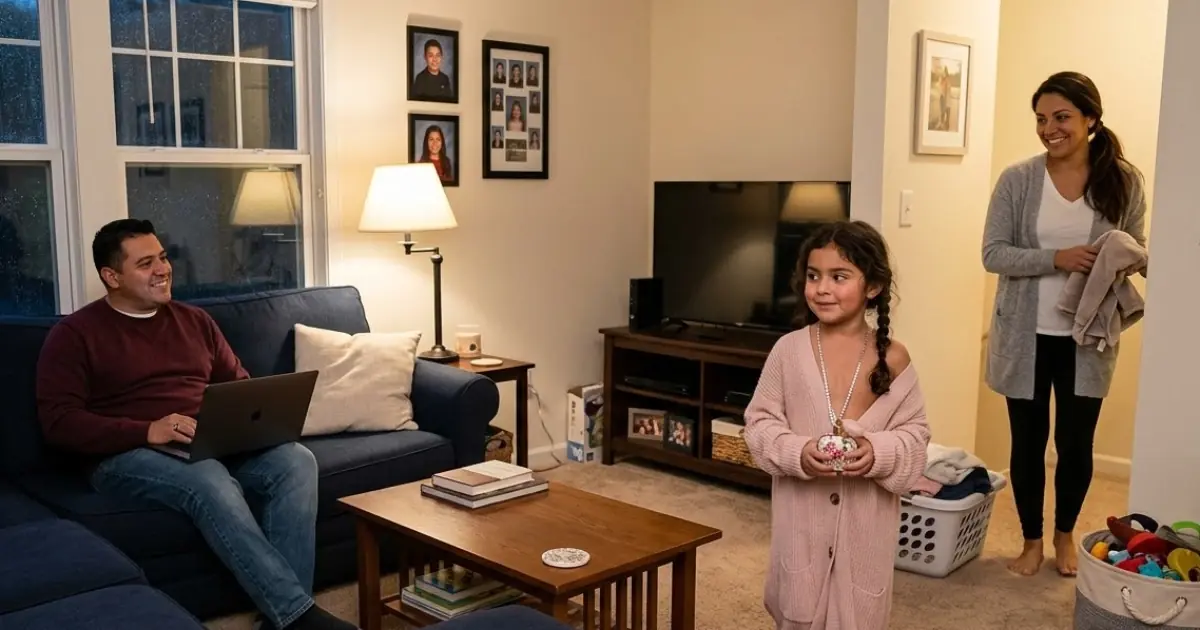
Marco swallowed. Outside, a car hissed past through the standing water. The framed photos watched them with their frozen smiles. He looked at the toy basket, then at the reading lamp, then finally at his wife.
“To the bus stop on Lancaster Avenue,” he said. “She asked me to drop her there. I did. That was it.”
“That was it,” Elena echoed. The words tasted like metal. “A woman was in your car. Our daughter found her perfume. You closed your computer like a man with something to hide. And you want me to believe that was it.”
“I am asking you to believe me,” Marco said quietly. “Even if I cannot tell you everything yet.”
Elena laughed once, a short sound without humor. She picked up a towel from the basket and folded it with sharp, precise creases. Then another. The motion steadied her hands while her mind raced through possibilities she hated herself for inventing—late nights, soft excuses, the particular way Marco had been tired lately, the phone calls he stepped into the garage to take. She had told herself he was stressed about work. She had told herself marriage meant assuming the best until the worst arrived wearing perfume.
“Who is she?” Elena asked.
Marco’s jaw tightened. “Someone from before. Someone complicated.”
“Before what? Before me? Before Sofia? Before you decided secrets were a kind of kindness?”
“Before I knew how much it would hurt to keep them,” he said.
Elena set the folded towels in a stack and pressed her palms flat against them. The rain continued its patient work against the townhouse. Upstairs, water ran in the bathroom sink—Sofia washing her wrists as instructed, singing something tuneless and happy. The sound of their daughter’s joy made the silence downstairs feel crueler.
“You will tell me tonight,” Elena said. “Not tomorrow. Not when Sofia is asleep and you have had time to invent a softer story. Tonight. Or I will assume the story that every wife assumes when a child’s mouth opens and a stranger’s perfume falls out.”
Marco nodded once. He looked older than forty in that moment, the burgundy sweatshirt suddenly like a costume for a man who no longer recognized himself.
“Let me put her to bed first,” he said. “Then I will tell you what I can.”
“What you can,” Elena repeated. “There it is again. The careful language of a man editing the truth.”
She carried the towels upstairs without waiting for his reply. On the landing she paused, perfume bottle still in her left hand, and pressed her forehead briefly against the wall. The scent rose again—jasmine, violet, a sweetness that had once meant celebration. She remembered wrapping the bottle in tissue paper. She remembered a younger voice laughing and saying, You didn’t have to, Lena, this is too much. She remembered believing that love between sisters could survive anything.
She put the perfume high on her dresser, behind a jewelry box, where Sofia could not reach it. Then she helped her daughter out of the trailing pink cardigan, hung the sparkly necklace on the little hook shaped like a moon, and listened while Sofia explained, with great seriousness, that grown-up clothes made her feel like a queen who could also still play with dinosaurs.
Marco read the story. Elena stood in the doorway and watched his mouth form the words, watched Sofia’s eyelids grow heavy, watched the ordinary tenderness of their bedtime ritual and felt, for the first time in years, like a guest in her own house. When Sofia finally slept, mouth open, one braid coming loose against the pillow, Elena and Marco returned downstairs without speaking.
The family room looked unchanged. Navy sectional. Framed photos. Toy basket. Reading lamp. Rain. The evidence of a life built carefully and, until tonight, believed in.
Elena sat on the far end of the sectional. Marco sat closer to the lamp. Between them, the distance of a marriage under sudden weather.
“Start,” Elena said.
Marco rubbed his face with both hands. “Her name is Carmen.”
The name landed in Elena’s body before it landed in her mind. For a second the room tilted. She heard the rain more loudly. She saw, unbidden, a girl with the same dark wavy hair Sofia had, only older, wilder, laughing with her head thrown back in a backyard in Allentown that no longer belonged to any of them.
“Carmen,” Elena said. The name came out flat. “My sister Carmen.”
Marco nodded. He did not look away. That, at least, he offered her.
For a stretch of seconds Elena could not decide whether relief or fury would arrive first. Relief that the woman was not a stranger with a motel key. Fury that the woman was worse than a stranger—family she had exiled for reasons that still felt, in her bones, like justice. She paced from the sectional to the toy basket to the framed photos and back, the gray cardigan tight across her shoulders.











