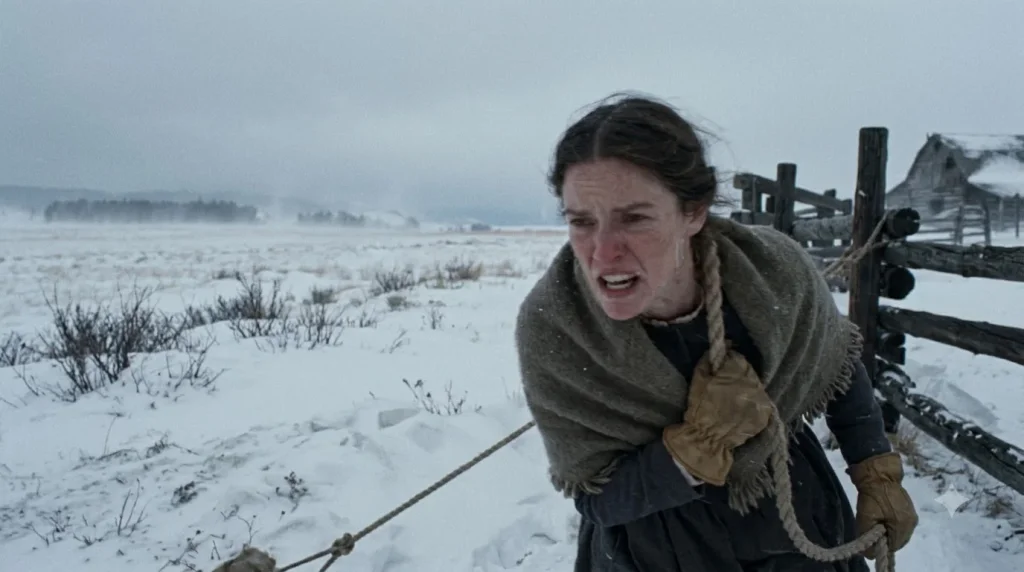
The Wagon Bed Was Never Meant to Be a Wall
Chapter 1: The Woman Who Refused to Die in the Storm
November 1884. Wyoming Territory.
The riders from Buffalo found the first of them a little after sunrise, when the wind had finally worn itself out and the light came up over a country nobody recognized.
The storm had moved the land around. Draws that had been ten feet deep were level with the prairie. Fence lines were gone. A stage road that men had driven for years had vanished so completely that the search party found it only by following the dead.
There were nineteen of them, scattered over eleven miles of trail.
Some were still on their wagon seats, sitting very straight, as if they had only stopped to rest the team. Some lay beside their horses under smooth white blankets of snow, where they had climbed down to walk and look for something, anything, that would break the wind.
The men who found them did not speak much. They brushed the snow from faces gently. They took off their hats.
And then, below a lonely sandstone ridge that none of them had paid attention to in years of riding past it, one of them saw smoke.
It was a thin gray thread, rising from a lump of snow at the foot of the cliff. When the riders came closer they saw that the lump had a shape. Someone had built a wall there. It was made of a wagon bed, standing on its side, laced with rope and stuffed with dead grass, and the snow had drifted over it so deeply that only the top edge and a sagging line of canvas showed.
A woman was standing in front of it with a shovel made from a wagon board.
She was thirty-one years old. Her face was cracked and red from the cold, and her dark hair had come loose from its pins and frozen into stiff strands against her collar. Her hands were wrapped in strips of wool felt. She looked at the riders as if she had been expecting them for a long time and was a little angry that they had taken so long.
“How many of you are there?” she asked.
“Eight, ma’am.”
“Good,” she said. “I have eight people in here and a mule and two oxen and a horse, and some of them cannot walk.”
She had not survived the storm alone.
What the riders found behind that wall would change the lives of everyone who lived along that road for the next forty years. But the story did not begin there. It began six days earlier, when a woman named Winifred Ashcom drove away from everything she had ever known.
Three months before the storm, Winifred had owned a home, a share of a small trading post on the freight road above the North Platte, and the comfortable belief that she knew roughly what the rest of her life would look like.
Her husband, Elias, had been a merchant. He was not rich. He was a tall, stooped, cheerful man with sandy hair that would not lie flat. Together they had built a store that served ranchers, bullwhackers, settlers, soldiers on leave, and anyone else who came up the road needing coffee, nails, cartridges, or a hot meal.
Winifred kept the accounts. She cooked for travelers in the back room. She knew nearly every customer by name, and most of their children’s names, and which of them paid on time and which of them paid in eggs.
She believed their life was modest and safe.
Then Elias got a fever.
It took him in five days. On the last day he kept trying to tell her something, but his mind had gone wandering, and what came out was mostly about a mule they had owned ten years before. She held his hand and said yes, yes, she remembered, and he died in the middle of a sentence.
She buried him under the cottonwood behind the store. She laid his pocket watch beside him, the silver one with the cracked crystal that he had wound every night of their marriage, and she walked back to the house believing that grief would be the worst thing she would ever have to carry.
She was wrong.
Two weeks after the funeral, a banker named Cornelius Vance came up the road from the railroad in a hired buggy. He had traveled from Chicago.
He was a lean man in his late forties, clean-shaven, with gray coming in at his temples and pale eyes that did not seem to blink often enough. He wore a black overcoat of a quality nobody on that road had ever seen, and he carried a leather document case with brass corners. He spoke with a cold, careful politeness, the politeness of someone who had never in his life worried where his next meal was coming from.











