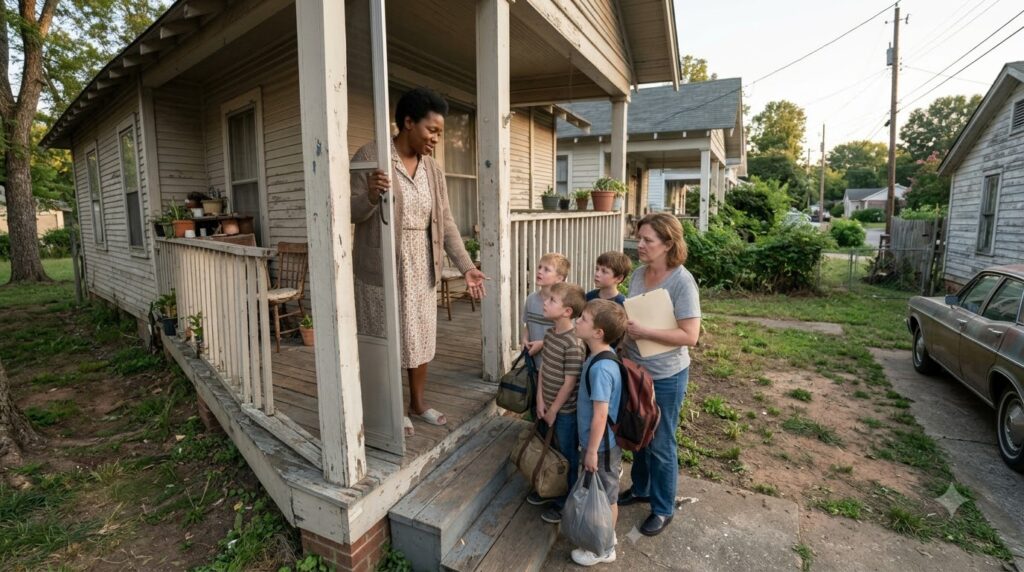
In 2024, three black SUVs rolled into a small Georgia town. The kind nobody in Hadley Springs had ever seen. The kind that cost more than most houses there. 800 people gathered in the town square. CNN cameras pointed at a wooden stage. On that stage stood a 65-year-old black woman. Tears streaming, hands trembling.
20 years earlier, she’d taken in three white boys nobody wanted. Three brothers the whole town rejected. She raised them with nothing but love and prayers whispered in the dark. Then they were ripped away from her. She never saw them again. Until today. But here’s what she didn’t know. Those three boys had become some of the most powerful men in the Southeast. And what they did next made the entire town fall to its knees.
Hadley Springs, Georgia. Population 2,800. One gas station, one church, one grocery store that closed at 6:00. The kind of town where everybody knew everybody. And everybody had an opinion about everybody else. Beatrice Owens lived in a three-bedroom house her grandmother built in 1955. Wooden floors that creaked. A wrap-around porch with a rocking chair. A vegetable garden out back that she tended every morning before sunrise.
She was 45 years old, never married, no children, not for lack of wanting. See, Beatrice had dreamed of being a mother her whole life. But after two miscarriages in her 30s, she stopped trying. Stopped hoping. Poured all that love into Sunday school kids and stray cats and tomato plants. She worked two jobs. Mornings at the elementary school cafeteria. Weekends cleaning the county courthouse. Took home $1,280 a month. The mortgage was $620.
Her roof had been leaking since February. She had a blue tarp over the back corner of the living room. Three buckets catching drips when it rained. Repair estimate? $3,400. Her savings? $780. She’d applied for a home repair grant through the county. Been waiting four months. The lady at the office kept saying she was in the queue. But Beatrice didn’t complain. That wasn’t her way.
Every Sunday she sat in the third pew at Greater Hope Baptist Church. Pastor Raymond Coleman knew her by heart. Knew she’d bring potato salad to every potluck. Knew she’d volunteer first and leave last. He watched her with the children after service. The way she knelt down to their level. The way she really listened when they spoke. Pastor Coleman noticed something the rest of the town didn’t see. Beatrice Owens had a gift for broken things.
Her neighbor Denise Harper came by most Tuesdays. They’d sit on the porch with sweet tea while Denise’s kids played in the yard. B, have you ever thought about leaving this place? Denise asked one afternoon. Your cousin in Atlanta has room. Beatrice smiled. Tired but warm. And who’s going to watch a grandma’s tomatoes? Who’s going to make sure Pastor Coleman doesn’t put too much sugar in the lemonade?
She laughed. But Denise saw it. The loneliness sitting behind Beatrice’s eyes. Like a permanent guest who never left. Every night Beatrice prayed the same prayer. Had been praying it for 15 years. Lord, if I’m meant to be a mother, send me someone to love. If I’m not, help me make peace with this empty house. She’d made peace with it. Mostly.
Above her fireplace hung a small wooden plaque. Hand-carved by her grandmother decades ago. The edges worn smooth from years of dusting. It read, A house becomes a home when it holds someone else’s pain. Beatrice had read those words 10,000 times. She was about to understand what they really meant.
Now, here’s the thing about Hadley Springs. It wasn’t openly hostile. No burning crosses. No shouted slurs. But there was a texture to the silence. When Beatrice walked into the grocery store, conversations paused. Just a beat. Then continued. When she applied to be a substitute teacher, she had 30 college credits, just 15 short of a degree, the school board thanked her for her interest. They never called back.
She told herself it didn’t bother her. Told herself she was content with the cafeteria. Content with the mop and the courthouse floors. But some nights, lying in that too quiet house, she wondered, what would it feel like to be chosen for something? To be someone’s first pick instead of their last resort. She didn’t know it yet. But she was about to find out.
That Tuesday night, the phone rang. It was Carolyn Mitchell. Social worker from the county office. Beatrice knew her from high school. Back when she was Carolyn Baker. B, Carolyn’s voice was strained. I know this is last minute. I know it’s a lot to ask. Beatrice sat up straighter. But I’ve got three boys. Brothers. And nobody will take them. I mean, nobody.











