The lean-to behind the shed held more shade than strength, but it was enough for Leo to work under. Its tin roof popped softly in the heat, and the ground beneath it smelled of dust, old hay, and sun-baked motor oil from machines that had not run in years. Leo rolled his motorcycle in slowly while Miles walked beside him, one hand ready near the handlebar, but not touching unless asked. That was how the brotherhood worked. Help did not have to crowd a man. Grant followed with a small tool pouch, his eyes passing over everything. The leaning fence posts, the cracked rain barrel, the sagging gutter along the back of the adobe house. The place was not falling apart all at once. It was losing arguments one small corner at a time.
Leo pulled the side cover and tested the relay with a pocket meter kept wrapped in a red shop rag. Numbers flickered, then dropped. “Relay is sticking,” he said. “Fan does not come on when it should.” Warren stood a few feet away, cane planted in the dirt, pretending not to be interested, and failing like a man who had spent his life fixing things. “I have wire in the shed,” he said. “Some connectors, too. Might be old.” Leo looked at him. “Old is fine if it conducts.” Warren almost smiled.
Mabel appeared at the back door with a damp towel for Miles to put around his neck, then stopped when she saw him looking at the orange paper taped near the kitchen window. It had been partly hidden by a curtain from inside. But out here, the color shouted against the cream adobe wall. County Housing Safety Order. Miles read only the first line before looking away. He did not stare at another man’s trouble like it was a roadside attraction. Mabel saw that. Her shoulders softened, then tightened again. “It is nothing for guests to worry over,” she said. Grant was standing near the porch now, tapping one boot gently against the front support. The wood answered with a hollow sound. Not good.
Miles took the towel from Mabel and folded it once in his hands. “I used to do structural welding and mobile home repairs,” he said. “Grant framed houses in Colorado before his knees quit liking ladders. Leo can make bad wiring confess before breakfast.” Mabel looked toward Warren, who had turned his face away as if the pecan trees needed his full attention. “We are not asking,” she said. Miles nodded. “I know.” He let the words rest. The fan on Leo’s bike kicked on with a rough little whir as Leo bridged the relay for testing. It sounded like a small victory. Beyond the yard, County Road 14 shimmered under the afternoon sun. The closed crossing was still waiting. The caution tape twitched in the wind.
Warren finally spoke from beside the shed. “Water came through after that storm Tuesday. Not high, but fast. Cut a channel right behind the house.” Grant stepped to the corner and looked down. The runoff had eaten a shallow trench along the foundation, exposing adobe where packed earth should have held firm. Forty years of weather could be patient. One hard rain could be rude. Miles crouched, rubbed the dry soil between his fingers, and saw the problem clearly. Water had nowhere else to go. Mabel still held herself straight, but her eyes had moved to the brick marked 1959 by the door. Warren had made that house with his hands. Now his hands could not save it alone.
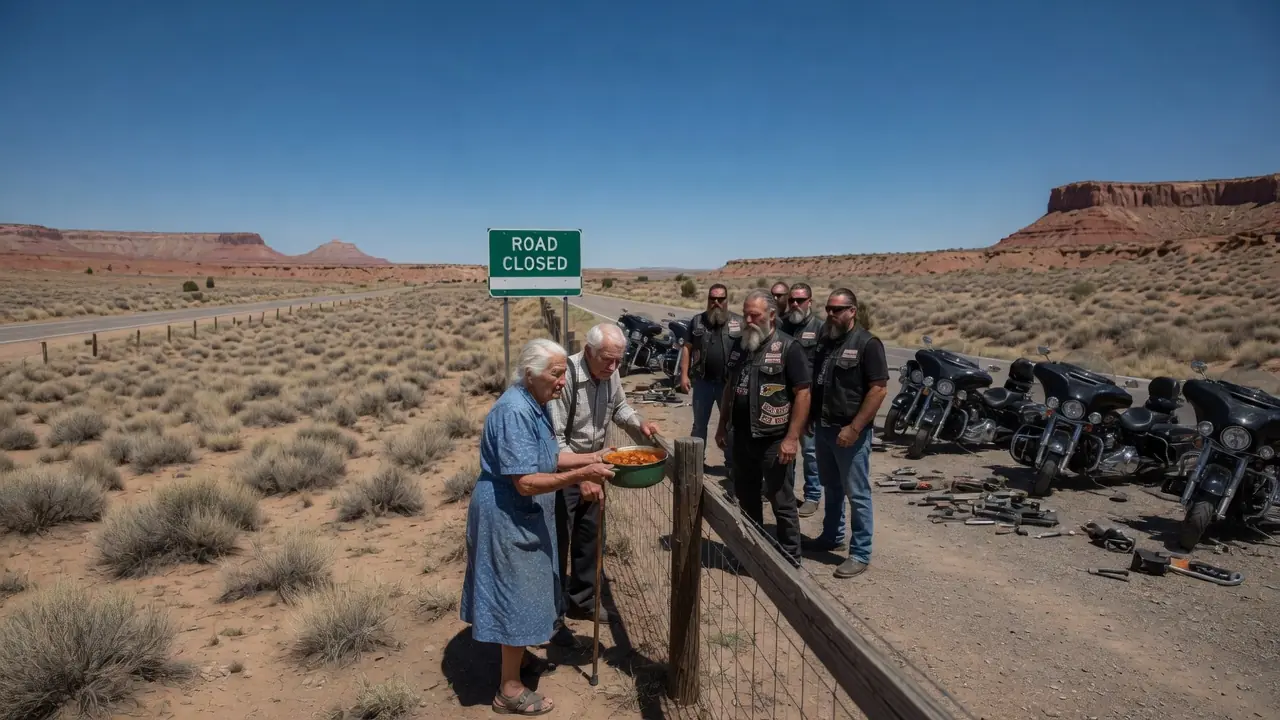
Miles stood and wiped the dust from his palms. “We can look,” he said. “Just look.” Warren looked at him for a long second. Then he gave the smallest nod. Sometimes permission arrived like a door barely opening. By 4:18, the closed crossing was still closed, but Leo’s motorcycle was no longer the most important thing in the yard. He had the fan running with a temporary bypass, safe enough to get them moving once the heat backed off, and he was wrapping the repaired wire with black tape when Mabel stepped inside to refill the lemonade. The kitchen door swung open behind her. That was when Miles saw the rest of the notice. It was pinned under a magnet shaped like a red chili pepper on the refrigerator, folded once, but not enough to hide the Orange County seal. Warren saw Miles see it. Neither man pretended otherwise. Silence can be a clean thing when it does not lie.
“Thirty days,” Warren said from the doorway, his cane tip resting on the worn threshold. “That is what they gave us.” Mabel stopped with the pitcher in her hand, eyes closing for half a second. She had been trying to keep the trouble small by not naming it. Trouble rarely stays small just because it is quiet. Grant stepped back from the porch support and removed his hat, not for drama, but because the shade under the roof suddenly felt like a room where a man should show respect. Miles read only what Warren allowed by leaving it visible. Structural concern near rear wall, water intrusion, unsafe porch support, follow-up inspection required. It was not an eviction notice yet. It was the road toward one.











