Now the scar told a different story.
The crowd, once so loud and eager to condemn, seemed to fold in on itself. Someone in the back muttered, “Jesus!” Another man took a slow step backward. A woman pulled her child closer to her side, as if realizing too late the true danger hadn’t come from the woman behind the counter, but the man who had stood beside them all along.
Barlo didn’t move at first. He blinked, opened his mouth, but no words came. When he finally found his voice, it was thinner, stretched with desperation. “That could be anyone,” he said, half laughing, half pleading. “Come on, grainy footage. You can’t arrest someone over that.”
Eli, standing beside the technician, didn’t even turn to him. His eyes stayed on the frozen screen. “Check the timestamp. Cross-section it with the delivery logs. The water contamination began precisely 40 minutes after this moment. No one else had access to that intake pipe. No one except you.”
Barlo’s face flushed, then paled. He turned to the police officer closest to him. “You? You know me, Rick. You know me. I ran kitchens in this town for 30 years. This woman, she’s manipulating you all. She’s got tricks, sympathy, some kind of story, but she’s not clean. She’s been lying. She’s always been playing the part.”
The officer, a man in his 40s with heavy eyes and a badge that looked too polished for such an old town, shook his head. “I know who you are, Barlo. That’s exactly why this makes sense.”
Another officer stepped forward. “Barlo Denton, you are under arrest for tampering with food infrastructure, criminal endangerment, and conspiracy to cause public harm. Turn around and place your hands behind your back.”
Hands hovered in the air, shaking. “No, no, this is ridiculous.” But he didn’t resist. When the cuffs closed around his wrists, the click was soft but final, like the closing note in a requiem. He was marched through the crowd, eyes wide, lips tight. He looked toward the people he had once treated to coffee, who had nodded at him on sidewalks, who had once feared him and respected him in equal measure. But now they averted their eyes. One woman hissed through clenched teeth. “You poisoned my niece.” Someone else spat near his shoes. He was no longer the powerful one in the room. He was a man undone.
As he passed Amara, he dared to meet her eyes. For a moment the hate was gone. So was the arrogance. In their place was disbelief, pure bone-deep disbelief that the woman he’d stepped on, dismissed, and mocked, had survived him. But Amara didn’t look away. She didn’t need to say a word. The world had finally seen.
As the murmurs faded, and the squad car carrying Barlo rolled away down the street, Amara stood in the soft hush that followed, like the world had been held in tension, and now dared to exhale.
The screen was off. The evidence had spoken. The storm had passed, but the emotional weight hadn’t left her chest. She turned toward the man who had made it all happen.
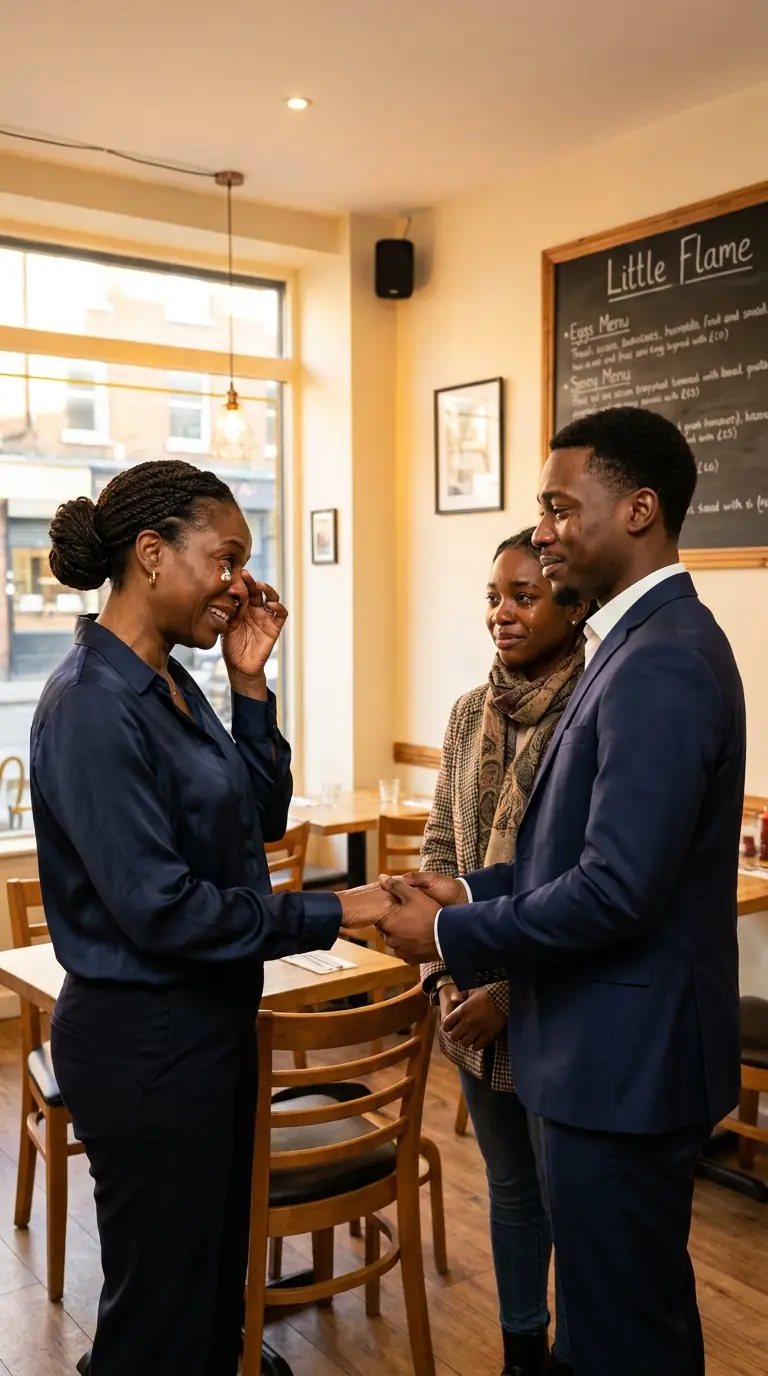
Eli, his suit was clean-cut, his face older, defined now, not in the way of years lost, but of purpose earned. But there was something unchanged, something in the eyes, in the stillness of his posture. He wasn’t a boy anymore. But Amara knew those eyes. She’d once watched them fill with snow and sorrow as he clutched his sister in the dark. Now they looked at her the way a man might look at a lighthouse after crossing an endless sea.
“Eli,” she whispered. Just the name, and in that one word, everything returned. The snow, the hunger, the quiet knock at the door, the scarf, the fire she tried to keep lit when the world around them had turned to frost.
He stepped forward. “It’s been a long time.”
She nodded, voice catching in her throat. “15 years.”
Nah appeared beside him, taller now, regal in posture, dressed in muted tones, save for a splash of blue. A painted scarf draped over one shoulder. Her hands were stained faintly with charcoal and color, nails trimmed short. Amara gasped softly as she realized those were the hands of an artist. The little girl with red fingers and hungry eyes now created beauty for the world.
“You both look…” Amara didn’t finish.
Nah smiled gently. “We became what you believed we could be.”
And then she reached into a long canvas case slung over her shoulder. Carefully, reverently, she pulled out a framed painting wrapped in soft cloth. She peeled back the covering. It was her, Amara, in the snow, kneeling, arms open, the folds of her coat painted in deep earth tones, her scarf catching light like stained glass. Behind her, two small children wrapped in her warmth. Snow whirled around them, but none touched them. The storm had no power where she knelt. The painting glowed.
Tears spilled down Amara’s cheeks. She touched the frame with trembling fingers. “You painted this?”
Nah nodded. “It took me years to finish. I had to wait until I was strong enough to face that night again.”
Amara’s voice was barely audible. “Why bring it here?”
“Because this is where the story began,” Eli said quietly. “And where it should be honored.”
She looked from one to the other. “You saved me today.”
Eli shook his head. “You saved us first. We only returned what you gave freely.”
They embraced, the three of them in the quiet awe that comes from knowing something profound has come full circle. She held them as she once did, and for a moment, despite the years, despite the noise, they were once again three souls in the snow, clinging to one another for warmth.
Weeks later, the painting now hung in the heart of Little Flame above the mantle, framed in mahogany, lit by soft amber sconces. Visitors stared at it, moved not just by its artistry, but by the spirit it carried — of survival, of memory, of one woman’s quiet refusal to stop caring. Below it, on a brass plaque etched in calm script: “Kindness needs no proof. It lives forever in those who are rescued from the dark.”
And every evening before closing time, Amara would stand beneath it, her hand brushing the frame, her heart steady, her eyes lifted, not in sorrow, but in gratitude. She had not been forgotten. She had been remembered. And through her, the town had remembered something of itself.











