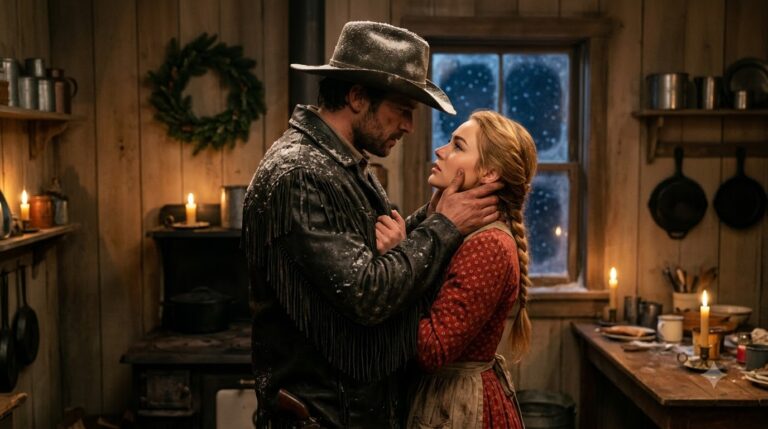
“I had reasons.”
He sat.
Emily looked at the old letter.
“If we’d known then.”
“What?”
“That I could eventually have Thomas.”
Daniel shook his head.
“I’m glad we didn’t.”
She stared.
“Why?”
“Because then you might have believed my answer depended on hope.”
Emily went quiet.
Daniel continued.
“When you told me you might never have children, I had to decide what I actually meant by loving you.”
“If some doctor had immediately promised us a baby, maybe neither of us would have learned that.”
Emily’s eyes filled.
Daniel pointed.
“No.”
“What?”
“We are too old for this much crying.”
She laughed.
He kissed her.
Then looked toward the yard.
Thomas was sixteen now.
Arguing with Clara over a saddle.
Ruth had returned from teaching school in Cheyenne for the summer.
Noise filled the ranch.
Daniel smiled.
“I wanted a house full of children.”
“You got one.”
“Eventually.”
Emily looked at him.
“You wanted me first.”
“Yes.”
“Still?”
He pretended to think.
She hit his shoulder.
“Cruel woman.”
“Answer.”
Daniel took her hand.
“Every version.”
She smiled.
The phrase had survived decades.
Every version of the future that mattered had her in it.
Their hair gray.
Children grown.
Grandchildren arriving later with muddy boots.
Cattle prices rising and falling.
Droughts.
Snow.
Illness.
Funerals.
Weddings.
Arguments.
Ordinary mornings.
Years.
One evening, nearly forty years after their wedding, Daniel woke before dawn.
Emily was beside him.
He looked across the room.
The original brown blanket still rested folded over a chair.
Patched now.
Faded.
Emily had refused to throw it away.
Daniel touched her shoulder gently.
She woke.
“What?”
“Nothing.”
“Then why are you waking me?”
“I was thinking.”
“That is rarely good.”
He smiled.
“Do you remember the first night?”
Emily opened one eye.
“The night you nearly volunteered to live in the barn?”
“I was trying to be respectful.”
“You were terrified.”
“You were crying.”
“You looked more frightened.”
Daniel laughed softly.
Emily shifted closer.
“What were you thinking?”
He looked toward the dark ceiling.
“That I almost left the room because I thought giving you space meant leaving you alone.”
Emily waited.
Daniel continued.
“I’m glad you stopped me.”
“So am I.”
“What would have happened?”
“You would have slept in the chair.”
“My back would have broken.”
“I would have felt guilty.”
“Terrible marriage.”
She smiled.
Daniel took her hand.
“You know what I remember most?”
“What?”
“When you said you thought I might hate you in five years.”
Emily’s expression softened.
“You didn’t.”
“No.”
“Ten?”
“No.”
“Twenty?”
“Occasionally.”
She hit him.
He laughed.
“Not for that.”
“Good recovery.”
Then he became serious.
“I never hated you for something your body could or couldn’t do.”
“I know.”
“You know now.”
“Yes.”
Emily looked toward him in the darkness.
“But I didn’t then.”
Daniel squeezed her hand.
“That’s the part I wish I could change.”
She shook her head.
“No.”
“Why?”
“Because you showed me.”
“Over years.”
“You couldn’t have said one perfect sentence that erased Henry.”
“You had to keep being you.”
Daniel thought.
That was true.
Trust had been built in mornings more than declarations.
Coffee.
Chores.
Arguments.
A hand offered instead of imposed.
A door left open.
A choice respected.
A grief shared without blame.
Their wedding night mattered.
But what made the confession safe was everything that followed.
Emily rested against him.
“Daniel.”
“Yes?”
“If we had never had Thomas?”
He did not hesitate.
“We’d still have Ruth and Clara.”
“And if they had never come?”
He turned toward her.
“Then we’d have had each other.”
Emily smiled.
“Enough?”
He kissed her forehead.
“Always.”
Outside, Wyoming wind moved through the cottonwoods.
The same valley where they had married beneath an old tree decades earlier lay quiet beneath moonlight.
The ranch Daniel once feared would disappear without sons had survived through daughters, a son, hired hands, neighbors, changing methods, and sheer stubbornness.
Nothing had continued exactly as he imagined.
That was perhaps the greatest gift.
Daniel had spent his youth believing a future was something a man built according to a plan.
Land.
Marriage.
Children.
Inheritance.
Names carried forward.
Emily taught him otherwise.
A future was partly built and partly received.
It asked people to surrender versions that no longer fit.
Emily had entered their marriage convinced that love depended on what she could give Daniel.
Children.
Work.
Beauty.
Companionship.
Something measurable enough to justify being chosen.
Daniel had entered believing he understood family because he understood responsibility.
Both were wrong.
The night Emily finally confessed what she feared most, Daniel could not promise her children.
Could not promise she would never grieve.
Could not promise he would never feel loss.
He promised something smaller and far more difficult.
He would not turn that loss into a debt she owed.