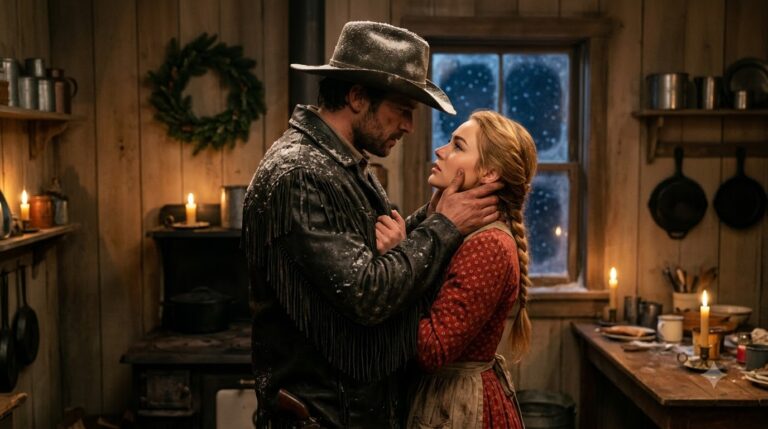
She hated herself for it.
Two weeks after the wedding, Daniel caught her watching him with Samuel.
That night, while they washed dishes, he said:
“You’re doing it again.”
Emily froze.
“Doing what?”
“Looking guilty.”
“I do not have a guilty look.”
“You do.”
“What does it look like?”
“Like you’re trying to apologize with your eyebrows.”
“That is absurd.”
“It’s very distinctive.”
She handed him a plate.
He dried it.
Then became serious.
“Samuel.”
Emily looked away.
Daniel put the plate down.
“Come here.”
She crossed her arms.
“I’m washing.”
“The plate will survive.”
He took her hands.
“You don’t need to feel sorry every time I enjoy being around a child.”
“I know.”
“Do you?”
“No.”
He sighed softly.
Emily whispered:
“I feel like I’m waiting for you to realize what you lost.”
Daniel looked at her.
“I can’t keep proving a future I haven’t lived.”
She frowned.
“What?”
“I can tell you I choose you.”
“I can tell you every day.”
“But if you’re waiting for me to become Henry, there’s no argument that proves I never will.”
Emily’s eyes filled.
Daniel continued gently.
“You have to watch.”
“See what I do.”
“Over time.”
“That’s the only proof I have.”
She stared.
Then nodded.
It hurt because he was right.
Trust could not be forced through reassurance.
It had to accumulate.
So it did.
Autumn moved toward winter.
Daniel never mentioned children unless Emily did.
He never treated intimacy like an attempt at conception.
Never counted dates.
Never asked questions about her body that she had not invited.
When people in town teased them about “little Mercers” arriving soon, Daniel answered before Emily had to.
“Let us finish being married five minutes first.”
Once an older rancher laughed and said:
“Land like yours needs sons.”
Daniel replied:
“Land needs rain.”
The man blinked.
Emily nearly choked on her coffee.
Later she asked:
“Did that bother you?”
“What?”
“What he said.”
Daniel shrugged.
“A little.”
She waited.
“Why?”
“Because I do think about who gets the ranch someday.”
Emily’s stomach tightened.
Daniel noticed.
“That isn’t the same as wishing you were different.”
She breathed again.
He continued.
“My father thought inheritance had to travel through blood.”
“I believed that too.”
“Maybe I still do a little.”
“I have things to unlearn.”
Emily appreciated that more than another perfect answer.
Daniel was not pretending her secret had erased every expectation he ever held.
He was examining them.
That felt real.
Winter arrived early.
Snow covered the northern pasture.
Cattle moved closer to shelter.
Days shortened.
Daniel and Emily became experts at sharing one cabin without driving each other insane.
Almost.
Daniel left muddy boots in the wrong place.
Emily rearranged tools and then forgot where she placed them.
He snored occasionally.
She stole blankets.
He accused her.
She denied everything while visibly wrapped inside most of the evidence.
They argued over coffee strength.
Lamp oil.
Whether the kitchen table actually needed flowers in December.
It did, according to Emily.
Daniel discovered marriage was composed of astonishingly small negotiations.
He loved it.
One night in December, Emily woke before dawn.
Daniel was gone.
She found him in the kitchen wearing trousers and no shirt, feeding another log into the stove.
She leaned against the doorway.
“You’ll freeze.”
He looked back.
“Morning.”
“It is not morning.”
“Four-thirty.”
“That is night pretending to be morning.”
Daniel smiled.
Emily noticed a letter on the table.
“What’s that?”
“Came yesterday.”
“You didn’t show me.”
“It’s for you.”
She crossed the room.
The envelope carried a Baltimore postmark.
Emily stopped.
Daniel noticed.
“You don’t have to open it.”
She looked at the handwriting.
Dr. Samuel Avery.
The physician who had taken over her former doctor’s practice.
Her hands became cold.
“Why would he write?”
Daniel put on his shirt.
“I don’t know.”
Emily sat.
She opened the envelope slowly.
The letter was three pages.
Daniel poured coffee.
He did not read over her shoulder.
Halfway through the first page, Emily stopped breathing.
Daniel noticed.
“What?”
She continued reading.
Her eyes moved faster.
Then back.
She reread a paragraph.
“Emily?”
Her hand covered her mouth.
Daniel crouched beside her.
“Tell me.”
She handed him the letter.
He read.
Dr. Avery had discovered additional surgical records while transferring old archives.
The surgeon who treated Emily after the carriage accident had documented internal injuries, but not the specific damage later described by the physician who warned her about infertility.
More importantly, notes indicated the physician had based his warning partly on assumptions common at the time rather than on confirmed anatomical findings.
The letter was careful.
No promises.
No certainty.
But one line stood out:
I do not believe the surviving records justify telling you that pregnancy is impossible, or even necessarily unlikely. The original prognosis appears to have been substantially more uncertain than you were led to believe.