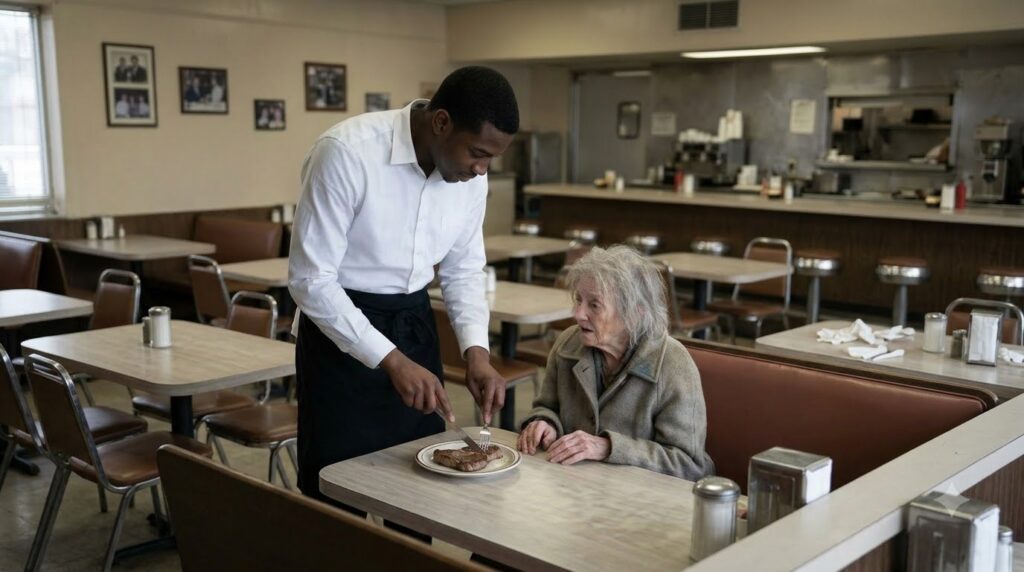
A Black diner waiter had been working non-stop since before sunrise, doing everything he could to provide for his little daughter. Every morning, an elderly woman with cloudy gray eyes shuffled in, quiet, distant, avoided by the staff’s annoyed looks. But the waiter always treated her with gentle warmth, noticing every detail and even cutting her toast into small squares for her trembling hands. Slowly, she opened up and the two grew close like family. But one morning, she didn’t show up. Instead, four men in sharp black suits walked in and what they told him next left him absolutely stunned.
The brass bell above Rosewood Diner gave a weary clang each time the door opened. Marcus Thompson’s morning anthem. Not cheerful, just tired metal announcing another shift. Another day, hoping the tip jar might be kinder.
The diner was a relic frozen in time. Cracked burgundy booths, sticky linoleum, and the lingering scent of burnt coffee welded into the walls. Tucked in Houston’s Heights, it had served the same working-class crowd for more than four decades.
For Marcus, in his mid-30s, Rosewood was both refuge and cage. Six days a week, from long before dawn until early afternoon, he performed the choreography of survival: balancing plates, pouring coffee, forcing smiles until they felt disconnected from meaning.
Once he had been a promising culinary student with a gift for flavor and a dream of a restaurant where food told stories. But that dream had drowned beneath overdue bills and the weight of single fatherhood. He had grown up in Houston’s Third Ward, son of a nurse and a port worker who filled their home with barbecue, cornbread, and hope. For a while, the future had seemed bright. Then marriage, heartbreak, and abandonment reshaped everything.
His wife Rachel left when their daughter was only three years old, leaving a note that read, “You are a wonderful father. Jasmine will be better off with you.” Overnight, Marcus became both parents. He left the fine dining kitchens for predictable morning shifts so he could pick Jasmine up from school. Stability required sacrificing every ambition he once held.
Years later, exhaustion ruled him. He rose at four each morning, moving quietly through their small apartment to prepare Jasmine’s breakfast and leave a handwritten note: “Daddy loves you more than all the stars.”
Mrs. Rosa from apartment 2C helped Jasmine get ready for school. While Marcus rode the early bus through darkness, hands rough from years of hot plates and cheap detergent.
At Rosewood, he greeted regulars who knew only his name and his polite smile. He kept moving because stopping meant thinking, and thinking hurt.
At home, Jasmine’s laughter was the one force strong enough to lift him. Seven years old now, with curls tied into two puffs and bright brown eyes full of wonder, she was his whole world.
But the math of poverty was merciless. Rent for their modest apartment demanded nearly $2,000 each month. After-school child care cost $750. Jasmine’s allergy medication added a little over $100. Groceries absorbed roughly $400 more. Utilities another $200 and bus fare close to $150. Altogether, the monthly total rose above $3,400, while Marcus earned between $2,600 and $2,900, depending on tips. Even in the best months, he fell more than $500 short. Debt piled relentlessly — nearly $18,000 on credit cards, much of it from his mother’s final medical bills and years of monthly deficits. Three late rent notices already hung on their door. One unexpected expense could shatter everything.
Still, Marcus hid the fear from Jasmine. Every evening when he opened their front door, she ran to him, shouting, “Daddy!” — a moment so warm it briefly erased the weight of scarcity.
He arrived at the diner at 5:43 most mornings. Walter Hayes, the 60-something manager with the permanently greased apron, would glare. “You are three minutes late, Marcus.” “Sorry, Walter. The bus was stuck on the interstate.”
Betty Sullivan, who had worked there for more than half a century, shook her head. “That single dad is always running behind.” Marcus never responded. He tied his apron, brewed coffee, and slipped into the day’s rhythm.
The regulars were a familiar cast in an unchanging play. Frank, the construction foreman, tipped exactly $1 regardless of the bill. Two administrative assistants from a nearby law office gossiped daily about their supervisor’s messy divorce.
And then there was Grace.

Grace was not simply a regular. She had become part of the diner’s landscape, as permanent as the faded neon sign outside. Every morning at precisely 7:20, she pushed open the heavy glass door and shuffled to the same corner booth by the window. She walked with a wooden cane, her steps slow but dignified. She always wore the same faded cardigan, plain blouse, worn slacks, and well-traveled shoes. Her face was lined with deep wrinkles, her pale gray eyes clouded by early cataracts. She existed like a quiet ghost in a noisy room.











