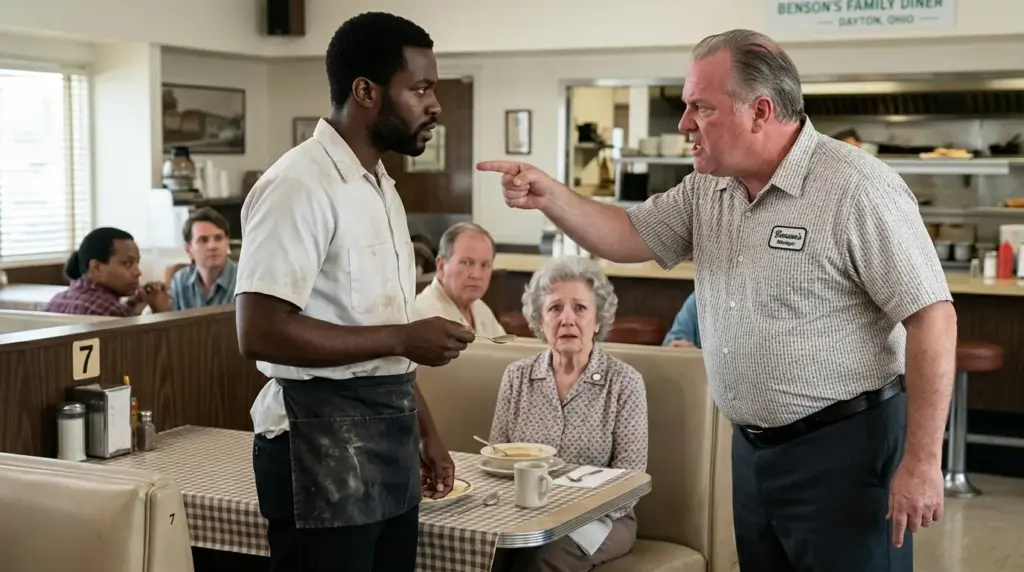
“Put the pie back.”
Daniel Foster looked at the elderly woman sitting alone in booth seven.
She had already eaten half the slice.
His manager, Carl Benton, stood beside the register with both arms folded.
“I said put it back on the tray.”
Daniel stared at him.
“She already ate half of it.”
“Then charge her for the whole thing.”
The woman lowered her fork.
Her name was Margaret Hale.
Seventy-nine years old.
Small frame.
Silver hair curled neatly above her shoulders.
A blue wool coat folded beside her.
She came to Benson’s Family Diner in Dayton, Ohio, almost every weekday between two and three in the afternoon.
Always alone.
Always booth seven.
Always coffee.
Usually soup.
Sometimes toast.
Never dessert.
Not because she did not like pie.
Daniel had learned that on his third week working there.
Margaret loved apple pie.
She just could not justify spending $4.25 on it.
That afternoon, Daniel had given her a slice without adding it to the bill.
Carl had noticed.
Now the diner manager looked at Daniel as if he had stolen something from his own pocket.
“You know the rule.”
Daniel lowered his voice.
“It’s one slice of pie.”
“It’s inventory.”
“She comes here five days a week.”
“That doesn’t make it free.”
Margaret pushed the plate away.
“It’s all right.”
Daniel turned toward her.
“No, ma’am.”
“I shouldn’t have accepted it.”
“You didn’t do anything wrong.”
Carl pointed toward the register.
“Daniel.”
“Back office.”
“Now.”
Daniel looked at Margaret.
“I’ll be right back.”
Carl said:
“No.”
“You won’t.”
Ten minutes later, Daniel Foster walked out of Benson’s Family Diner carrying his apron in one hand and a termination notice in the other.
He had $42 in his checking account.
Rent was due in six days.
His electricity bill was already late.
And he had just lost the only job that had kept him barely above water.
Inside booth seven, Margaret Hale sat staring at the half-eaten slice of apple pie.
She had no idea Daniel had been fired.
She would not learn until the next morning.
And when she did, she would make one phone call.
Three days later, someone would knock on Daniel’s apartment door.
The man standing outside would be wearing a dark overcoat and carrying Daniel’s old diner name tag in his hand.
His first words would be:
“My name is Thomas Hale.”
“You were kind to my mother.”
Daniel Foster was twenty-eight years old.
Nothing about his life looked dramatic from the outside.
He rented a one-bedroom apartment above a laundromat near North Main Street.
His car had stopped running eleven months earlier.
He took the bus to work.
He owned three good shirts.
Two pairs of black work pants.
One winter coat with a broken inside pocket.
His mother lived in Cincinnati with his younger sister.
His father had disappeared from their lives when Daniel was fourteen.
Not in a tragic way.
Just gradually.
First missed weekends.
Then missed birthdays.
Then no calls at all.
Daniel learned early that most disasters did not arrive with sirens.
Some simply stopped showing up.
At nineteen, he started community college.
At twenty-one, he left because his mother needed help after surgery.
He intended to return.
He never did.
By twenty-eight, Daniel had become skilled at surviving.
He knew which grocery store discounted meat after eight.
Which utility company representative would actually work with you if you called before the shutoff notice.
Which bus arrived late often enough that the posted schedule was fiction.
And how much money could safely disappear from a paycheck before the rest of the month became dangerous.
That was why Margaret Hale caught his attention.
She did not look poor.
Her clothing was old but well maintained.
Her shoes were clean.
Her handbag was real leather.
But Daniel recognized something familiar in the way she ordered.
“Coffee.”
“Soup.”
“No bread, thank you.”
“No dessert.”
Every decision slightly smaller than the menu suggested she wanted.
The first time Daniel offered bread, Margaret shook her head.
“It’s extra.”
“Ninety-nine cents.”
“Exactly.”
Daniel smiled.
“The soup comes with crackers.”
“I know.”
She opened two.
Put the other packet into her purse.
Daniel pretended not to notice.
Over the next four months, he learned small things about her.
Her husband’s name had been Arthur.
He died eight years earlier.
They had been married fifty-two years.
He loved baseball.
She hated baseball but learned enough about it to argue with him.
She had one son.
Thomas.
Busy man.
Lived outside Columbus.
Called often.
Visited less often than he wanted to.
Margaret always defended him.
“He works too much.”
Daniel once said:
“Maybe he likes working.”
Margaret smiled sadly.
“His father did too.”
Daniel never asked what Thomas did.











