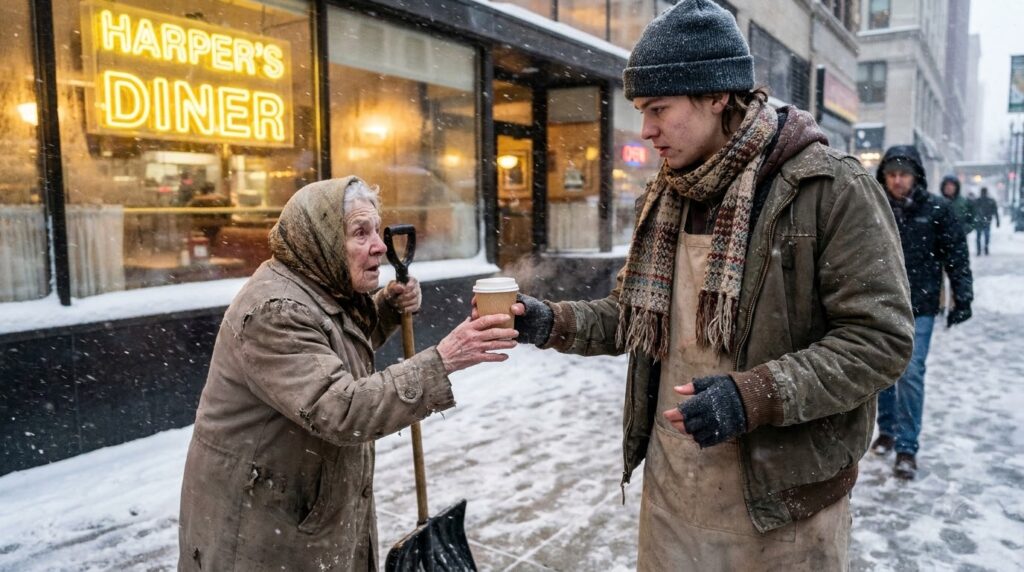
One snowy winter morning, a young waiter exhausted after three straight hours of work, happened to see an old woman shivering as she shoveled snow on the sidewalk. The woman wore only a thin coat, her lips turning blue from the cold. Without hesitation, the 15-year-old boy pulled out a crumpled $5 bill. Almost all the money he had left bought a cup of hot ginger tea, and stepped into the freezing wind to give the old woman the only warmth of that day. He had no idea that this small act would set off a chain of events where the woman’s true identity would change his life forever.
The diner’s door chimed for the hundredth time that morning. The boy barely looked up. His hands moved on autopilot pot in one hand mug in the other. Poor smile. Move on. The routine had become muscle memory after working at Harper’s Diner. Outside, Chicago was drowning in snow. Fat flakes fell thick and fast, piling up on the sidewalks, on car hoods, on everything. The street lights glowed dim and yellow through the white chaos.
Inside the diner was warm, but that warmth didn’t reach the boy. Not really. His fingers were cracked and raw from the cold. The walk here, three neighborhoods on foot at 4 in the morning, had been brutal, but rent didn’t pay itself, and the bus fare added up. Excuse me, hello. A sharp voice cut through his thoughts. The boy turned. Table six. A woman in an expensive coat phone in one hand, barely looking at him. This coffee is cold, the woman said, pushing the mug forward like it personally offended her. What kind of place is this?
The boy’s chest tightened. The coffee wasn’t cold. He’d poured it 2 minutes ago, but he smiled anyway. That thin practice smile that said, “I’m sorry.” without actually apologizing. “I’ll get you a fresh one right away, ma’am.” Make it fast. I don’t have all day. The boy took the mug and walked back to the counter. His reflection caught in the metal coffee dispenser. Tired eyes, hair pulled back tight, that worn scarf around his neck, his mother’s scarf. The edges were frayed now, but it was all he had left of her.
You can be poor baby, his mother used to say, but don’t ever let your kindness freeze up inside you. He poured the new coffee, added cream without being asked. He remembered this woman from last week. Same order, same attitude. When he set it down, the woman didn’t even look up from her phone. Finally, no thank you, no eye contact, nothing. The boy stepped back. That familiar feeling settling in his stomach, invisible. That’s what he was to most people here. A waiter, a body that brought food and took plates away.
Not a person with a name, with a life, with a mother he’d buried two years ago. Harper’s voice boomed from the kitchen pass through. He was a big man with a bigger voice, but he wasn’t mean, just always rushing. We got a lunch rush coming. Need you sharp, kid. I’m on it, he called back, forcing brightness into his voice. He wiped down table three, cleared table 7, refilled coffee at 9:00. His legs ached. His back ached. But he kept moving because stopping meant thinking. And thinking meant remembering how small his bank account was. How the landlord’s last warning had been 3 days ago.
The door chimed again. More cold air rushed in carrying snow and noise. A group of businessmen laughing loud, shaking off their coats like they own the place. Sweetheart, can we get some service over here? One of them called out, not bothering to wait for a host. The boy grabbed menus and headed over. Good afternoon, gentlemen. What can I get you? Just coffee for now. Black. All of us. He didn’t look at the boy’s face. Just his name tag. Coming right up.
As he walked away, he heard one of them mutter, “Service is slow here.” He’d been there for 10 seconds. His hands shook slightly as he grabbed the coffee pot. Not from anger. He couldn’t afford anger. From exhaustion, from being seen, but not really seen. from existing in a space where he was useful but never visible. Through the window, the snow kept falling. People rushed past, heads down, collars up, everyone trying to escape the cold, everyone in their own world. And the boy kept pouring coffee, kept smiling, kept being the invisible kid in the corner of their busy lives.
The lunch rush blurred together. The boy moved between tables on autopilot, refilling coffee, taking orders, clearing plates. His mind was somewhere else, stuck on bills, on the landlord’s last warning on how much was left in his account after buying groceries yesterday. $43. That’s it. Until Friday. He wiped down a table, his hands moving while his thoughts spiraled. The electric bill was due. If he paid it, he couldn’t pay rent. If he paid rent, they’d shut off his power.











