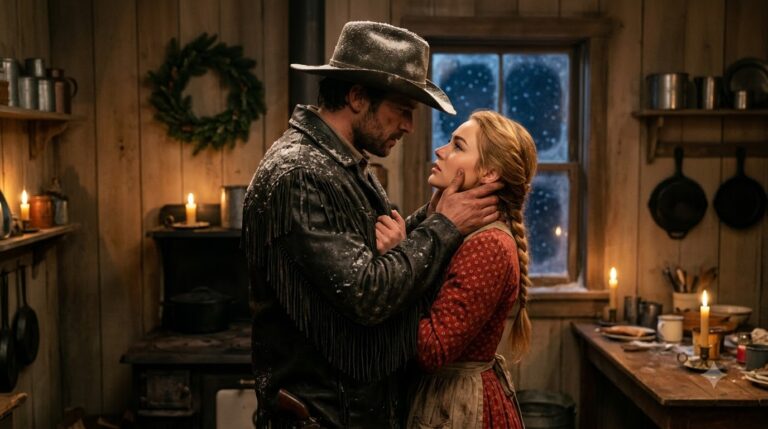
He stared.
The red-bearded rider called:
“Touching.”
Samuel turned.
Then another sound arrived.
More horses.
From the north.
Six riders.
One wore a territorial marshal’s badge.
Behind him came a thin man in a dark coat carrying a leather case.
Samuel stared.
“Prosecutor.”
Clara smiled.
“You look disappointed.”
“I was preparing something dramatic.”
“Terrible habit.”
The marshal approached.
“Samuel Carter?”
“Yes.”
“You sent this?”
The prosecutor held up one copied page.
Samuel nodded.
“Where is the original?”
“With your office if your mail works.”
The prosecutor looked toward the four freight riders.
“Names?”
Samuel gave them.
The red-bearded man stepped backward.
The marshal’s men shifted.
No gunfight followed.
That disappointed storytellers later.
Reality was paperwork backed by rifles.
The four men were detained.
Vale disappeared before arrest warrants reached his ranch.
He fled west.
For three months nobody knew where.
Then he was found in Idaho under another name.
The ledger opened investigations across three counties.
Old deeds were examined.
Judges questioned.
Sheriffs removed.
Not every crime could be proved.
Too much time had passed.
But enough remained.
The entry concerning Caleb Whitmore led investigators to an old well outside a former freight station.
Human remains were found.
A belt buckle carried his initials.
Abraham received the news without speaking.
Clara sat beside him.
Samuel stood near the door.
Abraham finally whispered:
“He didn’t leave me.”
Clara took his hand.
“No.”
Samuel looked away.
The old man cried.
Quietly.
For a brother lost twice.
Once to disappearance.
Once to truth.
The land-transfer documents were declared fraudulent.
The Whitmore property remained with Abraham.
Additional acreage that had been taken decades earlier could not all be restored because later innocent purchasers were involved.
Instead a compensation settlement came from seized Vale assets.
Enough money to repair the cabin.
Hire seasonal help.
Give Abraham choices.
Clara realized immediately what that meant for her.
Freedom.
Real freedom.
She could leave.
Travel.
Move to town.
Marry.
Or not.
For the first time, caring for her father did not require surrendering every other possibility.
That frightened her almost as much as being trapped had.
Samuel remained through winter.
Not automatically inside the house.
Clara made boundaries.
He respected them.
He took work at a ranch six miles away.
Visited evenings.
Helped Abraham.
Courted Clara openly.
Slowly.
Some nights they argued about his past.
Clara refused to make redemption easy for him.
Samuel did not ask her to.
He returned money he could trace to Vale work.
Not all of it could be traced.
He paid restitution to the rancher whose horses he had taken.
The man initially refused to see him.
Samuel returned three months later.
Then again.
Eventually the rancher accepted the money.
Not forgiveness.
Money.
Samuel understood the difference.
One spring evening, Clara found him sitting outside her cabin.
“Father says you refused supper.”
“Wasn’t hungry.”
“That has never stopped you.”
Samuel smiled faintly.
Clara sat beside him.
“What happened?”
“The rancher wrote back.”
“The one from Miles City?”
Samuel nodded.
“What did he say?”
Samuel handed her the letter.
Clara read.
Money received.
Does not restore what happened.
Do something useful with the years you have left.
That was all.
Clara folded it.
Samuel looked across the field.
“I don’t know whether men like me deserve second chances.”
Clara said:
“Deserve is a difficult word.”
He looked at her.
She continued.
“You have one anyway.”
Samuel stared.
“What you do with it is your responsibility.”
He took her hand.
“Still praying for me?”
Clara smiled.
“Less desperately.”
“That’s progress.”
She leaned against his shoulder.
“Samuel.”
“Yes?”
“Do you still think of leaving?”
He answered honestly.
“Sometimes.”
Her body stiffened.
He continued quickly.
“Not because I want to.”
“Because staying still feels dangerous.”
Clara looked up.
“Why?”
“If I build something here, I can lose it.”
She understood.
“You already lost things before you met me.”
“Yes.”
“Did running protect you?”
Samuel thought.
“No.”
Clara rested her hand against his chest.
“Then perhaps stop confusing loneliness with safety.”
He stared.
“That sounds unfairly wise.”
“I prayed a lot.”
He smiled.
Winter had ended.
Grass returned.
The cabin windows stayed open some afternoons.
Abraham regained some strength now that better food and hired help reduced the burden on Clara.
Samuel built a small shed near the pasture.
Then another.
Clara noticed he was building like someone who intended to remain.
She said nothing.
By June, townspeople had opinions.
A former Vale enforcer courting Clara Whitmore.
Some disapproved.
Others romanticized him.
Samuel hated both reactions.
He told Clara:
“They either think I’m a monster or some tragic outlaw.”
“What are you?”
“Tired.”
She laughed.
One woman in town asked Clara directly:
“How can you trust a man with that history?”
Clara answered:
“Carefully.”
The woman stared.
Clara continued:
“Trust isn’t pretending the past didn’t happen.”