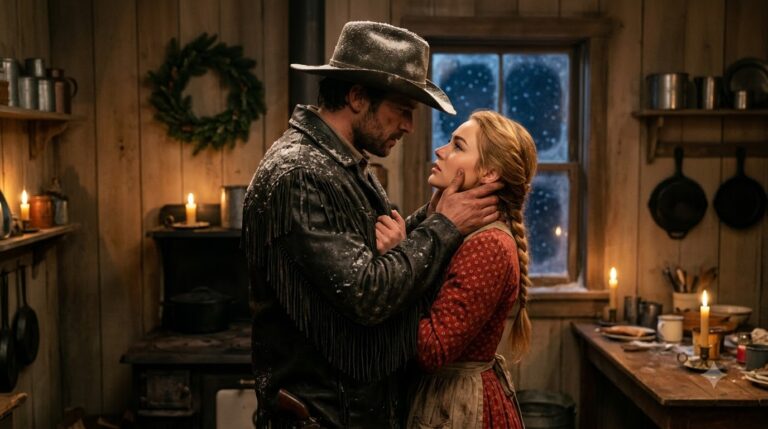
Same place.
Same cabin, expanded but recognizable.
Samuel came from the bedroom.
Stopped when he saw her.
Clara looked up.
“I couldn’t sleep.”
He smiled faintly.
“Should I pretend?”
She laughed through tears.
“Absolutely not.”
Samuel sat beside her on the floor.
They leaned against each other.
Clara whispered:
“I prayed here once because I was afraid nobody would ever love me.”
Samuel took her hand.
“I remember.”
“I know.”
“You mention it constantly.”
He smiled.
Clara looked toward the doorway where Grace slept.
“Seems foolish now.”
Samuel shook his head.
“No.”
“Why?”
“Because it was true then.”
She looked at him.
He continued.
“Fear doesn’t become foolish because life later answers it.”
Clara rested her head on his shoulder.
“You have become irritatingly wise.”
“Marriage.”
“Dangerous condition.”
They sat there until morning.
Years passed.
Samuel’s past never disappeared entirely.
People occasionally recognized him.
One man refused business.
Samuel accepted it.
Another spat near his boots in town.
Samuel walked away.
Clara wanted to confront the man.
Samuel stopped her.
“He has a right to anger.”
“Not disrespect.”
“Maybe both.”
Clara disagreed.
But she respected his choice.
He became known less for who he had been and more for what he did now.
Helped ranchers fight fraudulent liens.
Testified in land cases.
Worked with the marshal on stolen livestock recovery.
Not officially.
He refused badges.
He did not trust himself with authority easily.
The marshal once offered him a deputy position.
Samuel declined.
Clara asked why.
“Good pay.”
“Yes.”
“You’re qualified.”
“That’s the problem.”
She waited.
Samuel continued.
“I spent years learning how easy it is to enjoy being feared.”
“I don’t want a job that rewards that part of me.”
Clara kissed him.
“That may be the best reason to give you one.”
He still refused.
Grace grew.
Then came a son, Abraham Samuel.
Clara named him.
Samuel pretended outrage at the middle name.
Lost the argument instantly.
Their children learned the story of their parents in pieces.
Not the intimate prayer.
Clara threatened Samuel with death if he told that part.
He obeyed mostly.
At fourteen, Grace discovered an old letter.
Samuel’s original note:
Still alive.
Business worse than expected.
Should be back within a week.
Do not pray too loudly while I’m gone.
Grace brought it to supper.
“What does this mean?”
Clara nearly dropped her spoon.
Samuel looked delighted.
“Your mother—”
Clara pointed.
“Choose survival.”
Samuel reconsidered.
“It means your mother was religious.”
Grace stared.
“That is clearly not all.”
Abraham laughed.
Clara burned the letter later.
Samuel protested.
She did not regret it.
At fifty, Samuel’s dark hair began turning silver.
Clara noticed before him.
One morning she touched a strand near his temple.
“You’re getting old.”
Samuel looked offended.
“You first.”
“I’m younger.”
“Cruel.”
She smiled.
He pulled her into his arms.
Their physical affection never disappeared.
Changed.
Softened.
Deepened.
The urgency of early desire became familiarity without becoming dull.
Samuel still looked at Clara across rooms in ways that made her feel thirty-one again.
Clara still reached for him at night.
Sometimes desire.
Sometimes warmth.
Sometimes simply confirmation that the person beside her remained there.
At sixty, Samuel developed pain in one hip.
At sixty-three, he stopped long rides.
At sixty-five, he handed most ranch work to Abraham.
He hated it.
Clara reminded him:
“You told me once you didn’t know how to stay.”
Samuel looked around their home.
“I may have overcorrected.”
She laughed.
Grace married a schoolteacher.
Abraham married the blacksmith’s daughter.
Grandchildren arrived.
Samuel became absurdly gentle with them.
Clara enjoyed reminding him that a man once feared throughout three counties now allowed a four-year-old girl to braid ribbons into his beard.
“She has good technique.”
he defended.
“Of course.”
The old ledger eventually went into territorial archives.
Researchers later connected dozens of stolen parcels to Vale’s network.
Caleb Whitmore’s name appeared in official records as a murder victim rather than a man who abandoned his family.
That mattered to Clara.
She took her children to his grave once the remains were moved near Abraham.
Samuel stood behind them.
Clara touched the stone.
“You came home eventually.”
Wind moved through grass.
No answer.
Enough.
One autumn evening, forty years after Samuel first rode wounded into the Whitmore yard, he sat beside the fireplace.
Same room.
Different bed.
The original narrow wooden frame still stood against the wall.
Used now for grandchildren during visits.
Clara entered carrying blankets.
Samuel looked toward it.
“Remember?”
She followed his gaze.
“No.”
He smiled.
“Liar.”
Clara set down the blankets.
“You nearly bled to death on that.”
“I was fine.”
“You could barely stand.”
“Details.”
He pointed toward the table.
“And you knelt there.”
Clara stared.
“Samuel.”
“What?”
“If you repeat the prayer, I will end a forty-year marriage tonight.”