“You’re Thomas? The man from my letters?”
He said the next part to the porch boards, then made himself lift his eyes at the end of it.
“I bought this ranch last month. I meant to tell you.”
“You live right across the creek and said nothing?”
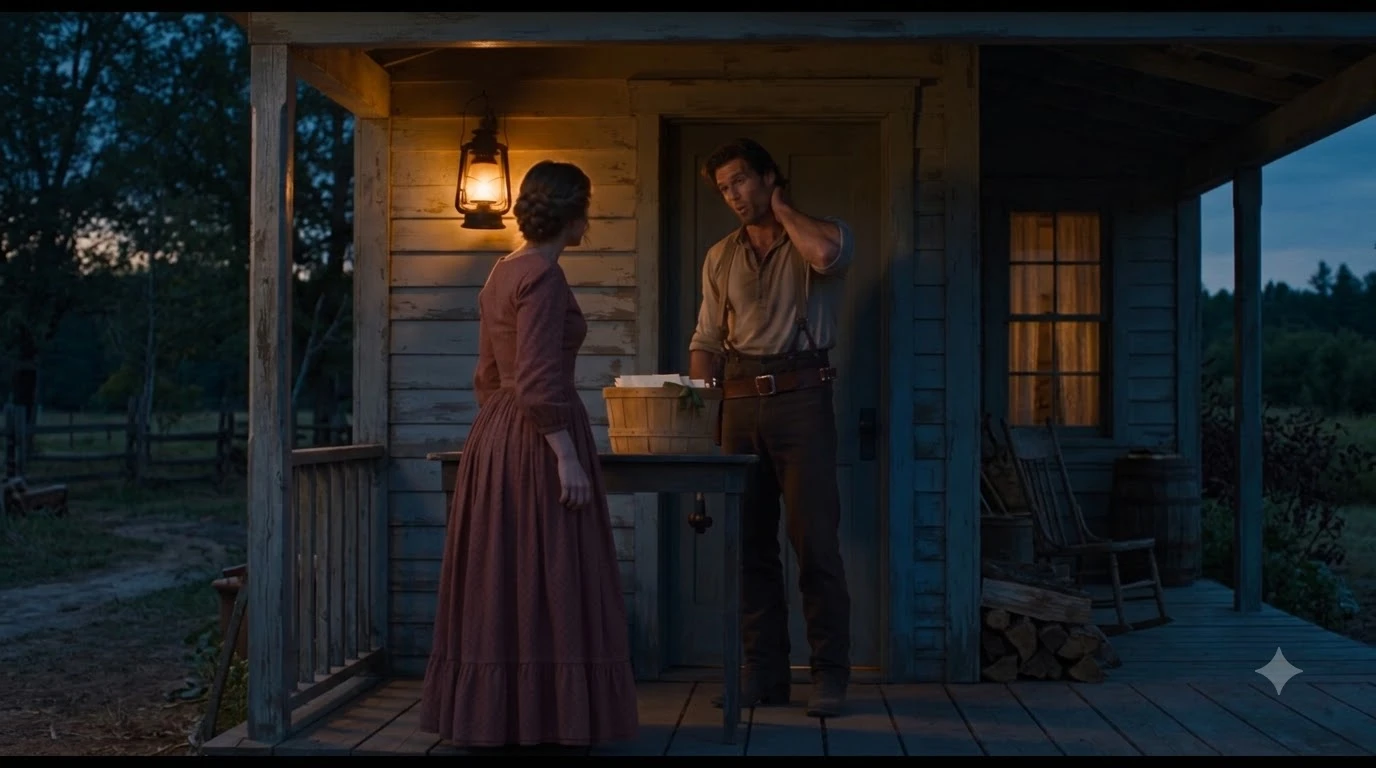
He opened his mouth and shut it again. A moth came and battered itself gently against the lantern glass between them. When he finally spoke his voice was low and rough, and it was plain that every word was costing him something.
“I was scared you’d be disappointed in person.”
Clara looked at him. She took her time about it, because it seemed to her that she had been owed this look for two and a half years. She looked at the stubborn jaw and the unhappy mouth and the dark eyes, which were kind and frightened and fixed on her as though she were a judge about to pronounce sentence. She looked at the shoulders and the rest of him and the tool belt, and she felt the color come up in her own face, warm as oven heat.
“Trust me, I am not disappointed.”
Something went through him like a wind through wheat. He seemed suddenly to remember the state of his person. He snatched a blue work shirt off the porch rail and yanked it on, missing the sleeve once, and did up the buttons so fast that he started on the wrong one and ended a hole short, so that the whole front of him hung crooked, one side of the collar up by his ear.
“Is that the apple pie you wrote about?”
Clara climbed the steps. She did not decide to; her feet simply did it. She stopped in front of him, close enough to smell sawdust and sweat and creek water, and she reached up and undid the top button, which was in the wrong place entirely, and did it up again where it belonged. Her fingers were steadier than she expected. His breath was not.
“Invite me inside and you’ll find out.”
He looked down at her as though she had handed him something breakable and precious and he was afraid to close his fingers on it. Then he reached past her and opened the door, and the warm yellow light of the house spilled out over both of them, and as she stepped across the threshold he bent his head and kissed her cheek, quick and shy and careful, the way a man might touch a bird’s egg.
“You’re even better than your letters.”
II.
It had begun, as a great many good things in the West began, with a complaint.
In the spring of 1882, eleven months after Walter Pruett had coughed his way out of the world in the hard February of the year before, Clara had ordered twelve apple trees from a catalogue. The catalogue belonged to Opal Fenwick at the Mercantile, who kept it under the counter beside the ledger and the jar of horehound drops, and it was called *The Kittredge Nursery & Orchard Company of St. Joseph, Missouri: Fruit Trees, Ornamentals & Small Fruits Shipped Safely to All Points West*. On the cover was an engraving of a woman in a straw hat holding up an apple the size of her own head and smiling about it in a way Clara found personally encouraging.
Walter had always meant to plant an orchard. He had meant a great many things. He had been a cheerful, freckled, big-hearted man, and he had brought her out from Zanesville to Wyoming Territory in 1876 on the strength of a homestead claim, a borrowed wagon, and a theory that the soil along Sweetbrier Creek would grow anything a person cared to put in it. He had dug a ditch from the creek to the bottomland with his own two hands and a mule named Phineas, and he had named the ditch after her, the Clara Ditch, and carved the name into the headgate board with his pocketknife, crooked and proud, and the year beneath it: CLARA DITCH 1877. He had quarreled with old Ezra Doane across the water about where the headgate ought to sit, and lost his temper, and won the argument anyhow by refusing to stop talking. He had been going to plant apples, and cherries, and a row of plums along the lane. Then the winter came and the cough came with it, and in the end there was a grave on the little knoll behind the house and a widow of twenty-eight with a ditch named after her and nothing growing at the end of it but alfalfa and grief.
So she ordered the trees. She paid for them with pie money, which was the only money she had of her own: every week she baked eight or ten pies and drove them into Halloway to sell at the Mercantile and the Railroad House hotel, and the miners and drummers and cowhands bought them faster than she could carry them in. Twelve trees cost her two months of pies. They came on the Union Pacific to Halloway Station in a long box packed with damp moss, and she drove them home and opened the box on her kitchen table with the reverence of a woman opening a Bible, and every single one of them was dead.











