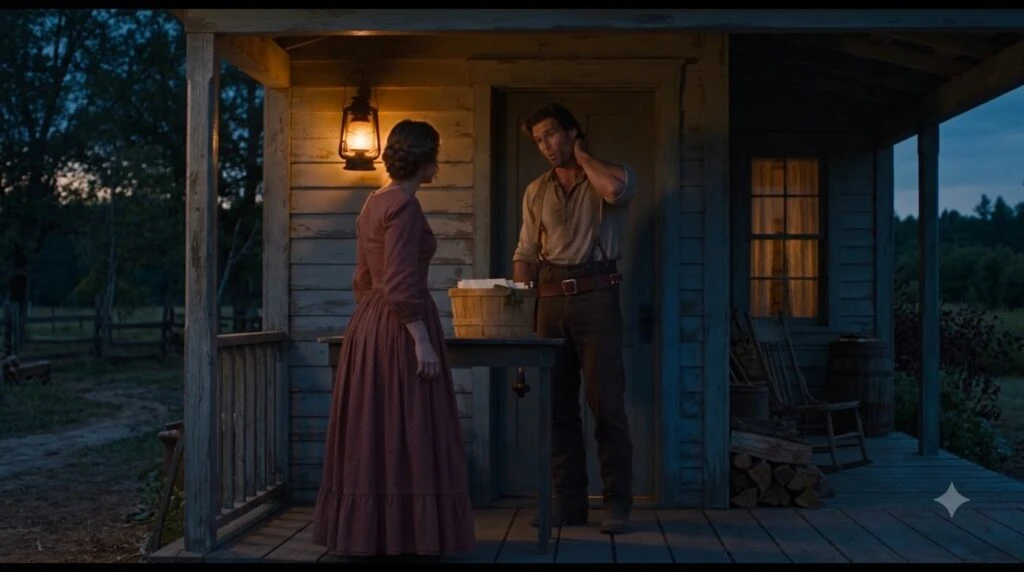
The dusk came down blue over Sweetbrier Creek the way it always did in late September, first in the cottonwoods and then in the water and then everywhere at once, until the whole valley looked as if it had been dipped in a basin of cool ink. Clara Pruett carried the pie across the stepping stones with both hands and her skirt hitched up in a manner no lady in Ohio would have approved of, and she did not care, because the pie was still warm and the stones were slick and the new neighbor had been the new neighbor for a full month now without anybody on her side of the creek having laid eyes on him closer than a quarter mile.
She had seen him from a distance. Everyone had. He was tall, he was broad, he chopped wood in the mornings with the steady unhurried swing of a man who had never once in his life been in a hurry, and on warm afternoons he did it with his shirt hung over a fence rail, which was the sort of thing a widow of thirty-one noticed only in the most general and neighborly way. She had brought him a pie twice already. Both times she had found the house shut and the mule grazing and a hammer lying on a sawhorse as though its owner had evaporated mid-swing. Both times she had carried the pie home again and eaten a good deal of it herself, out of spite.
This was the third pie. Third pies, in Clara’s experience, were not to be wasted.
The Doane house sat on a little rise above the creek, a square log-and-plank place with a deep porch along its front and a stone chimney leaning companionably against one end. Old Ezra Doane had let it go gray and sullen in his last years. Now the porch steps were new yellow pine, raw and sweet-smelling, and somebody had rehung the front door so it no longer sagged like a tired mouth. A lantern burned on a nail beside it. Its light lay in a warm puddle across the boards, and in the middle of that puddle, as if it had been set there on purpose for her to find, was a wooden crate.
Clara stopped at the foot of the steps.
The crate had once held tinned peaches; the label was still on the side. Now it held letters, a great many of them, stacked in neat bundles and tied, every bundle, with a length of green silk ribbon. She knew that ribbon. She had bought six yards of it at Fenwick’s Mercantile in the spring of 1882 for a dress she never made, and for two and a half years she had been snipping it off in hand-lengths to tie around every letter she sent east, because it had seemed a small extravagance that cost nothing anybody could see, and because a woman alone needed one or two of those.
She knew the handwriting on the top envelope as well. It was hers.
Behind her the creek talked to itself. Somewhere in the house a board creaked, and then the side of the porch creaked, and around the corner of it came the new neighbor, carrying a pry bar in one hand and a lantern in the other, with a leather tool belt slung low on his hips and nothing at all above it but a good deal of sun-bronzed man.
He was taller up close. His hair was dark brown and stood up in several directions as if he had been running his fingers through it in despair, and his jaw was rough with three or four days of stubble, and his chest and shoulders had the deep, even color of somebody who had worked out of doors every summer of his life. He saw her. He saw the pie. He saw where she was looking. And every bit of that bronze went red from the collarbone up.
Clara set the pie down on the top step very carefully, because her hands had begun to shake, and pointed at the crate.
“Those are my letters! Why are they on your porch?”
He set the lantern down. He set the pry bar down. He looked at the letters and then at her, and he seemed to arrive at the conclusion that there was no road out of this but straight through it.
“Because I’m the man who’s been writing back.”
For a moment Clara could not have said what she felt. It was as if somebody had opened every window in a shut house at once and the wind had come through and blown all the papers off the table. She looked at his hands, which were large and scarred across the knuckles and stained faintly green at the fingertips, and she thought of a line from a letter she knew by heart: *I have been grafting all week and my hands are the color of a frog’s opinion.*











