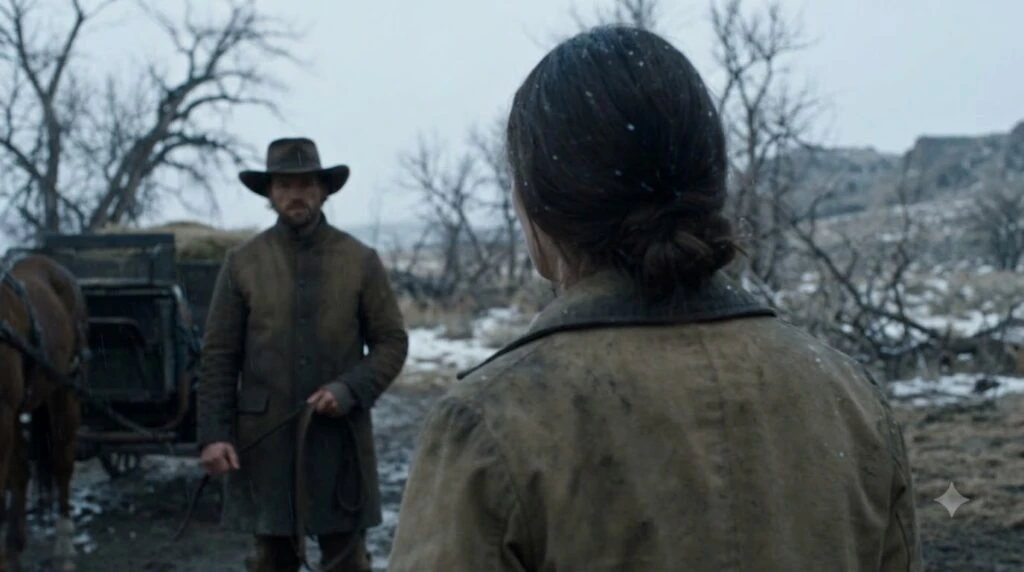
Lord, send someone to fix this roof before snow. Willa Prior said it very quietly to no one. With both hands locked around the rails of a ladder and her forehead almost touching the rung, she added one thing more, softer than the first, and did not say amen. She did not know that 30 ft behind her, at the edge of her yard, a tall man stood holding the heads of two wet mules, and that he had heard every word. It was the 1st of October, 1883, and the sleet had started an hour before dark.
Ezra Colton had not meant to stop anywhere. He was driving a wagon down the foothill road toward the railhead at Loveland with a wagon stacked high with baled hay and a tarp that was already letting the weather in. The mules were tired, and the road was turning to glue. And when a sagging gate came up on his left with a barn behind it, he turned in without really deciding to. A barn meant a dry corner and an hour of rest for the animals.
He would ask first. He always asked first. The place looked like something once loved with great care and now held together with wire. The house was a low log-and-board cabin with a porch across the front, a stone chimney, and a split pine lintel over the door with letters cut into it by a patient hand. Behind it, on a gentle slope, stood an orchard of perhaps 200 apple trees in tidy rows, so heavy with fruit, that the lower branches were propped on forked sticks.
Half the apples lay in the grass, bruising in the cold. The roof was the trouble. The north slope dipped in the middle like a swaybacked horse. Someone had patched it with tar paper and flattened coffee tins, and a few boards that did not match, and the whole mended surface was shining black with sleet. From somewhere inside the house, steadily came the sound of water dripping into buckets.
And the woman on the ladder had not seen him yet. She was somewhere in her middle 30s, thin and straight-backed in a man’s canvas coat, too big for her, and a gray wool skirt hitched up to the boot. Her right wrist was wrapped in a strip of flannel, and she held that hand a little away from the ladder as she came down, rung by rung, like someone favoring a sore tooth. She stepped off the bottom rung and stood with her face to the sky and her eyes closed. That was when she said it.
Ezra stood very still. He had grown up in a house where prayer was a private room, and he did not walk into private rooms. She had opened her eyes and turned, and in the gray light, her face changed so fast he could have counted the stages. Surprise, embarrassment, suspicion, and then last, a plain and steely politeness. This is private land, she said.
Yes, ma’am. He took off his hat. I’m Ezra Colton. I’m hauling hay to Loveland, and the road’s gone to mud. I wondered if I might put my mules under your barn roof for the night.
I’ll sleep in the wagon. There’s a public house at Pine Fork, four miles. My mules won’t make four. She looked at the mules. She looked at his boots, which were caked to the ankle, and at his wagon with its sagging tarp.
Then she looked at her own roof, and her mouth tightened. “The barn doesn’t leak,” she said. “I’d be obliged if you didn’t go in the house.”
“I wouldn’t.”
“Nobody puts stock in my barn for free, Mr. Colton. A dime a night for the mules. Ten cents. You can leave it on the post.”
He nearly smiled. She said it so fiercely with her chin up that it would have been an insult. A dime’s fair, he said. Then it settled.
She turned and walked up the porch steps with her back straight under the carved lintel. She paused with her hand on the door. He could read the letters from where he stood, cut deep and square into the weathered pine. Except the Lord build the house. Willa Prior looked at the words for a moment, the way a person looks at a debt.
Then she went in and shut the door. Ezra led the mules to the barn. It was a good barn, tight and swept, with a harness room and a row of stalls kept as neatly as a church pew. At the back, under a canvas tarp lashed down with rope, lay a long stack of pine bolts, each one the length of a man’s arm, split once, and stacked with air between them to season. Those bolts had been cut and stacked by someone who knew exactly what he meant to do with them.











