They were shake wood. Someone had meant to re-roof that house. Someone had cut the wood to do it and then had not. But he unharnessed the mules and rubbed them down and gave them hay. He climbed into the wagon bed with his blanket and his supper of cold biscuit.
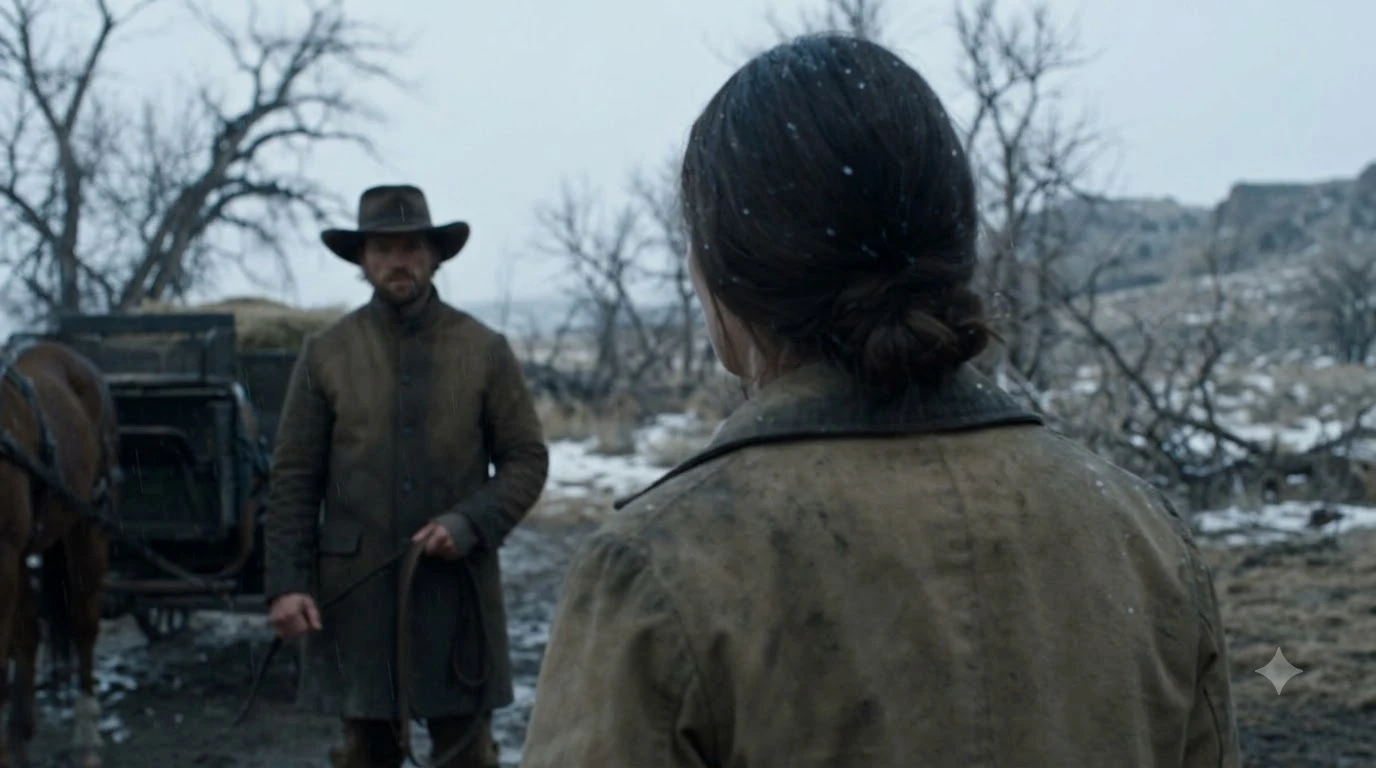
Through the gap in the barn door, he could see the lit window of the cabin and a thin figure crossing it once, twice, with a bucket in each hand, emptying them out the back door into the sleet. He had not been asked for anything. He told himself so as he lay awake, listening to the water. But he had heard the prayer, and long after the last light went out, he found that he was still hearing it. Morning came up hard and clean with ice on the puddles and the first sun lying along the orchard rows.
Ezra put his dime in the twist of paper she had tied to the gate post. She came out of the house with a coffee pot in her good hand and two tin cups hooked over her fingers. She put the pot on the porch rail and did not offer him a cup. She put it where he could see it and looked at the barn and then at him. The dime wasn’t a gift either, she said.
“I know. I thought you might want to count it.”
“I counted it.” She poured one cup and set it on the rail and stepped back from it. That was her answer to hospitality and he understood that it cost her something.
He took the coffee and drank it standing in the yard. “Those are shake bolts under the tarp,” he said. “Pine, properly seasoned. That’s a fine stack.” Her face went still.
“They were my father’s. He cut them for the roof. He cut them for a number of things. He was a man of plans.” She came down the steps and crossed to the barn, and he followed a pace behind.
In the half-light by the tarp, she stood looking at the long stack. “I can split my own shakes, Mr. Colton. I’ve watched it done for thirty years. I’ve got the tools.”
She did. A froe hung on a nail by the harness room door with a heavy wooden mallet below it and a shaving horse in the corner. Dusty as if the dust had gone unbroken for a season. She took the froe down with her good hand and set a bolt on the block. She held it with her bad one.
The first blow of the mallet was clean. The second slid and the shake peeled off crooked and thin at one end like a bad slice of bread. She frowned. She tried again. Her wrapped wrist jerked at the shock and she caught her breath through her teeth and set the mallet down for a moment very carefully as though it were something that might break.
“Grain’s running out at the tail,” Ezra said mildly. “If you turn the bolt end for end, the split follows the tree instead of fighting it.” She stood for a moment, the muscle tight in her jaw. Then she turned the bolt end for end. The next shake came away whole.
A clean, straight board as long as her forearm. Its face rippled like water. “That’s what I’d have done,” she said stiffly.
“Yes, ma’am.”
“I was about to.”
“Yes, ma’am.” Something happened at the corner of her mouth. It was not a smile.
It was the place where one might have been, and she put it away at once. “How many shakes does it take to roof that north slope?” he asked.
“Three hundred more. The whole roof is closer to six hundred.” She set the froe down. “I have the bolts for about five hundred. It takes a man a week to split and lay it.”
A man who knows how. I’ve had two come and quote me. One wanted $22 and the other would not climb the ladder after he looked at it.
Her eyes flicked away and came back. I have $6 and some cents and apples. A good many apples. two hundred trees. My father put every one of them in.
Nobody can pick them because I can’t pick and press at the same time, and the frost will have them by Sunday. Her voice had gone flat in the way of someone reciting a list she has recited to herself in the dark. Nobody here buys what I can’t deliver. I’ve got a wagon and two days slack, he said instead, as if thinking aloud. My hay buyer in Loveland doesn’t care which day it comes so long as it’s there by the twelfth and I’m tired of eating cold biscuit.











