Emily knew the voice before she turned. She would have known it underwater. She had known it since it was a newborn’s voice, a thin furious wail coming through the wall of their mother’s bedroom in the old house in Belfast when Emily was five years old and had been told that a sister was a kind of present.
She turned.
“Why are you here?”
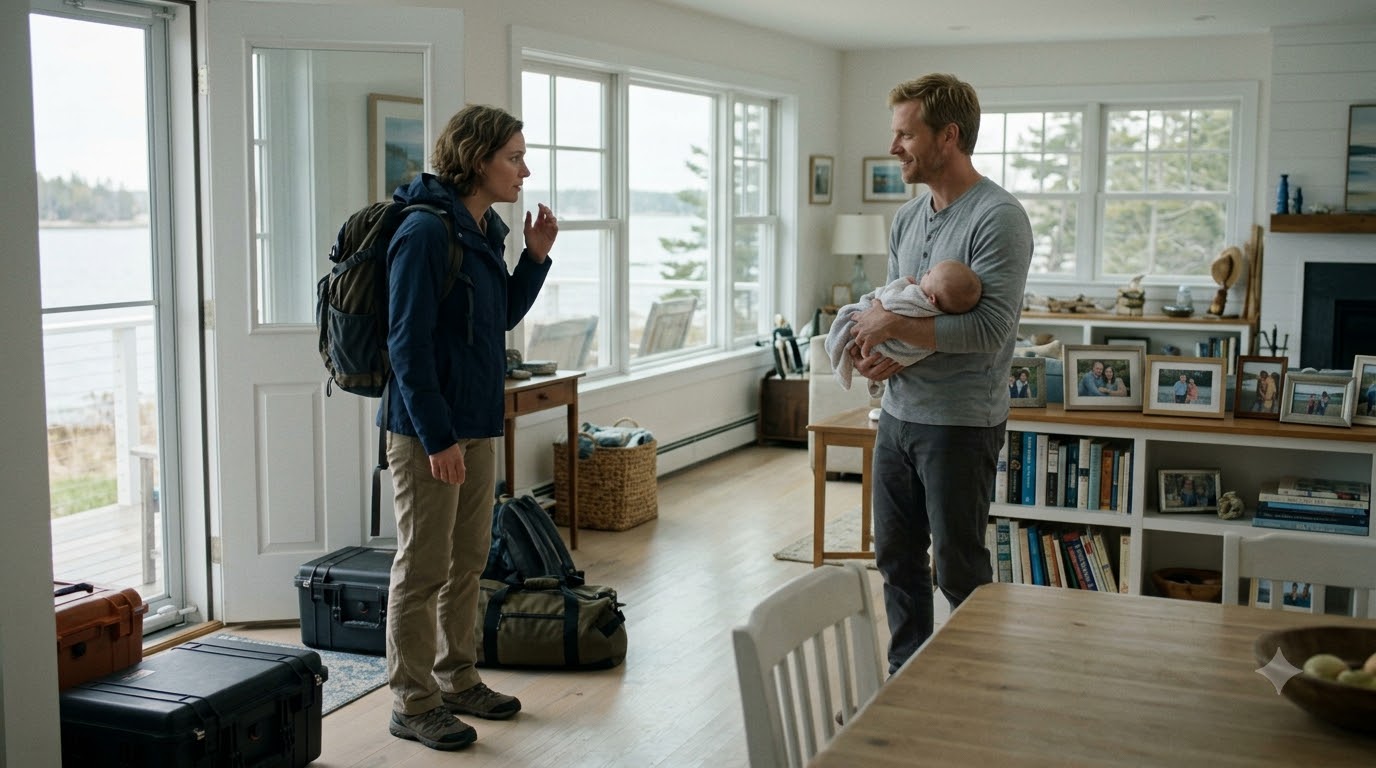
Nora stood in the doorway between the hall and the kitchen. She was thirty now, and she looked, for a dislocating second, much younger, because her face was blotched and swollen, her eyes red-rimmed and glassy in the way they had been when she was a girl and had cried herself out and still couldn’t stop. Her long red-brown hair was pulled back in a knot that had mostly come down. She was wearing one of David’s old flannel shirts over leggings, and her feet were bare on Emily’s floor. In one hand she held a baby bottle, filled, a bead of milk at the nipple. In the other, pressed flat against her stomach as if to keep it from blowing away, she held a long manila envelope. Emily could see the printed return address in the corner, the blue seal of the State of Maine, and the words DISTRICT COURT, and a strip of red tape across the flap where it had never been opened.
Nora Harlow. Emily had been a Harlow too, for twenty-four years, before she had been a Marsh. They had the same chin, people always said, the same stubborn Harlow chin, and right now Nora’s was trembling.
Nora looked at Emily, and then past her at David and the baby, and then at the bottle in her own hand as if she had forgotten she was holding it. She lifted the envelope a few inches. It was a small gesture, almost helpless.
“Because of her.”
Emily looked from her sister to her husband to the baby. Her sister barefoot in her kitchen. Her husband in his gray shirt, with his practiced elbow. Her sister’s eyes red from crying. The envelope. The bottle. A year. A year, and all those thin, compressed emails across the satellite link, the twice-monthly phone calls with a two-second delay that made everything they said to each other sound like a question. Nora’s messages, bright and short. Work is fine. The apartment’s fine. Rockland’s fine. I miss you. Send me a whale.
The room tilted slightly, the way the deck of the Halcyon had tilted in the long swells below fifty degrees south, a slow lean that the inner ear argued with.
“What is going on?”
No one answered at first. The lobster boat’s engine came across the water, rose, fell away. The baby made her creaking sound again, louder, and turned her mouth against David’s shirt, searching. Nora took a step forward, then stopped, holding the bottle out a little, uncertain, toward David, toward the baby, as if asking permission. David nodded to her, barely. Emily saw the nod. It went into her like a splinter.
David looked at Emily over the baby’s head. His eyes were wet. He did not look away from her, and later she would give him that, that he did not look away.
“We had to make a decision while you were gone.”
We. Emily heard the word and her mind, which had been trained for fifteen years to find patterns in noise, to pull a whale’s song out of the roar of an ice shelf calving forty miles away, began to assemble the pattern before she wanted it to. We. Her husband and her sister. A baby. A year.
Her eyes went back to the envelope against Nora’s stomach. Nora had shifted it when she moved, and now the front of it faced the room, and through the clear plastic window Emily could read the first lines of the document inside. Her own street address. David’s name, typed in capitals. A docket number. And beneath that, in bold type, two words she knew from no part of her own life.
“Why does that say temporary custody?”
*
Nobody spoke. The baby began, in earnest, to cry.
It was a thin, rising, outraged sound, and it filled the bright room the way a gull’s cry fills a harbor, and both David and Nora moved toward it at once, and then both stopped, and then Nora came the rest of the way and David turned the baby in his arms so that Nora could get the bottle to her. They did it without speaking, a two-person maneuver performed so smoothly that Emily understood they had done it a hundred times. The crying stopped mid-breath. In the silence afterward she could hear the baby swallowing, small wet greedy sounds.
Emily’s hands had begun to shake. She put them in the pockets of her jacket.











