“You’re really home.”
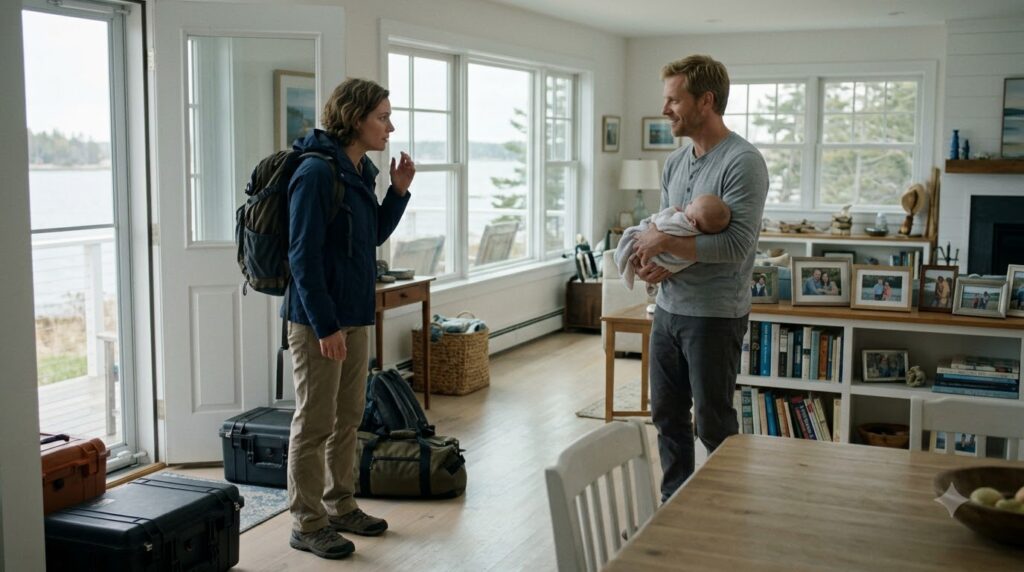
David said it from the far side of the living room, where the big windows ran floor to ceiling and the afternoon came in off the water as if it had been poured. He did not cross the room. He stood very still with the light behind him, and for a moment Emily could not see his face well enough to read it, only the shape of him: the sandy hair grown longer than she had ever seen it, the gray henley she had bought him three Christmases ago, its sleeves pushed to the elbow. His arms were curved in front of his chest in a way she did not understand.
She had let herself in with her own key. That was the first thing she would remember later, how ordinary it had been. She had paid him and dragged her three expedition cases up the granite steps one at a time, the hard black Pelican cases with their stenciled white letters, R/V HALCYON, SOUTHERN OCEAN ACOUSTIC SURVEY, and the duffel with a year of salt in its seams. She had stood on the porch for a full minute, smelling the low-tide smell of the cove and the cold edge of October in the spruce, and she had thought, I am going to surprise him. She had thought, I am going to watch his face.
The ship had lost a main engine bearing south of Tasmania, and the last leg of the survey had been scrubbed. They had limped into Hobart nine days early. She had not called. She had wanted, for once in her careful life, to walk through a door unannounced and be wanted on sight.
Now the cases stood just inside the door where she had dropped them, three black slabs on the pine floor, and she still had her navy weatherproof jacket zipped to the chin, and her short hair, which had grown into loose brown waves she kept forgetting about, was stiff with the wind off the water. The house was very quiet. It smelled of coffee and of something else, something faintly sweet and powdery that she did not recognize.
And David’s arms were curved because there was a baby in them.
It was small and swaddled in a cream-colored blanket with a pattern of tiny blue boats, and its head, under a knit cap, was turned against his chest. One hand had worked free and lay open on the gray cotton of his shirt, the fingers moving slightly, the way sea anemones moved in a tide pool. Emily looked at the hand. She looked at it for what felt like a long time.
“Who is she?”
She did not know why she said she. Something about the blanket, maybe, or the way David held her, which was the way you held a thing you had held many times before, a thing whose weight you knew. He did not hold her like a man who had been handed a neighbor’s child and asked to wait. He held her like someone with a practiced elbow. The baby’s head fit into the crook of it exactly.
David took one step toward her and then stopped, as if the floor between them were thin ice.
“Emily, listen before you panic.”
His voice was low and level, the voice he used on the phone with the boatyard when a hull had cracked in a cradle and someone was going to lose money. She knew that voice. She had married that voice. It frightened her more than shouting would have.
She stayed where she was, by the cases. Through the windows behind him the cove was bright and flat, the tide halfway out, the dark weed lying on the ledges like wet hair. A lobster boat was working the far side of the island, its engine note coming and going on the wind. Everything was exactly where she had left it, and none of it was.
“She’s a baby, David.”
It came out flat and stupid, a fact read off a page. She heard how it sounded. She did not take it back. The baby, as if she had heard her name spoken, which she had not, made a small creaking sound and turned her face farther into David’s chest, and David’s free hand came up automatically to cup the back of her head, and his body began, without his seeming to notice, a slow side-to-side sway. Emily watched him sway. In twelve years together she had seen him do a great many things with his hands. She had never seen him do that.
Somewhere behind her, from the direction of the kitchen, came the soft suck of the refrigerator door closing and then footsteps on the floorboards, quick and light, stopping short.
“You weren’t supposed to be back until next week.”











