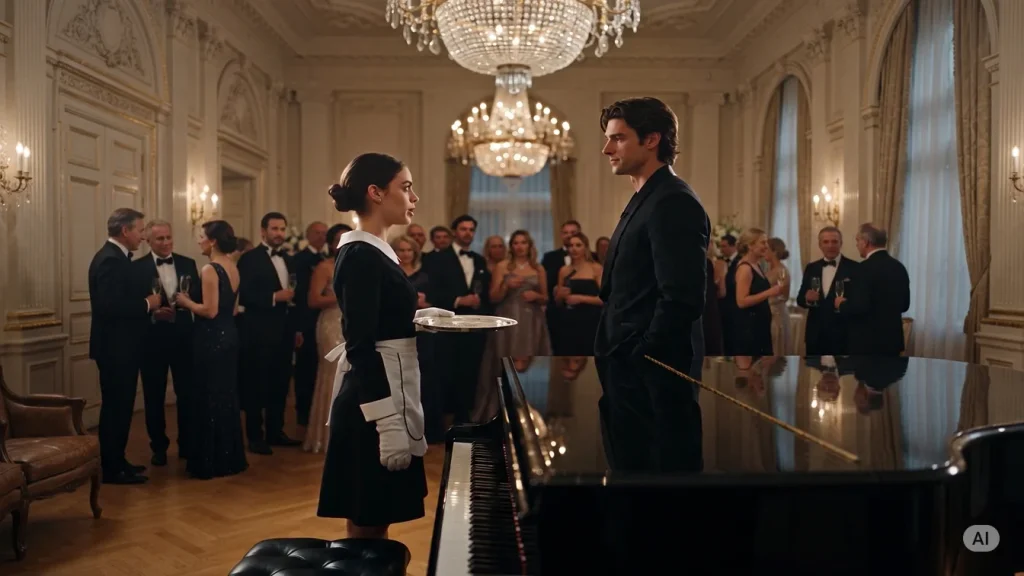
The first time Elena Hart touched the Moretti grand piano, she was wearing a maid’s uniform and had exactly three hundred dollars in her checking account.
She knew the figure to the dollar because she had checked it on the bus that morning, standing in the aisle with her phone held close to her chest, the way a person checks a wound to see whether it has stopped bleeding. Three hundred dollars. The electricity bill folded in her handbag said one hundred and eighty-four of those were already spoken for, and the rent, which nobody had sent a bill for because nobody needed to, said the rest of it was spoken for too.
The instrument stood beneath a chandelier worth more than her mother’s house. It was nine feet of black lacquer on three curved legs, older than anyone in the room, and its surface held the whole ballroom upside down: the candles, the silk, the white jackets of the waiters, the guests who had come to the charity gala at Serafina House to be seen giving money. Elena had polished its lid that morning with a soft cloth and a bottle of something that smelled faintly of lemons. She had worked slowly, because Mrs. Alvarez had told her the piano was the one thing in the house nobody was allowed to hurry around. She had not imagined she would be invited to open it.
By nine o’clock the room was warm with perfume and money. Elena moved through it with a silver tray balanced on her left palm and her face arranged into the expression the job required, which was no expression at all. She was twenty-three, slim, with straight dark brown hair pinned into a knot at the back of her neck, a narrow face, and gray eyes that people sometimes called cold until they saw her laugh. The uniform was black with a white collar. The white cotton gloves were a size too large and wrinkled at the knuckles.
“Another glass, Miss Russo?” she asked.
Vivienne Russo turned in a gown the color of spilled wine. She was about thirty, tall, with honey-blond hair swept over one bare shoulder and a face so carefully made up that it looked painted on porcelain. Her diamond necklace caught the light as she studied Elena’s face, then the white gloves on her hands. Something in her look sharpened, the way a cat’s attention sharpens on a moving thread.
“Tell me something,” Vivienne said loudly. “Do you know how to play that piano?”
Nearby conversations quieted. Elena felt the attention move toward her like a cold draft through an opened door. A man with a silver beard lowered his glass halfway to his mouth. Two women in matching pearls turned their whole bodies toward her, as if a show had started.
“A little,” she answered.
It was the truth, and also the smallest possible version of it.
Vivienne laughed. It was a bright, practiced laugh, the kind that had been trained at dinner parties. “Girls like you were born to clean the piano, not touch its keys.”
A few guests smiled because Vivienne was Lorenzo Russo’s daughter, and in this room her cruelty carried the protection of money. Lorenzo chaired the Moretti Foundation, which owned Serafina House, which owned the piano, the chandelier and, for the length of a shift, the girl holding the tray. Everyone knew it. Even the girl knew it.
Elena set her tray down carefully on the edge of a side table, beside an arrangement of white lilies. She had spent years teaching herself how not to respond when people confused employment with ownership. She had learned it at a coffee counter at sixteen and at a hotel laundry at nineteen and in a dozen kitchens since. Her mother used to say that dignity was not something anyone could hand you. It was what remained when they tried to take everything else.
“Miss Russo,” Elena said, “I have work to do.”
“Not yet. Play something. Entertain us.” Vivienne lifted one finger, as though calling a waiter, which in a sense she was.
“I’d rather not.”
“I didn’t ask what you’d rather.”
Somebody chuckled. Elena felt heat climb up the back of her neck and kept it off her face by force. She was already counting exits. She was already composing the apology she would give Mrs. Alvarez in the kitchen.
From the far end of the room came a man’s voice. “If she plays without a single mistake, I’ll marry her.”
Silence snapped across the ballroom.
Dante Moretti rose from his chair. He had been sitting alone at a round table near the terrace doors, his back to the night, a glass of water untouched in front of him. Tall, broad-shouldered, with dark hair cut short and going gray at the temples, a hard, square jaw and deep-set brown eyes, he wore a charcoal suit without a tie, and the edge of a tattoo was visible above his collar, dark lines that disappeared beneath the cloth. He looked like the kind of man who never needed to repeat an instruction. He was forty-four, and he had looked forty-four since he was thirty.











