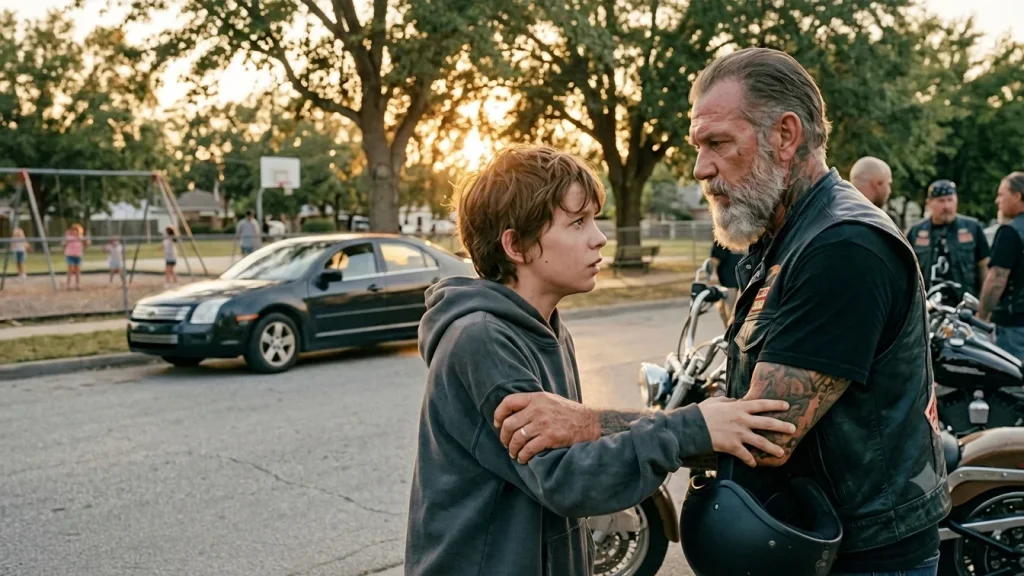
The black sedan had been parked beside the playground for 47 minutes, and nobody noticed but the boy who had learned to survive by noticing everything. eleven-year-old Leo Mercer stood in the heat shimmer of a Bakersfield afternoon, stomach hollow, shoes held together with electrical tape, watching the men inside that car, the way prey watches a snake still calculating, measuring the distance between itself and death. He’d seen a car like that before on a different street in a different city on the last night he ever saw his little sister. Now the sedan’s engine idled just enough to keep the air conditioning running. The windows were tinted dark and a little girl in a yellow dress was pumping her legs on a swing set 20 yards away, laughing at the sky with no idea at all.
The heat in Bakersfield in July was not the kind of heat that made people poetic. It was the kind that cracked asphalt, drove dogs indoors, and made the air above the parking lots ripple like something alive and hostile. By 2:30 in the afternoon, the smart people were inside. The dumb ones and the desperate ones were still out. Leo Mercer was both.
He’d been behind the food stand for 20 minutes. A battered hot dog cart operated by a man named Curtis, who’d stopped asking questions after the third time Leo showed up, looking like something the street had chewed and spat out. Curtis let him stand in the shade and pretended not to see him pocket a stale bun when he thought no one was looking. It was the closest thing to charity Leo had accepted in 4 months without running afterward. He was watching the black sedan.
He didn’t know why at first. Survival instinct didn’t always announce itself. It just grabbed you by the back of the neck the way a mother cat grabs a kitten. Sudden and insistent. And you either listened or you ended up in a ditch somewhere wondering what you’d missed.
Something about the car bothered him. The way it was parked close enough to the playground to have a clean sight line to every exit, far enough from the street cameras mounted on the traffic light that the angle would make license plate recognition difficult. Leo knew about angles and cameras and sight lines the way other 11-year-olds knew about video games and soccer practice. Necessity was a brutal teacher. The girl in the yellow dress had been on the swings for about 15 minutes.
She was maybe seven, maybe eight, red sneakers, hair in two braids tied with white ribbons. She was alone on that side of the playground. Her mother was visible near the benches on the far end, talking on a phone, back half turned. The distance between them was not large. It was, however, exactly large enough.
Leo’s throat went dry in a way that had nothing to do with the heat. He thought about his sister, about Maya, about a parking lot in Fresno 2 years ago and a gray van and the sound of his own screaming that nobody came to help with because they all assumed it was something else. A kid throwing a tantrum, a family argument, nothing to get involved in. He’d been 9 years old, screaming his sister’s name until his voice broke, and not one single adult in that parking lot had walked toward him instead of away. He pushed that memory back down where it lived, behind his sternum, in the locked box he only opened when he needed to remember why he trusted absolutely no one.
The sedan’s engine was still running. Leo counted, 47 minutes. He’d been tracking it since he arrived. Normal people, normal cars, didn’t idle in a parking lot beside a public playground for 47 minutes in 100° heat unless they were waiting for something specific. Normal people didn’t park at that angle.
Normal people didn’t keep their windows up in this heat unless they didn’t want anyone to see inside. He looked around for a cop. There was a traffic unit two blocks east. He’d clocked it on his way here, but it was gone now. He looked for anyone with a phone out, anyone else paying attention to the car.
There was a woman with a stroller near the path, scrolling through something, a pair of old men playing chess under a tree, 20 yards past the playground fence, a delivery driver wrestling with a hand truck outside the bodega across the street. Nobody was watching the sedan. Nobody but Leo. He thought about walking up to the woman with the stroller. He thought about it for about 4 seconds, which was enough time to run the full calculation.
He was an eleven-year-old boy, visibly homeless, wearing shoes held together with electrical tape and a t-shirt with a tear across the shoulder. His hair hadn’t been properly cut in months. His left eye still had a faint yellow-green shadow under it from where a man in a shelter 3 weeks ago had shoved him into a door frame for looking at something that wasn’t his. If he walked up to a strange woman in a park and told her there was a suspicious car, one of two things would happen.











