The room had been dared to look. It had not yet been given a sound.
The morning had started in a kitchen that smelled like old coffee and the wool of a coat drying on a chair.
Claire’s apartment was a third-floor walk-up in Albany Park, above a tailor who played a radio so softly it might have been a memory of a radio. The piano against the inner wall was an upright with a scar on its cheek where a previous tenant had clipped it with a door. One key, the E above middle C, stuck when the weather forgot what it had decided about damp. She had learned to lift it with a fingernail before she trusted a phrase. On the music rack sat a paperback Brahms, the spine taped, and a notebook she did not open in the mornings because mornings were for the other life.
She drank the coffee standing up. Her uniform hung on the back of the bedroom door, pressed the night before with a care she pretended was only professional. Through the window the el tracks drew a dark line across a sky the color of tin. A neighbor’s shower ran. Mrs. Kim downstairs would already be awake, and Claire did not play. She had made that bargain years ago without signing anything: before noon the apartment was a place a person slept and ate, not a place a person filled with evidence.
On the table, beside the mug, lay a grocery receipt and a letter from the building about a boiler inspection. No music. She liked it that way until she didn’t. Some mornings the not-playing felt like wisdom. Some mornings it felt like a scar she kept checking to see if it still had a job.
She rinsed the mug. She twisted her hair into the low bun in the bathroom mirror and pinned it until it agreed. Hazel eyes looked back, and she told them, without drama, the list: six tables if Andre was in, eight if he wasn’t; the duck; the allergy at fourteen; do not let the new busser stack the hot plates against the cold ones. She did not put the piano on the list. The piano was not scheduled.
The train was crowded with Saturday errands. She stood and watched her reflection slide over brick and backyards. At the restaurant door, before the elegance began, there was a narrower door for staff and a stair that smelled like lemon cleaner and the ghost of stock. She changed nothing about her face on the way up. Changing your face in a stairwell was how you arrived already tired.
Martin Hale was at the pass with a pencil behind his ear, sixty, precise, a man who believed a room could be kept from harm if the names were said correctly.
“Patrick’s out,” he said. “Fever. Don’t let guests migrate to the bench. If anyone asks, the piano is resting, which is a sentence I would like you to deliver without irony.”
“I can do without irony,” Claire said.
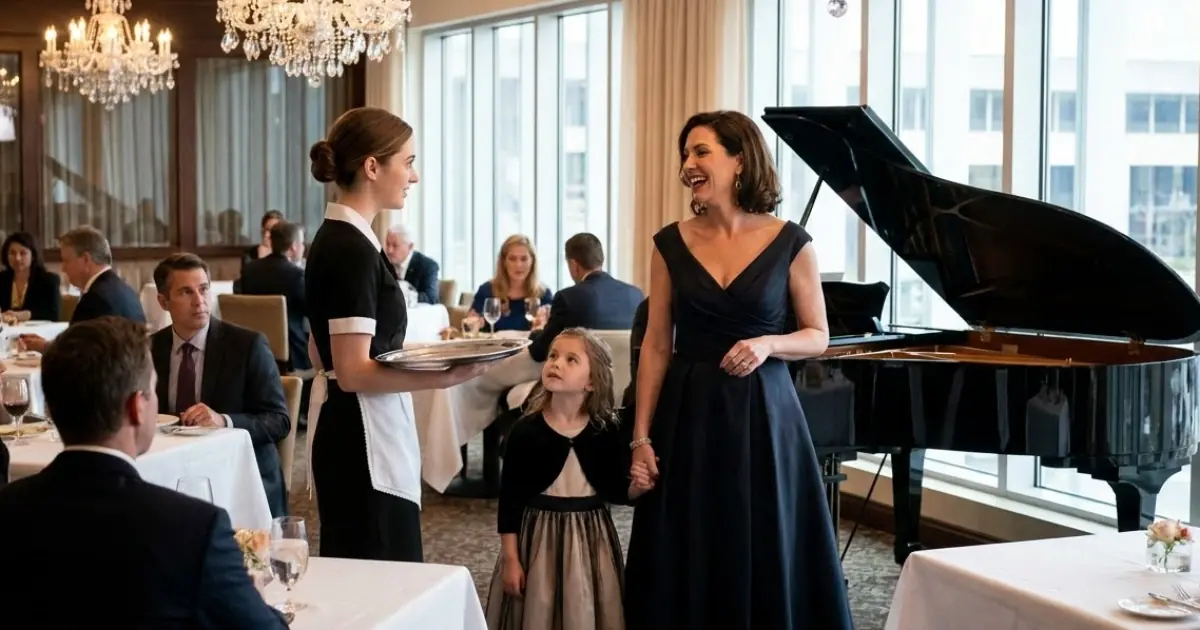
“You can do whatever you want on your own time,” Martin said, not unkindly. He knew she had a piano at home the way he knew Andre sang in a church on Sundays: as a fact that did not need to be used. “On my floor, resting means resting.”
“Understood.”
She tied the apron. The lunch crew was clearing into the quieter hour before dinner, that held breath when the cloths were changed and the silver was counted and the room put its jewels back on. Claire polished a row of knives until they threw the overhead light in clean lines. Her hands knew the work. That was the trouble and the mercy. The hands had been trained for years to know several kinds of work, and they did not announce, while aligning a knife, which life they missed.
By five the Winslow had become itself again. The chandeliers were up. The street had gone blue. Coats went to the check. Voices lowered as if the carpet had asked them to. Claire took her section. Table nine was a walk-in that had become a favor, a name Martin said with the slight care he used for people who did not need a favor and were receiving one anyway.
“Rowe,” he said. “Evelyn. And her daughter. Window. Be kind, be exact, don’t hover. The girl is ten. They ordered the pasta off-menu for her and the duck for the mother. If the mother edits the room, let her. We are not in the business of winning.”
Claire had said, “We’re in the business of dinner.”
She did not know she was about to walk that sentence into a corner and sit down in it.
Ruth Brennan’s living room in Akron had been a studio that apologized to no one, even though it was also a living room.











