“Kids this age should be running around, not acting like concert players.”
Malik looked at his father, then at Aaliyah, then at the pretzel bite in his hand as if it might offer a second opinion.
Lauren turned slightly, grateful for the alliance, and let the smile finish its job.
“Exactly. Let kids be kids.”
The tile kept reflecting people who were not listening. A stroller passed. A teenager laughed into a phone. The fountain kept raining. Aaliyah looked at the keys, which were still covered by nothing but air, and then at the woman, and then at the man who had not asked her name. Her voice, when she used it, was clear and not loud. It had practice in it, not of performance, of being heard in kitchens.
“Maybe I can do both.”
Lauren’s eyebrows rose by a measured amount. She shifted the coffee to her other hand. The phone screen woke and went dark again, a small impatient blink.
“Oh, you think you can play that?”
Marcus stood then, not menacing, simply taller, the way fathers become taller when they believe they are saving a child from herself. He nodded toward the play area visible past the planters, where a soft structure in primary colors held a knot of children and a teenager in a mall polo watched them with professional boredom.
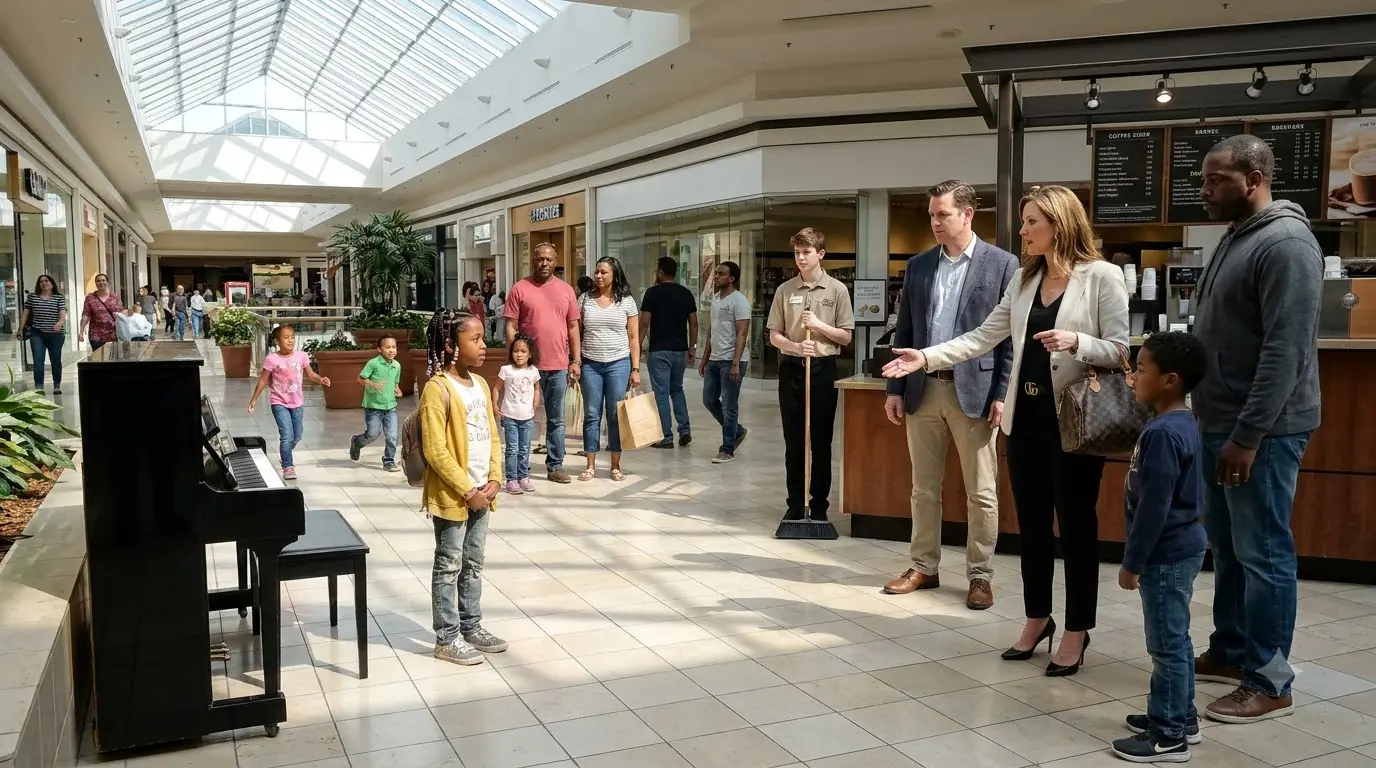
“Go have fun with the other children.”
Aaliyah’s chin did not lift for drama. It settled. She took the backpack off one shoulder and then the other and set it on the floor beside the bench, close enough that her foot could find it, because her grandmother had taught her that unattended bags become other people’s problems and other people’s problems become security guards. She looked at the play structure, at the bright tunnel and the child climbing the wrong way, and she answered the man without the anger the moment could have justified. Anger would have been a kind of performance too.
“I am.”
From behind the coffee counter, a teenage employee paused with a rag in one hand and a stack of lids in the other. Jordan Ellis was seventeen, brown-skinned, with a Hearth & Bean visor pushed up off a forehead that still broke out along the hairline, and a black apron tied twice because the first knot never held. He had been wiping the same six inches of counter while the line moved, the way you wipe when your body is at work and your attention has slipped its leash. He had seen kids bang the piano. He had seen a man in a suit play three smug bars of something famous and bow to nobody. He had never seen a girl this small put her bag down as if the bench were a place she had arrived to on purpose. The question came out before he decided whether asking it was his job.
“Is she really about to play?”
A woman in the coffee line turned her head. Malik forgot the pretzel. Lauren looked at the keys, then at the child’s sneakers, then at the yellow cardigan’s pilled cuff, and assembled a future in which the next minute would restore the afternoon to its proper size. She took a sip of coffee that had gone from hot to useful. Her mouth made the shape of amusement, which is not the same shape as welcome.
“This should be interesting.”
Aaliyah sat.
The bench was a little far from the keys. She drew it in with both hands, not a scrape for attention, a correction. Her feet did not quite reach the floor in a way that satisfied her, so she shifted forward until the balls of her feet found tile and the cardigan settled at her wrists. She looked at the keyboard the way a person looks at a face she knows and has not seen in a public room. Her hands rose. They hovered. The right thumb knew where it meant to go. The left hand waited in the air above a C that had not yet agreed to sound. A security guard near the fountain glanced over and decided, for the moment, that a child at a public piano was not a crisis. The glass ceiling held the light steady. Somewhere above the second-level railing, a shop door chimed.
Aaliyah did not look at Lauren. She did not look at Marcus. She looked at the place where the first note would have to live if she let it, and she spoke to the whole small audience the room had accidentally become, including the boy with the pretzel and the teenager with the lids and the woman who had used sweetheart as a fence.
“Just wait.”
Her wrists were lifted. The keys reflected a thin bar of ceiling light and the yellow of her sleeve. No one had heard a note yet. The mall did not know what it was holding. Aaliyah held it a second longer than comfort, because she had been taught that the silence before a sound is part of the sound, and because she was ten and her heart was knocking hard enough that she needed the extra breath to keep her hands from telling on her.











