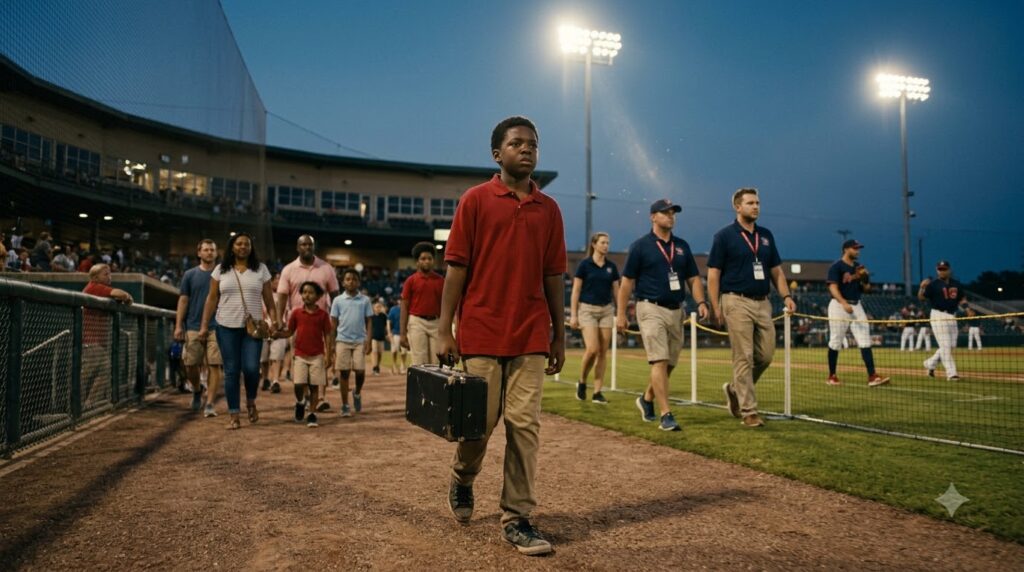
The lights at Harlan Field came on at ten minutes past six, while the sky over the river was still the color of weak tea, and for a moment the whole ballpark seemed to hold its breath under the hum of them. Then the organ in the press box coughed out three bars of something cheerful, a vendor shouted about kettle corn, and the evening began the way evenings at Harlan Field always began, with too many people talking at once.
The Calder Falls Millers were warming up along the first-base line. Pitchers in gray hooded sweatshirts threw long, lazy arcs to one another across the outfield grass. A coach with a fungo bat lifted easy grounders to the infielders, and the ball made a clean, private sound each time it struck the leather, a sound that carried all the way into the bleachers if you were listening for it. Families filled the stands in loose, sunburned clusters. Somebody’s little brother was crying about a foam finger. Somebody’s grandmother had brought a seat cushion embroidered with the Millers’ old logo, the one with the waterwheel, which the team had retired eleven years ago and which nobody in Calder Falls had ever really stopped loving.
Along the foul line, the staff moved the way staff move before any show, quickly and without seeming to hurry. A woman in a green polo shirt counted folding chairs for the color guard. A teenage boy dragged a rake across the dirt near the visitors’ dugout. And a broad man named Ray Okafor, who had worked the grounds crew at Harlan Field for nineteen seasons, came down the line with three coils of black audio cable looped over one shoulder and a fourth coil hanging from his fist like a dead snake.
Ray had a list in his head, and the list was long. The microphone stand at home plate had a loose collar. The monitor speaker by the backstop had cut out twice during the sound check. The anthem was at six fifty-five, first pitch at seven-oh-five, and the music people from the school district were, as usual, somewhere other than where they were supposed to be. He was thinking about the monitor speaker when he saw the boy.
The boy was standing just past the end of the field-level railing, on the warning-track side of the little gate that led from the concourse tunnel down to the field. He could not have been more than twelve. He wore a red polo shirt tucked carefully into khakis, and white sneakers that had obviously been cleaned with a toothbrush, because the soles were brighter than the uppers. In his right hand he carried a black trumpet case, the old hard-shell kind with brass latches, and even from twenty feet away Ray could see that one corner of it was caved in, a deep dent with a crease running out from it like a crack in ice.
The boy was looking around with the careful stillness of someone who had decided not to look lost.
Ray changed direction. He did not do it unkindly. He had sons of his own, grown now, and he had learned a long time ago that most trouble with kids at a ballpark was the trouble of a kid being in the wrong place at the wrong time with nobody to tell him so.
“Hey, bud,” he said, shifting the cables on his shoulder. “You can’t just walk onto the field with an instrument.”
The boy looked up at him. His face was serious and composed, the face of a kid who had rehearsed being polite. “I was told to meet someone here.”
“Who told you?”
“A lady. On the phone. She said field level, by the gate, six-thirty.”
Ray glanced at his watch. It was six thirty-four. Behind him, someone laughed, and he turned to see the home-plate umpire coming up the line from the backstop, already in his navy shirt and gray slacks, his mask tucked under one arm and his ball bag riding his hip. Walt Hennessey had been umpiring in the league for twenty-six years. He was sixty-four years old, built like a mailbox, and possessed of a dry, grudging humor that the players pretended to hate and secretly relied upon.
Walt took in the boy, the red shirt, the case. “Maybe they meant the parking lot band,” he said.
There was a parking lot band. On Fridays, a group of retired men called the Riverside Brass played Sousa marches by the main ticket windows for tips, and they were, by general agreement, loud. It was not an unreasonable guess.
The boy considered this. He did not smile, but something moved at the corner of his mouth. “I don’t think so.”
“Son,” Ray said, more gently, “there’s a lot going on down here tonight. We got the color guard, we got the anthem, we got a microphone that’s held together with hope. The anthem isn’t an open-mic activity. If you’re with a school group, they’ll be up on the concourse, by Section 104.”











