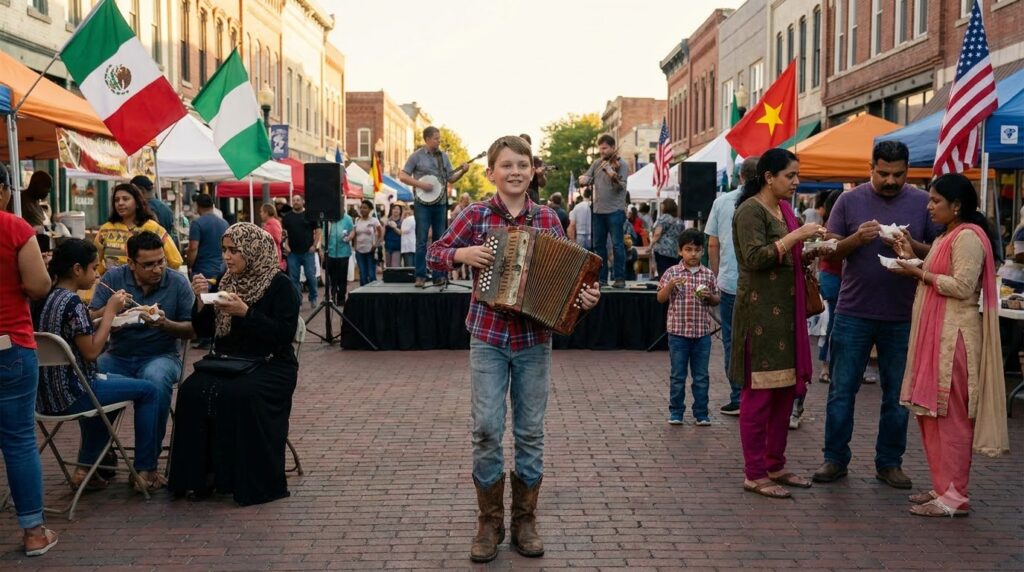
The street fair took over Alder Avenue every September, from the bank on the corner of Fourth to the boarded-up theater that the city kept promising to restore. By noon on the last Saturday of the month the six blocks had stopped being a street at all. They had turned into a long, loud room with no ceiling. Strings of flags ran from lamppost to lamppost: the green, white and orange of Ireland next to the red disc of Bangladesh, Mexico’s eagle snapping above a pennant from a soccer club in Lagos, a Ukrainian blue-and-yellow faded to the color of weak tea after three summers of sun. Smoke from charcoal grills drifted sideways across the crowd. There was a stand selling pupusas and a stand selling pierogi and a stand run by two Ethiopian sisters who poured coffee from a clay jebena while their teenage nephew filmed them on his phone. Little kids with painted faces were carried on shoulders above everyone. Older men argued in four languages about which grill made the best food, and none of them would ever admit to losing.
Halfway down the block, in front of the hardware store, the organizers had built a low plywood platform and draped the front edge with bunting. A hand-painted sign on an easel said FOLK STAGE, and under that, in smaller letters someone had added in marker, ALL TRADITIONS WELCOME. Two speakers on tripods leaned a little toward each other, like old friends listening in. Behind the platform a canvas awning sagged in the middle where rainwater from the night before still sat.
The band that owned the platform that afternoon was called the Front Street Ramblers. The name was older than most of the people watching. There were five of them, and on most days they played the kind of music that made people stop with a paper plate in one hand and start tapping a foot without meaning to: reels and polkas, a waltz or two, a few border songs from down south, a Cajun two-step a fiddler had brought in thirty years ago that never left. Their fiddler was a lanky woman named Dolores Achebe-Kline who played barefoot. Their bass player was a retired mail carrier, Gus Ferreira, who had a stool he refused to let anyone else sit on. There was a guitarist in his forties named Teddy Ruan, and a young drummer with a single snare and a cajón who had joined only that spring. And there was the accordion player.
His name was Walter Dureau, and everyone called him Walt, and he had been squeezing a button accordion on stages like this one for more than forty-five years. He was seventy now, broad in the chest, with a white mustache that he trimmed every morning and forearms that still looked like they belonged to a younger man. His accordion was a black three-row box with mother-of-pearl buttons and bellows the color of oxblood, and he held it against his body the way some men hold a dog that might bolt. He was not a cruel man. But he was proud, and pride that has gone forty-five years without being seriously tested can turn into something with edges.
On the platform, beside Walt’s chair, there was another chair. It was a plain folding chair, gray metal, with a strip of yellow tape across the back. The Ramblers always set it out. Ask any of them why and they would shrug and say that was Walt’s thing, and Walt would say it was for guests, for anybody who wanted to sit in. Now and then a fiddler from the crowd climbed up, or a man with a harmonica, or once a tiny woman from Cape Verde with a voice that made the street go quiet. Mostly it stayed empty. People had stopped noticing it, the way you stop noticing a clock on a wall.
At ten minutes past two, between sets, a boy came walking along the edge of the crowd with an accordion case in both arms.
He was twelve years old and small for it, with straw-colored hair that someone had wet down and combed that morning and that had since given up. He wore a red-and-black plaid shirt buttoned all the way to the collar, blue jeans that were a little long and stacked over the tops of brown boots, and the boots were scuffed at the toes in a way that said he wore them for real and not for show. The case was old, black leatherette peeling at the corners, with brass latches gone green. He held it the way you hold something that is heavier than it looks and worth more than it looks, too.
His name was Caleb Hollis.
He climbed the three wooden steps at the side of the platform, set the case down beside the empty chair, and opened it. Inside, on a bed of crushed burgundy velvet, lay an accordion that looked like it had come out of another century. It was a two-row diatonic box, its wooden end panels painted a red so deep it was almost brown, with gold filigree worn away in the places where a hand had held it for decades. The buttons were yellowed ivory. On the grille, in looping script, a brand name had nearly vanished; you could make out an S, and an a, and the tail of something Italian. The straps were new leather, stiff and pale, the only new thing about it.











