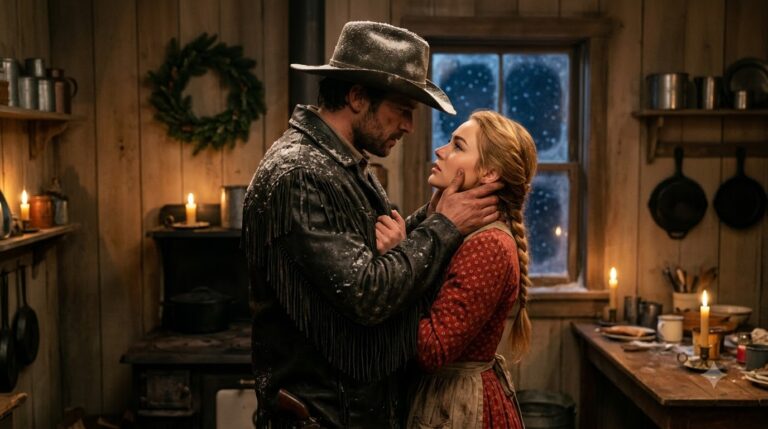
The first settlement Caleb paid was returned.
With interest.
Eleanor received the money.
She placed the check on the cabin table after they returned home.
Caleb looked at it.
“That’s yours.”
She nodded.
“I know.”
“What will you do?”
Eleanor thought.
“A separate account.”
Caleb nodded immediately.
“Good.”
She raised an eyebrow.
“No objection?”
“Why would I object?”
“My first husband would have.”
“I am beginning to dislike a dead man.”
“You are late.”
Caleb smiled.
Eleanor deposited part in her own account in town.
Then used part to purchase three dairy cows.
Caleb objected fiercely.
“Cows?”
“Yes.”
“We don’t need three cows.”
“We need one.”
“Then why three?”
“Because I intend to sell butter.”
“Eleanor.”
“What?”
“You moved to the mountains and became entrepreneurial.”
“I was always entrepreneurial.”
“Baltimore suppressed it.”
He looked at the cows.
“One of them hates me.”
“Good judgment.”
Caleb stared.
Eleanor laughed.
Life became busy.
Not easy.
Busy.
They argued.
About money.
About Caleb taking dangerous routes alone.
About Eleanor buying chickens without warning him.
Twenty-three chickens.
He counted.
Twice.
“You bought an army.”
“I bought eggs.”
“They are occupying the barn.”
“They live there.”
“It was my barn.”
“It is our barn.”
Caleb stopped.
Then smiled.
“Yes.”
“Our barn.”
That ended the argument.
Mostly.
Their physical relationship deepened at its own pace.
Caleb never became careless with consent.
Eleanor eventually teased him for asking too often.
He learned confidence.
She learned to say what she wanted instead of waiting for him to guess.
Sometimes what she wanted surprised her.
Sometimes him.
Their intimacy became playful.
Warm.
Private.
There were nights when Eleanor remembered the frightened man sharpening an unnecessary knife and could hardly reconcile him with the husband now capable of making her blush with a single look across the table.
Yet some part of him remained that nervous man.
Especially when she wore the pale-blue nightgown.
One evening in early summer, she stepped from behind the screen wearing it.
Caleb looked up.
Then immediately looked toward his knife.
Eleanor laughed.
“Do not start sharpening anything.”
He put both hands flat on the table.
“Wasn’t planning to.”
“Liar.”
“Possibly.”
She approached.
He smiled.
“What?”
“Nothing.”
“You’re staring.”
“You once complained I didn’t.”
“Fair.”
She stood between his knees.
His hands settled at her waist.
No trembling now.
She kissed his forehead.
“Do you remember asking me to teach you?”
His eyes warmed.
“Yes.”
“How did I do?”
Caleb pretended to consider.
“Acceptable.”
Eleanor stared.
“Acceptable.”
“Room for improvement.”
She stepped away.
He caught her gently.
“Excellent.”
“Too late.”
“Exceptional.”
“Still too late.”
“Life-changing.”
She laughed.
“There.”
“Truth at last.”
He looked at her.
Something changed in his expression.
Not desire this time.
Emotion.
Quiet.
Deep.
“What?”
He shook his head.
“Tell me.”
Caleb looked around the cabin.
The shawl beside his coat.
Her books.
Bread cooling near the stove.
A bowl she painted with little blue flowers.
Two cups.
Always two now.
“You’re here.”
Eleanor’s throat tightened.
“That was the original request.”
“I know.”
“You wanted footsteps.”
“Yes.”
“You got chickens too.”
“Unfortunately.”
She touched his face.
“Caleb.”
“Yes?”
“I’m glad I’m here.”
He closed his eyes briefly.
Then pulled her closer.
No grand speech.
No dramatic promise.
Only a man who had once wanted another voice in an empty cabin holding the woman who had filled it with more life than he knew what to do with.
Years later, when people asked Eleanor why she had traveled west to marry a stranger, she never gave the complete answer.
Necessity.
Fear.
Debt.
Chance.
A misdirected aid letter.
A suspicious creditor.
A lonely trapper.
All true.
None sufficient.
When women asked whether she had been frightened on her wedding night, Eleanor sometimes smiled.
“Terrified.”
They assumed she meant Caleb.
She rarely corrected them.
The truth was stranger.
She had been terrified of discovering that kindness was another form of control.
Terrified that generosity carried a hidden invoice.
Terrified that marriage meant exchanging one obligation for another.
Instead, the enormous mountain man standing in front of her had been more frightened than she was.
Not of her rejection.
Not entirely.
He had been afraid of becoming the kind of man she had already survived.
That fear did not make him perfect.
He made mistakes.
A serious one when he hid the truth about her debt.
He learned that protection without consent could become another form of control, however kindly intended.
Eleanor learned something too.
Trust did not require pretending people would never fail.
It required seeing what they did after failure.
Caleb apologized without demanding forgiveness.
Changed without asking for praise.
And when Eleanor reclaimed decisions that belonged to her, he did not call that rejection.
He called it marriage.
Their first winter eventually became family legend.
Though Eleanor edited it heavily.