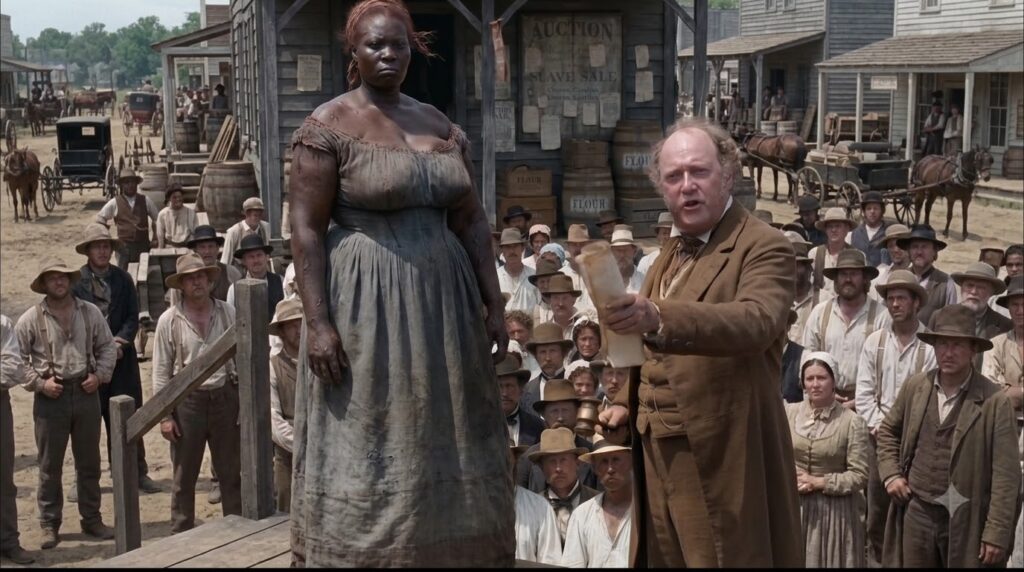
The auctioneer’s gavel had already fallen twice that morning before they dragged her up onto the block, and the crowd that had been fanning itself in the Carolina heat went suddenly, hungrily quiet. She stood a full head taller than any man in the yard. Her shoulders strained the seams of a flour-sack dress gone gray with washing, and her arms, corded, scarred, thick as a smith’s, hung at her sides like things carved rather than born. A woman near the front pressed a handkerchief to her mouth and laughed.
It was the cruel, bright laugh people used to cover fear. “Lord,” a planter muttered, “what do you even feed a thing like that?” Nobody bid. The auctioneer, a soft pink man named Hollis, who sweated through his coat by 9 each morning, worked the crowd, and got nothing but jeers, and the price fell and fell until it landed at a number so low it was an insult to speak aloud. The town was Cheraw, and the day was a Saturday, and the auction had drawn the usual crowd.
Planters in fine coats came to buy, poorer men came to watch, women beneath parasols, boys darting underfoot, and the ordinary Saturday traffic of a southern market town, flowing around the edges of a business that the town had long since stopped seeing as anything remarkable. Men were bought and sold in that square the way mules and hogsheads of tobacco were bought and sold under the same sun to the same drone of the same auctioneer and the citizens of Cheraw fanned themselves and made their bids and thought nothing of it. It was only when the giant girl was brought up that the ordinary drone broke because she was a spectacle, a thing outside the day’s dull commerce. And a crowd will always turn to a spectacle the way a field turns to the sun.
His name was Elias Warfield, and by every measure that mattered in Chesterfield District, he was a man on the losing end of his own life. His father had left him 400 acres of exhausted cotton land, a house with a sagging gallery, and debt stitched into every deed and ledger in the strong box. His wife had died of fever three winters passed, and with her had died whatever softness the world had left in him. He had gone hard and gray and quiet in his grief.
He had become a man moving through his days out of habit rather than hope. His fields, worked by too few hands and those hands worn thin, brought in less each year. He had come to town that day not to buy, but to sell, a mule, a broken plow, whatever might buy him another season, and he had lingered at the edge of the auction, the way a hungry man lingers outside a bakery, wanting nothing he could afford. Then the girl was brought up, and the laughing started, and something in Elias Warfield went cold and still.
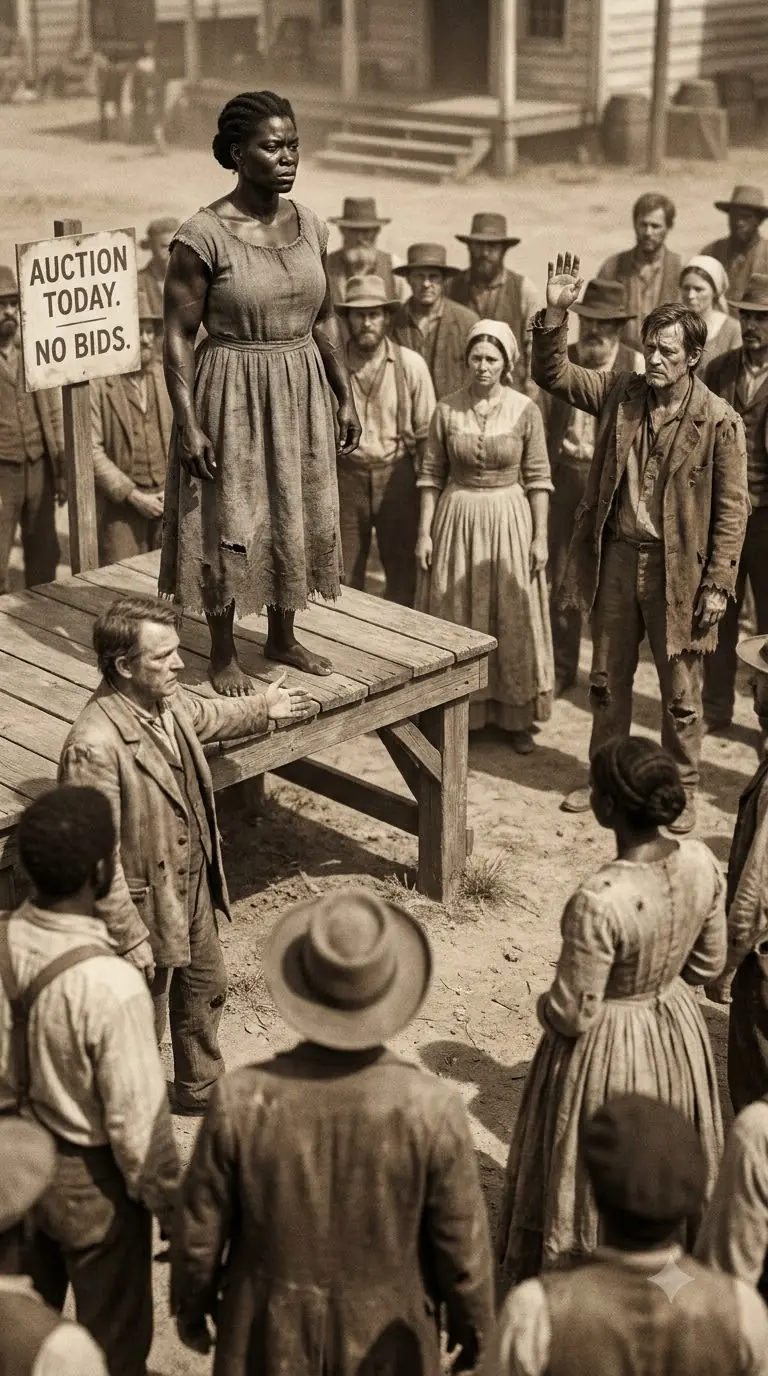
He knew that laugh. He had heard it turned on himself often enough, the shabby Warfield boy, the failing farmer, the widower, who couldn’t keep his own gate on its hinges. He watched the girl keep her eyes fixed on a point above the crowd, her jaw set, refusing to flinch, and he recognized the particular labor of a person holding themselves upright under the weight of a hundred stares. He did not decide to raise his hand so much as find it already raised.
“I’ll take her,” he said, and his voice cracked the silence. Hollis blinked. “For the standing bid, Warfield. That’s for the standing bid.” The $3 in his palm was the last coined money he had in the world.
The laughter did not stop. It changed. Now it was aimed at him. A man in a fine planter’s coat clapped him on the shoulder as he passed and said loud enough to carry.
“Warfield’s bought himself a plow horse that walks on two legs. Going to marry it too?” And the yard howled. Elias felt the heat climb his neck, but he counted the coins into Hollis’s damp hand, took the paper that made a human being his property, a paper that would sit in his chest like a swallowed stone for the rest of his days, and he turned to the girl and did the thing nobody in that yard expected. He took off his hat.
“Ma’am,” he said, though nobody had ever troubled to call her ma’am in her life. “My wagon’s yonder. I’d be obliged if you’d ride up on the seat. Road’s rough in the back.” The girl looked down at him.
She had to look down and he saw her brace for the trick in it. The cruelty coming. It did not come. He simply waited, hat in hand, until she stepped off the block.











