“Ma’am, I’m Not Here to Hold the Door”
At 6:41 on a Saturday evening in late February, the lobby of the Harlan Civic Music Hall smelled like lemon oil, wet wool, and the little paper cups of coffee the volunteers sold for two dollars and called a donation.
The coffee was not good.
Everybody bought it anyway.
That was the kind of town Harlan was.
The lobby had been built in 1928 by people who believed that a building should make you lower your voice before anybody asked you to. The walls were dark walnut, paneled floor to ceiling, rubbed so many times by so many janitors that the grain looked wet. The ceiling was coffered. The chandeliers were brass and had been converted from gas to electric sometime before anybody now living could remember, and they gave off a low amber light that made everyone look a little kinder and a little more tired than they were.
Along the walls hung framed posters from old seasons.
THE HARLAN CIVIC PHILHARMONIC PRESENTS, said most of them, and then a list of things it had presented. Symphonies. A visiting choir. A ballet that had come through in 1971 and left, according to the house manager, one slipper and a smell.
Under the posters stood the people.
They came in from the cold in clumps, stamping slush off their shoes on the long runner by the doors. Retired schoolteachers in good scarves. Couples who had held season tickets since their wedding. A cluster of college students who had been required to attend for a class and looked like it. Grandparents dragging grandchildren in clip-on ties. A man in a hunting jacket who came to every concert alone, sat in the same seat, and fell asleep in the same movement, and whom the ushers had nicknamed The Critic.
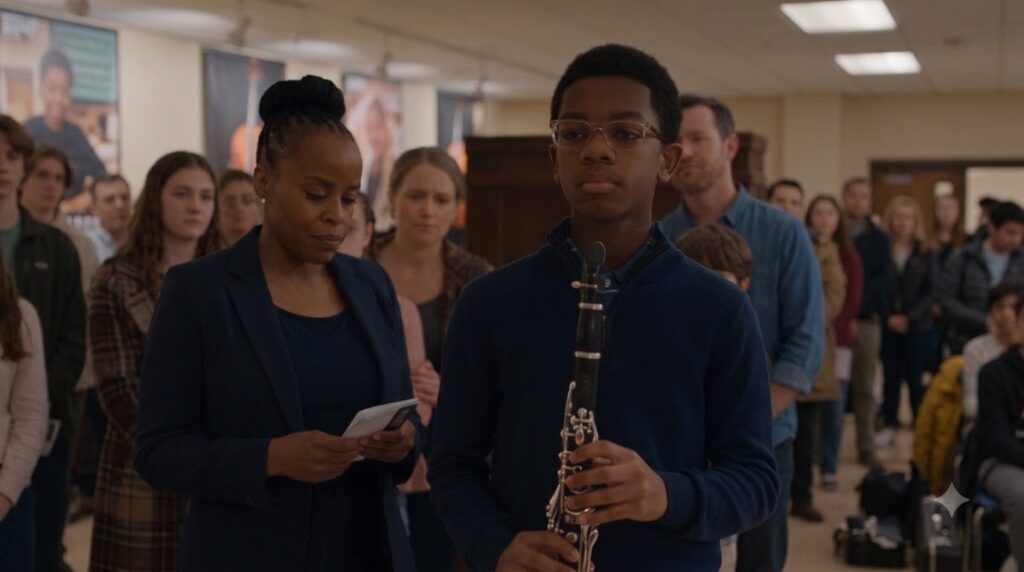
In the middle of all of it, about ten feet inside the main doors, stood a boy holding a clarinet.
He was thirteen.
Thirteen and four months, if anybody was counting, and he was the only one who was.
His name was Isaiah Combs.
He had short hair, cut that morning by his father in the kitchen with the clippers they kept in a shoebox marked CLIPPERS — DO NOT TOUCH, PEARL, and he wore clear-framed glasses that he pushed up with one knuckle when he was nervous. He was pushing them up now. He wore a navy quarter-zip sweater over a white collared shirt, and the collar of the shirt had been ironed so hard by his mother that it could have stood up and walked out on its own.
The clarinet was black.
He held it upright in front of his chest with both hands, the bell resting just above his belt, the way he had seen soldiers hold flags in old photographs.
He did not know why he was holding it like that.
It just seemed like the clarinet should be held like something that mattered.
Directly in front of him, so close he could smell her hand lotion, stood a woman in a navy blazer.
She was Black, somewhere in her fifties, with her hair pulled back into a bun so neat it looked architectural. Under the blazer she wore a navy top with a small silver pin at the collar shaped like a treble clef. She had reading glasses pushed up on her head and a second pair, the real pair, on her nose. In her hands she held a stiff white card, about the size of a postcard, and she was looking down at it the way a person looks down at a bill they have already paid once.
Her name was Constance Whitlow.
She was the general manager of the Harlan Civic Philharmonic, which was a title that sounded grand and meant, in practice, that she did everything nobody else wanted to do, including, twice, unclogging the women’s restroom on the mezzanine with a coat hanger while wearing pearls.
She had been doing the job for nineteen years.
She had not taken a full vacation in eleven.
“Honey,” Constance Whitlow said, not unkindly, still looking at the card. “The student greeters go to the east doors. Mr. Ruddock’s got the programs over there. He’ll show you where to stand.”
Isaiah did not move.
“I’m not a greeter,” he said.
“You’re wearing the sweater.”
He looked down at the sweater.
It was true. It was the sweater. Navy quarter-zip, a little white embroidered H on the chest, the kind the Philharmonic gave out every fall to the middle-school kids in its outreach program, the ones who stood by the doors on concert nights and said Welcome to the Harlan Civic Philharmonic, enjoy the show, in voices that had been coached to sound like they meant it.
Isaiah had been one of those kids.











