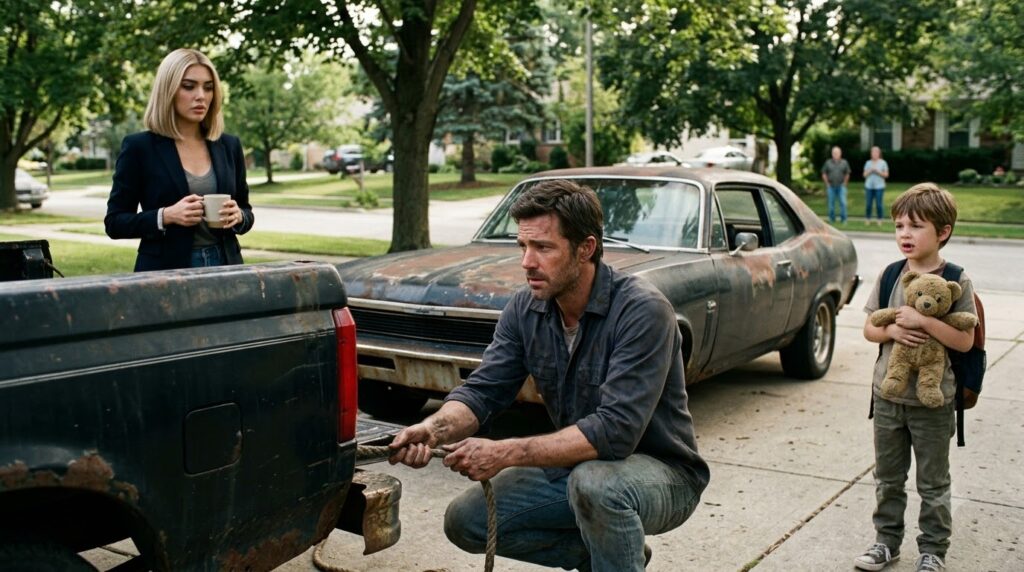
On a Saturday morning in April, Thomas Rodriguez handed over $100 at a salvage yard and towed home a car that looked like it had been dead for decades. Paint stripped to bare metal, roof seams eaten through by rust, a license plate barely readable. His neighbor stood at her gate, coffee in hand, and laughed loud enough for the whole street to hear. “You just taught your son the fastest way to waste money.” “Poor kid.”
Thomas said nothing. He looked at the car, then he looked at his 7-year-old son standing at the edge of the driveway with his backpack still on. The boy didn’t cry, he just watched. And Thomas went to work. What nobody knew, what nobody could have known, was that 5 days later a racing legend would arrive at that same driveway with a check for $5 million.
All Thomas had was a $100 mistake and a neighbor who wouldn’t let him forget it. The day started the way every Saturday started. 5:00 in the morning, dark outside, coffee brewing in the kitchen, while Thomas packed a lunch for Ryan even though it was the weekend. Because routine was the architecture of their days, and he didn’t take it apart without reason. Ryan was still asleep upstairs.
The house was quiet except for the hum of the refrigerator and the occasional creak of the floorboards under Thomas’s feet. He moved through the kitchen with the efficiency of a man who had done this a thousand times. Sandwich, apple, juice box. A granola bar Ryan liked but pretended not to like because his friend at school said granola was for old people. Thomas didn’t argue about the granola bars anymore.
He checked the handwritten schedule pinned to the refrigerator with a magnet shaped like a wrench. Someone had given him that magnet at Rebecca’s funeral. He didn’t remember who, didn’t matter. Saturday, pick up carburetor for Mrs. Chen’s Civic, oil change on the Lawson truck, check. He drained his coffee, grabbed his keys, walked out to the garage behind the house where he worked as a freelance mechanic.
Word of mouth kept him busy enough. It paid the bills, mostly. And on the months it didn’t, he didn’t mention it to anyone. Thomas was 34 years old and he had the kind of life that didn’t photograph well. There were no dramatic tragedies anyone could see from the outside, just the quiet grind of a man who woke up every day and kept moving because stopping meant thinking too hard about what he’d lost.
Two years earlier, his wife Rebecca had died in a car accident on the interstate. The other driver walked away. The medical bills she left behind did not. $47,000. Thomas had been paying them down in chunks, quietly, without announcement, without looking for sympathy.
The neighbors on Cypress Street mostly thought of him as the quiet man with the truck and the little boy. They were not wrong. They just hadn’t finished the sentence. Ryan was seven, missing a front tooth, devoted to a stuffed bear he carried everywhere. Rebecca had named the bear Rocket the night Ryan was born because she loved racing.
Loved the blur of speed, the smell of engine oil, the way a well-tuned engine sounded like controlled chaos. The bear had lost one button eye, been repaired twice with mismatched thread. Ryan did not care. Thomas almost never talked about Rebecca. When Ryan asked questions about her, he answered them fully, but he did not volunteer stories on his own.
The grief had settled in him the way sediment settles in still water, invisible on the surface, permanent underneath. Kenneth Perez was Thomas’s only real friend on the block, 40 years old, ran a small repair shop at the end of Cypress Street, had the useful quality of knowing when to talk and when to sit in silence with a cup of coffee.
On Friday evenings he sometimes brought sandwiches over. The two of them would eat in the garage while Ryan did his homework at the workbench. Kenneth was the only adult in Ryan’s life the boy called by his first name instead of sir or uncle. Thomas climbed into his truck at 6:15 and drove across town to Voss Auto Salvage. Larry Torres had operated the place for over 30 years on the eastern edge of town.
The lot was surrounded by chain-link fence, faint smell of transmission fluid, rows of cars in various states of decay stacked like metal corpses waiting for resurrection or the crusher. Larry was 60, practical to the point of bluntness, priced his inventory by intuition rather than research. Thomas found him in the office, a small shed with a space heater and a desk covered in paperwork that looked like it hadn’t been filed since the Reagan administration. “Got that carburetor for the Civic?” Larry didn’t look up from his clipboard.











