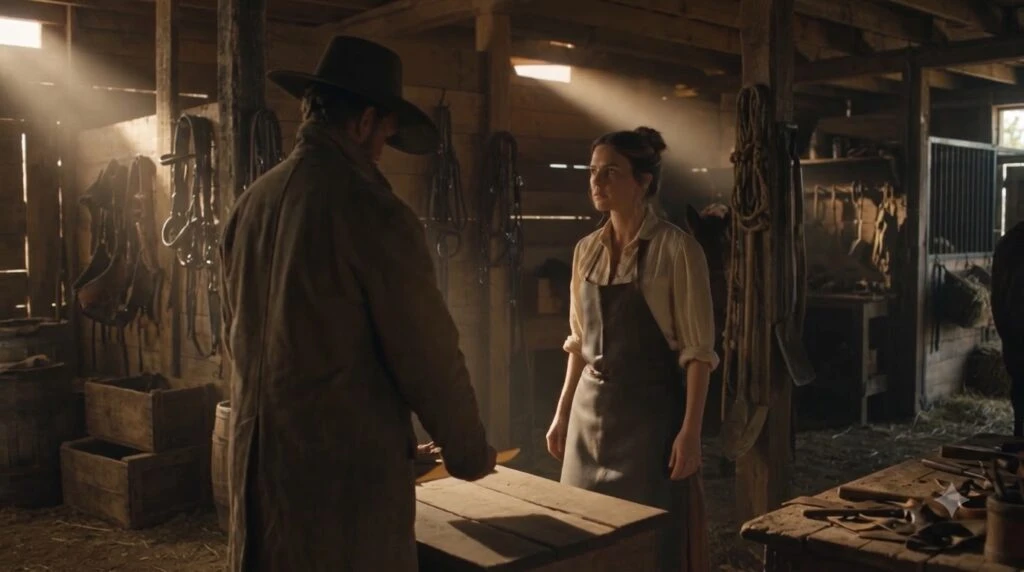
The light came in low through the west wall of the Lindholm stable, where the boards had shrunk apart over a dozen Colorado summers, and it lay across the packed floor in long gold bars full of drifting dust. At that hour of the afternoon the whole building seemed to be breathing slowly. The horses shifted in their stalls. A cat crossed the loft ladder. Somewhere toward the back the old gray freight mare blew through her nose and rattled her halter ring against the manger, which was what she did every day at a quarter to five, whether or not anyone came with oats.
Marta Lindholm had the near hind foot of a bay gelding cradled between her knees and was clinching the last nail. She worked without hurry. The gelding belonged to the Methodist minister and had a habit of leaning, so she leaned back, her shoulder against his flank and her weight set low, and the two of them held each other up in a kind of truce while she bent the nail tips over and rasped them smooth. Her leather apron was scorched dark at the knees. Her cream blouse had been clean at sunrise and was not now, and the sleeves were rolled above her elbows, showing forearms browned to the color of saddle leather and marked here and there with the small white scars of the trade. Her hair, which she had pinned up that morning in a bun as tight as she could make it, had given up somewhere around noon. Dark-blonde strands hung against her neck and stuck to her temple.
She heard the door before she saw who had come through it. The big front door of the stable had a drag to it, a groan where the lower hinge had gone out of true, and anyone who did not know the trick of lifting as they pulled made it complain. Whoever this was had not lifted. The door complained. Then boots on the floor, slow and heavy, and the light from the doorway broken by a shape so tall she knew it before she straightened.
She did not straighten. She finished the rasp stroke, set the gelding’s foot down, ran her palm once down the cannon bone as she always did, and only then stood and turned.
Caleb North had taken his hat off in the doorway, as he always had, as if the stable were a church. He stood just inside with the black hat in one hand and something flat and brown in the other. He was bigger than she remembered, or the coat made him so, a heavy brown canvas coat gone pale along the seams and darkened at the cuffs. His beard was dark and cut close. His face had the look that faces got up high, where the wind worked on a man year after year until his skin was the color of the rocks he slept among. He looked at her and did not smile, and she understood from that, before he said a word, that whatever he had come for was not a social call.
She untied the minister’s gelding and led him to his stall and latched the gate. She wiped her hands on the apron. Then she walked to the long worktable under the tack wall, the scarred old table where her father had cut harness leather and her brother kept the stable’s ledger and she, these days, did the sums her brother no longer did. The ledger lay open there, a pencil across it. Bridles and breast collars hung on pegs above. A coil of new lead rope. Two saddles on their trees.
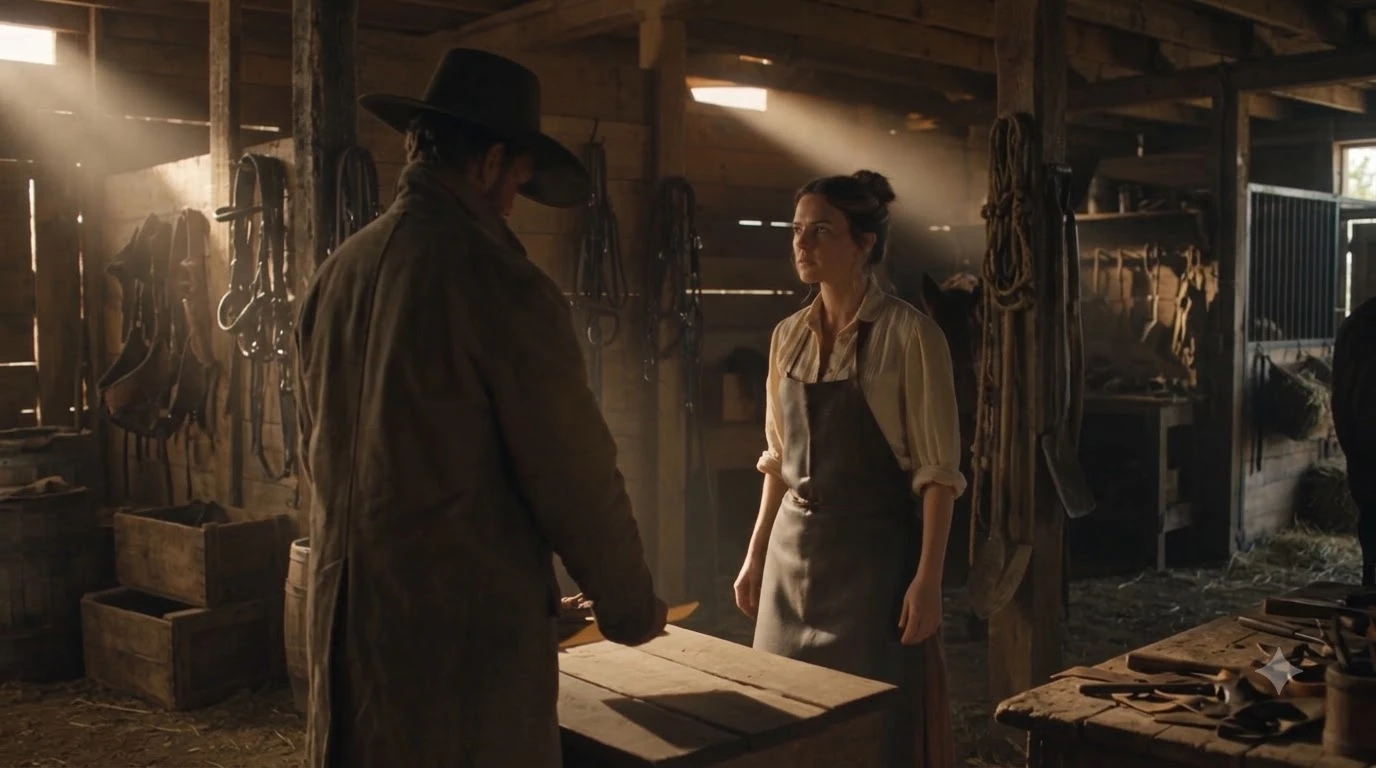
Caleb crossed the floor and laid the flat brown thing down on the table beside the ledger. It was a leather envelope, the kind a lawyer or a cattle buyer carried, with a flap and a tie. He untied it for her and stepped back.
She did not touch it at first. She could see the top edge of the papers inside, and she could see the printed letterhead, because she had seen it on other papers in this same room, over this same table, with her brother’s handwriting under it. The Red Creek Merchants’ and Miners’ Bank. And under that, in a different hand, a stamp in purple ink she did not know: First National Bank of Denver. Assigned.
She drew the papers out. There were four of them, folded in thirds, each one a note with her brother’s signature at the bottom. She knew every one. She knew the dates. She could have recited the sums. Below them was a fifth sheet, newer, a bill of assignment with a notary’s seal, and on it a name she had not expected to see in any bank’s ink.











