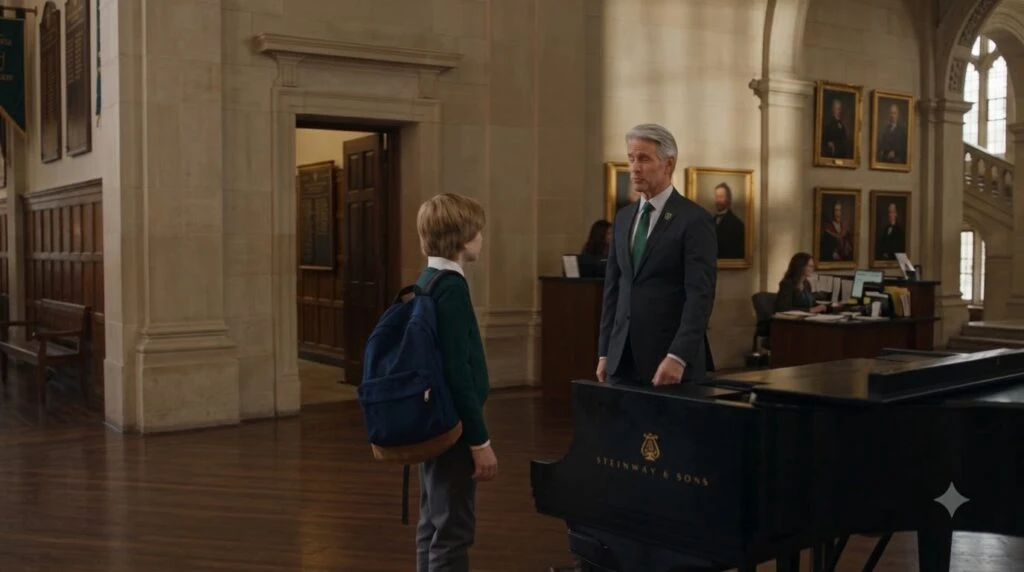
Snow pressed against the tall windows of the Westbridge Conservatory of Music like a quiet audience that had forgotten how to clap. Inside the main lobby, the afternoon light was the color of old brass, and the air smelled faintly of polished wood, wool coats, and the sharp sweetness of lemon oil. A Christmas wreath hung above the reception desk, its red ribbon already worn at the edges by a winter that had arrived early and stayed late. Parents spoke in low voices near the registration table. Children in recital clothes sat with their knees together, staring at sheet music as if the notes might rearrange themselves into mercy.
Jack stood a little apart from all of that.
He was about eleven, freckled across the bridge of his nose, with sandy-blond hair that refused to lie flat no matter how many times his grandmother had wet her palm and pressed it down that morning. He wore a forest-green sweater that had been washed one too many times and a navy backpack that looked as if it had traveled farther than a child of his age ought to have traveled. He was not tall for his age. He was not dressed for the kind of place that hung oil portraits of deceased directors above the staircase. But he had walked through the heavy oak doors without hesitation, and he had walked, as if drawn by a private gravity, toward the black grand piano that occupied the far side of the lobby like a sleeping animal.
His hand hovered near the fallboard.
“Careful, son. That piano isn’t part of the waiting area.”
Jack turned. Principal Harrison stood three paces away in a charcoal suit and a deep green tie that matched, almost accidentally, the boy’s sweater. At fifty-eight, Harrison carried silver hair with the kind of precision that suggested a man who believed disorder belonged outdoors. His voice was not unkind. It was the voice of a man who had spent decades protecting rooms from the wrong kind of curiosity.
“I know, sir,” Jack said.
“Good. I’d hate to have someone mistake curiosity for an audition.”
Jack’s freckles did not hide the steadiness in his face. “I am auditioning.”
Principal Harrison’s eyebrows rose a fraction. “For piano?”
Jack nodded once.
Principal Harrison glanced toward the registration table, then back at the boy. “This academy gets a lot of hopeful children.” He paused, as if the next sentence had been waiting in his mouth for years. “Hope and preparation aren’t the same thing.”
Jack said nothing.
“The scholarship panel is for serious students,” Principal Harrison continued.
“I know.”
“Then you understand why this isn’t a place to experiment.”
Jack shifted the strap of his navy backpack. “I’m not experimenting.”
From an inner pocket of the backpack he drew a cream-colored card, slightly bent at one corner, and held it out with both hands the way a person might present a passport at a border. Principal Harrison took it. The print was neat and official:
JACK
FINAL PIANO SCHOLARSHIP AUDITION
and beneath that, a number that made Harrison look at the boy again as if seeing him for the first time.
“You made the final round?” Principal Harrison asked, and there was more surprise in the question than he intended to show.
Before Jack could answer, a woman in a black dress crossed the lobby with the quick, purposeful stride of someone who had been searching and had just found what she needed. Ms. Blake’s chestnut hair was pinned back with a single silver clip. She was about forty-five, head of piano at the academy, and her presence had a way of quieting rooms without raising her voice.
“Jack, we’ve been looking for you,” she said. Then, to Principal Harrison, with a professional calm that left little room for argument: “He’s next.” She looked at Jack and softened. “You can warm up here before we go inside.”
Principal Harrison held the cream card a moment longer. “You know him?”
“Of course I know him,” Ms. Blake said.
“On this piano?” Principal Harrison asked, nodding toward the lobby grand as if the instrument itself might object.
Ms. Blake’s mouth tilted. “Why wouldn’t he?”
Principal Harrison looked from the teacher to the boy and then to the open expanse of marble and glass where every footfall seemed to echo twice. “Well, Jack… everyone can hear you out here.”
“I know,” Jack said.
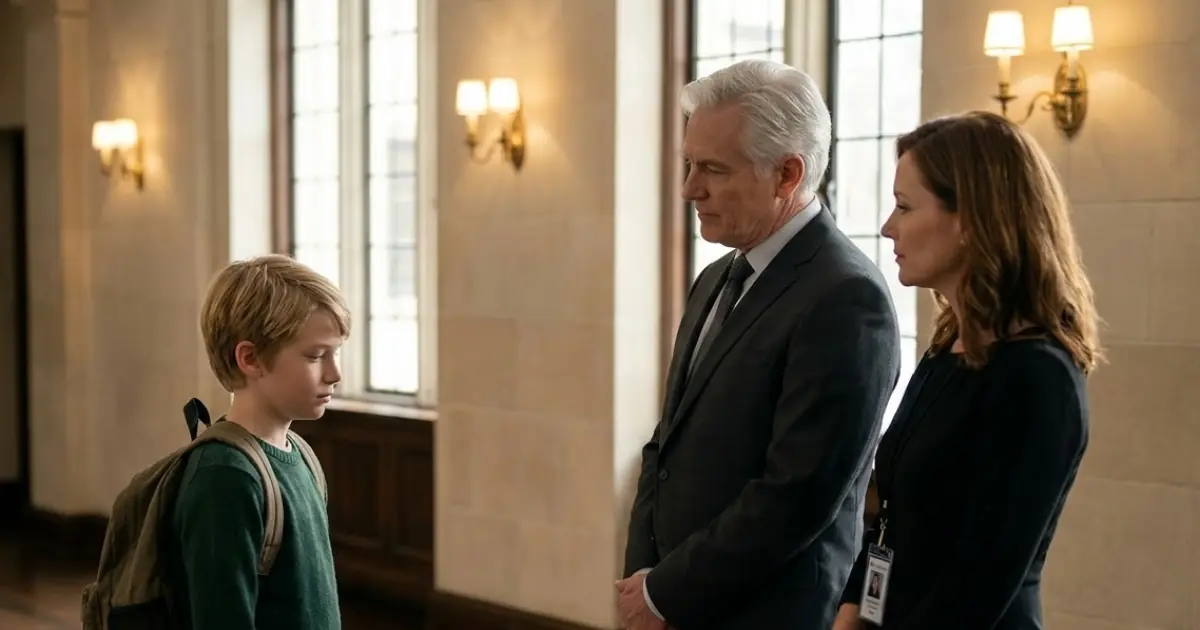
Principal Harrison studied him. The lobby had grown quieter. A mother near the wreath had stopped mid-sentence. A boy in a pressed blazer had lowered his Beethoven. Snow continued its soft assault on the windows.
“Still want to do this?” Principal Harrison asked.
Jack’s answer was immediate and unadorned. “Absolutely.”
Ms. Blake gestured toward the bench. Jack set his navy backpack carefully against one of the piano’s carved legs, slid onto the seat, and rested his hands just above the keys without touching them. For a breath, the whole lobby seemed to lean forward. Principal Harrison folded his arms. Ms. Blake waited with the patience of someone who had heard a thousand openings and still believed the next one might matter.











