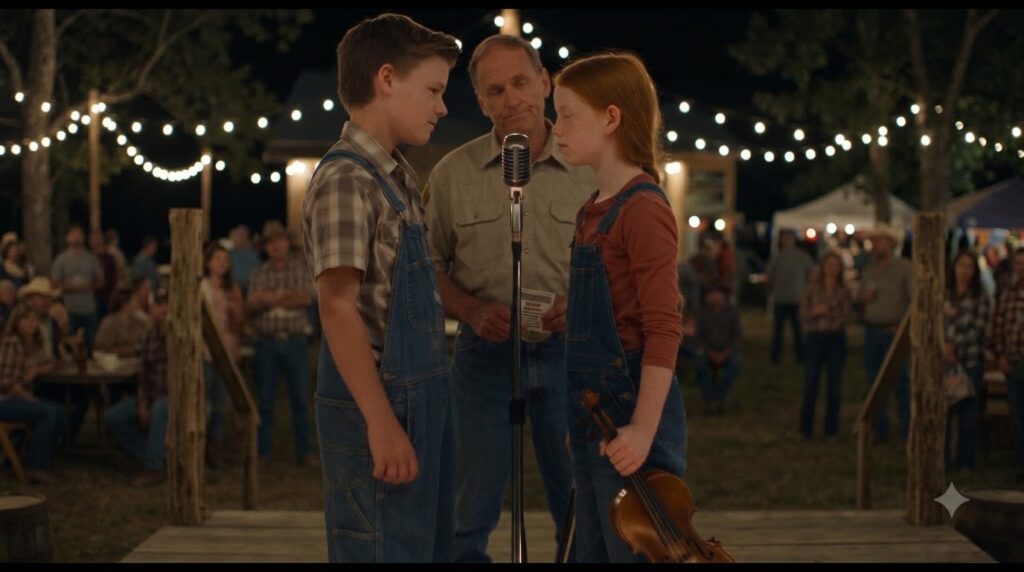
Nobody at the Tolliver County Fair asked eleven-year-old Hattie Larkin whether she could play the fiddle.
They asked whose fiddle it was.
Then they asked whether she was lost.
The stage was not much.
It was a wooden platform built of two-by-tens and plywood, painted barn red sometime before Hattie was born and repainted every third summer by whichever 4-H club lost the coin toss.
It stood at the far end of the midway, between the poultry barn and the grandstand, close enough to the hog barn that on a warm night the audience could smell the hogs and the hogs could, presumably, hear the music.
Strings of yellow bulbs ran from the stage roof out to two light poles, sagging in long, lazy curves.
Moths ran into them all night and never learned.
In the middle of the stage stood a single microphone.
Chrome.
Old.
Round-headed, on a heavy stand with a base like a pie tin.
It had belonged to the fair since before the fair had a website, and it made everything sound like it was coming from a kitchen radio in 1958.
People loved it.
The sound man hated it.
The sound man was outvoted every year.
A hand-painted sign hung from the front edge of the stage roof.
JUNIOR FIDDLE CONTEST — SATURDAY 7 P.M.
Under that, someone had added in smaller letters with a different brush:
Ages 10–15. Three Minutes. Be Kind.
Hattie had read the sign maybe forty times that week.
She was eleven years and five months old.
She had red hair.
Not auburn.
Not strawberry.
Red.
The kind of red that made old men at the feed store say, “Well, there’s no hiding you,” as if she had been trying.
She wore it in one long braid over her left shoulder because her mother said a braid was the only hairstyle that survived a county fair, and her mother had survived thirty-one of them.
She had freckles across her nose and cheeks and arms and, according to her little brother, Gus, “probably your insides too.”
She wore a rust-colored long-sleeve shirt, faded at the elbows, and a pair of denim overalls that had belonged to a cousin in Iowa before they belonged to her.
The overalls had a pocket on the bib.
In the pocket was a block of rosin wrapped in a sandwich bag.
In her right hand was a fiddle.
It was not a new fiddle.
It was not a pretty fiddle.
The varnish had worn down to bare wood on the upper bout where somebody’s jaw had rested for sixty years.
There was a hairline crack near the tailpiece that had been glued twice, once well and once by a man named Chester who should not have been allowed near glue.
The scroll had a chip in it shaped like Arkansas.
The strings were new.
Hattie had bought them herself.
That had taken eleven weeks of egg money.
The fiddle belonged to Opal Dunaway.
Opal lived a quarter mile down the gravel road from the Larkin place, in a white farmhouse with a green roof and a porch that sloped toward the road as if it was trying to leave.
She was eighty-one years old.
She had played fiddle at square dances, barn dances, church suppers, grange halls, two weddings that ended in divorce, and one funeral where the deceased had specifically requested “something you can stomp to.”
She had stopped playing in public when her left hand started to shake.
She had not stopped playing in private.
She had also not stopped having opinions.
“The fiddle is a loan,” she told Hattie, the first time she let her take it home.
“From you?”
“From everybody who played it before you. You’re just the one holding it right now. Don’t drop it, and don’t get stuck up about it.”
“I won’t drop it.”
“You notice which half you answered.”
So that was what Hattie was holding when she stood beside the stage at six-forty on Saturday evening.
A borrowed fiddle.
A three-minute tune she had built herself.
And an entry card.
The card was the problem.
Eventually.
Not yet.
Hattie’s family did not come to the fair to be entertained.
They came to work.
Her mother, Corinne Larkin, ran a booth in the Commercial Building between the man who sold miracle mops and the church ladies who sold sloppy joes.
The booth said LARKIN FARM — EGGS • PIES • JAM on a sign Hattie’s father had wood-burned during a winter when he was too stubborn to buy one.
The O in FARM was crooked.
“Gives it character,” her father said.
“Gives it a limp,” her mother said.
Corinne sold brown eggs by the dozen, pies by the slice and by the whole, and strawberry-rhubarb jam in jars with gingham lids that customers kept asking about, as if the gingham were the point.











