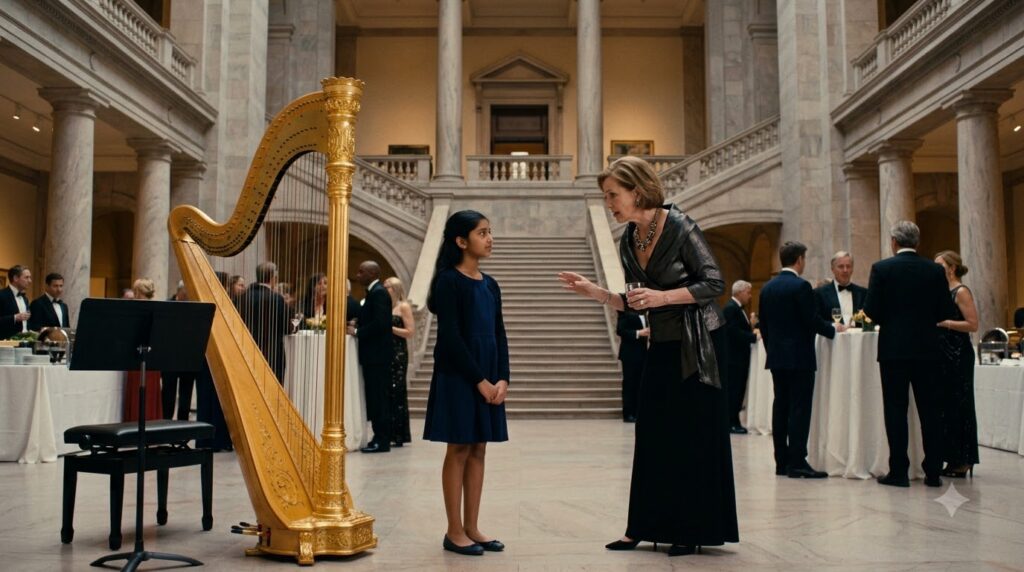
The atrium of the Halvorsen Museum of Art had been built in 1911 by men who believed that a room could teach people how to behave. Its marble columns rose four stories to a coffered ceiling painted the color of old cream, and its floor was laid in a pattern of gray and white stone that made even hurried visitors slow down, as if the floor itself were asking them to consider their steps. On ordinary afternoons, schoolchildren lay on their backs in the center of it and stared upward until a guard asked them to get up. On this Saturday evening in late October, no one lay on the floor. The guards wore white gloves. The caterers wore black. The donors wore whatever donors wear when they wish to look as though they have not thought about it at all.
It was the annual Family Circle reception, the one evening each year when the museum invited its most generous patrons to bring their children and grandchildren, so that the next generation might learn early that the building belonged, in some unspoken way, to them. Long tables ran along the eastern colonnade, draped in linen and crowded with silver trays: tiny tartlets of goat cheese and fig, shrimp arranged in spirals on beds of crushed ice, a pyramid of macarons in the museum’s signature shades of slate and gold. There was a separate table for the children, lower to the ground, with hot cocoa in porcelain cups and cookies shaped like famous paintings, and a young woman from the education department stood beside it with the bright, exhausted smile of someone who had answered the question “Can I have another one?” two hundred times.
At the far end of the atrium, the grand staircase swept upward in a double curve, its balustrade carved with acanthus leaves, and beneath the place where its two arms met, in a pool of soft amber light, stood a concert harp.
It was a full pedal harp, six feet tall, its column gilded and carved with wheat sheaves and small faces of cherubs worn smooth by a century of hands. The soundboard was pale spruce, the color of honey held up to a window. Forty-seven strings ran from the neck to the board, the C strings dyed red and the F strings dyed blue, so that in the light the instrument looked like something half made of air. Beside it stood a padded bench and a small music stand, and on the stand lay a single sheet of paper: the evening’s program, printed on heavy ivory stock.
A girl stood near the harp.
She was twelve years old, slight for her age, with black hair pulled back into a single braid that reached the middle of her back. She wore a simple navy dress that came to her knees, a gray cardigan with one button missing, and black flats that had been polished that afternoon with a rag and a little shoe cream borrowed from her father. Her name was Priya Raman. She was not hovering, exactly. She was standing the way a person stands at a train platform, facing the direction from which something is expected to come. Every so often she looked at the harp, and then at the tall bronze doors at the back of the atrium, and then at her hands, which she held loosely clasped in front of her.
She had not touched the harp. She had come close enough to see the tiny scratches in the gilt near the base, close enough to smell the faint resin and lemon oil of the wood, but she had not touched it.
The woman who noticed her was named Evelyn Carraway.
Mrs. Carraway was sixty-four and had been a trustee of the Halvorsen for nineteen years. Her family’s foundation had paid for the restoration of the atrium ceiling, the new conservation laboratory in the basement, and, most recently, an entire gallery on the third floor that would open to the public in the spring: the Carraway Gallery of South and Southeast Asian Art. Her name was engraved in the donor wall beside the entrance in letters slightly larger than anyone else’s. She wore a silk dress the color of claret, a single strand of pearls, and an expression of pleasant authority that she had practiced so long it no longer required practice. She had two grandchildren somewhere in the room, a boy and a girl, aged nine and seven, who were at that moment conducting an unsanctioned experiment involving cocoa and a potted palm. She did not know this yet.
What she knew was that there was an unattended child near the harp, and that the harp was very old, and that it was on loan from the Lindqvist family, and that if anything happened to it, there would be letters.











