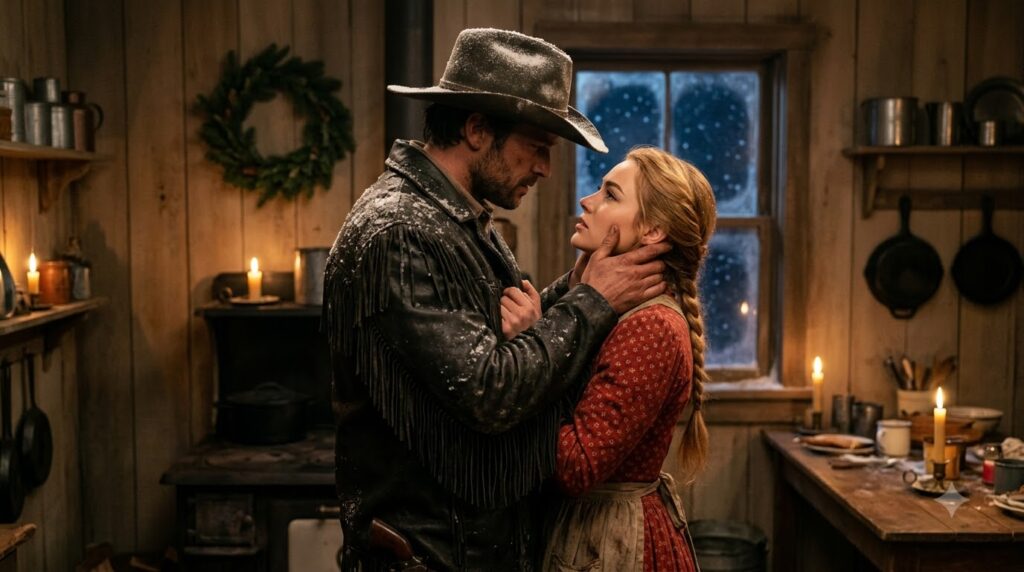
The snow had come down blue at dusk, the way it did in the high country when the light went out of the sky before it went out of the ground, and by the time Ruth Calloway lit the last candle in the kitchen window the whole valley of the Little Sweetwater lay under it like a sheet drawn over a sleeping face. Inside, the iron stove ticked and sighed. The wreath she had twisted from juniper and red willow hung on the door, its little dried rose hips catching the firelight like drops of old wine. Everything within the four log walls was amber, and everything beyond them was cold and blue and still, and Ruth stood between the two with a letter in her hand that she had read eleven times since noon.
She was twenty-seven years old and had been a widow for two winters. She did not look like what the women in town thought a widow ought to look like, and she had long since stopped apologizing for it. Her hair was the color of clover honey held up to a window, and she wore it in a single thick braid that fell over her shoulder nearly to her waist. Her brows were dark and sharply arched, two clean strokes that gave her face a look of perpetual, intelligent challenge, and beneath them her eyes, gray as creek stones, were lined with a dark winged sweep of kohl she had bought from a peddler in Rawlins and refused to give up. Her lashes were full. Her mouth was full, too, and she kept it glossed with a salve of beeswax and rose oil she made herself every autumn, so that in candlelight her lips shone as if she had just come in from the cold and licked them. She wore a red calico prairie dress, faded at the elbows, printed with tiny white sprigs, and over it a muslin apron with a scorch mark at the hem shaped like the state of Ohio, where she had been born Ruth Ashby and where, as a girl, she had believed she would never see a mountain.
The letter was from the Rawlins Stock Growers’ Bank. It said, in a clerk’s tidy and indifferent hand, that the mortgage note on the property known as the Calloway place, comprising one hundred and sixty acres of patented land, a timber claim of equal size, the house, the barn, the corrals, and all water rights appertaining, had been satisfied in full by purchase on the twenty-second of December by Mr. Jonah Whitlock, and that the bank’s interest in the property was hereby concluded. It wished her the compliments of the season.
She had not wept when she read it. She had gone out and split kindling until her palms burned and then she had come in and made a pie, because it was Christmas Eve and because her hands needed to be doing something that did not involve breaking.
The pie was cooling on the sill when she heard the horse.
She knew the horse before she knew the rider. It was a tall bay gelding with one white sock, and it had come up her lane every Sunday since the October after Daniel died, and she knew the sound of its stride in snow the way she knew the sound of her own kettle. She heard it stop at the rail. She heard the creak of leather as the man swung down. She heard his boots on the porch, two steps, a pause while he knocked the snow from them against the post, as he always did, because she had once told him she would not have mud on her floor and he had remembered it ever since.
Then he knocked.
She did not answer right away. She stood with her hand flat on the table and watched the door, the wreath trembling very slightly on its nail.
“It’s open,” she said at last.
Jonah Whitlock came in with the cold. It rolled off him in a visible breath and lay along the floorboards and touched her ankles. He was thirty-two, tall in the way of men who had grown up on horseback and never quite learned to stand still on the ground, and he was, she had admitted to herself sometime in the second summer and then refused to admit again, a handsome man. His jaw was dark with three days of stubble. His hat was a gray Stetson gone soft at the brim, and there was snow on the crown and caught in the creases of it, so that he looked as if he had ridden in out of a story. He wore a fringed leather jacket the color of strong coffee, open over a dark wool vest and a shirt of faded blue, and a red bandana knotted loose at his throat. His boots were scuffed to the color of dry earth. His eyes were brown and steady and very tired.











