“Is there a problem?”
She turned the smile toward him as if he had arrived to agree.
“I think she may be in the wrong place.”
Mr. Carter looked at Nia. He did not inventory her shoes. He looked at her face, and at the registration list he already knew, and at the harp beside the doors.
“Did you bring your own instrument?”
The question landed clean. Nia answered it cleanly.
“No, sir.”
He nodded once, the way a man nods when the answer is the one the procedure was written to hold. He stepped past the ivory blazer, took the bench by its wooden edge, and pulled it out from beside the harp until it sat where a player would need it. The legs made a small, definite sound on the stone. A few parents turned. A boy with a cello case stopped chewing his thumbnail.
“Use ours.”
The sentence was not loud. It did not need to be. It rearranged the air around the harp more effectively than a speech would have. Claire’s fingers tightened on the scarf-wrapped handle. The woman’s smile thinned into something more honest, which was not the same as something kinder.
“You know everyone’s going to hear this.”
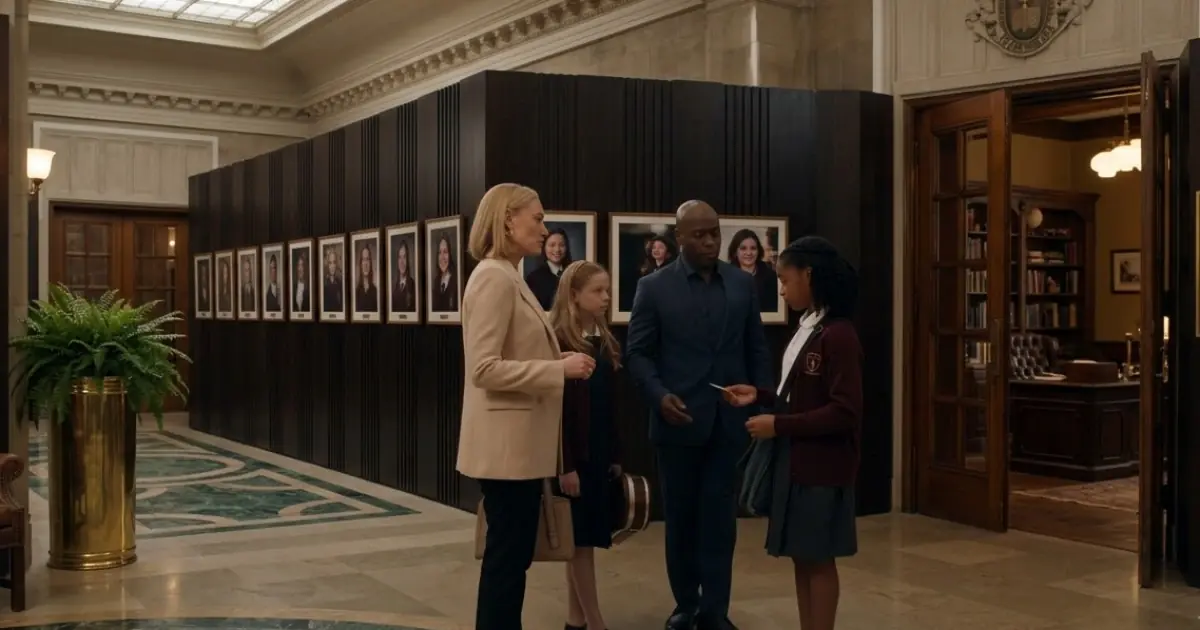
Nia looked at the strings. She looked at the bench. She set the navy bag down carefully, away from the harp’s brass feet, because she had been taught that respect could be a placement of objects and not only a tone of voice. She sat. The bench was a little high. She adjusted it without fumbling, one hand on the wood, a small practiced turn she did not announce. She brought the harp to her shoulder. The column was cool even through the cardigan. Her right hand rose. Her left found the middle of the strings and did not strike them. Someone near the windows coughed and then thought better of a second cough. The framed orchestras watched from behind glass. The woman waited with the patience of a person who believed the next moment would put the afternoon back in its proper order.
“I know.”
Mrs. Whitmore — that was the name on the registration clipboard two lines above a daughter listed for violin — folded her hands over the leather strap of her handbag. The gold earrings shifted when she tipped her head, performing the courtesy of an audience that had not bought a ticket and did not intend to be impressed.
“Well? We’re waiting.”
Nia’s mouth was dry. The walk from the bus had been longer than the map suggested, and she had not wanted to drink from the lobby fountain and then have to find a restroom before they called her. Her voice, when it came, was not loud. It did not shake as much as she had imagined it would on the bus, which felt like a small mercy she had not budgeted for.
“Then listen.”
Her wrists lifted. The red discs held their positions like a row of small closed mouths. The first string took the window light along its length, bright as a decision that had not yet been allowed to become a sound. The lobby leaned in. Mrs. Whitmore’s eyebrows rested in their expectation. Mr. Carter stood with his hands at his sides, badge level, face unreadable to anyone who did not know what he was holding still. Claire forgot, for a second, to look at her mother.
No one had heard a note yet.
The morning had started in a kitchen the size of a confession.
Aunt June stood at the stove in her work shoes even though her shift had ended at dawn, because taking the shoes off meant the day had officially asked something else of her feet and she was not ready to grant it. The apartment was on the third floor of a brick walk-up where the stairwell smelled of mop water and somebody’s fried onions from last night. The window over the sink looked into the brick of the next building and, if you leaned, a strip of sky the color of a laundered sheet. On the table sat a bowl of oatmeal, a spoon, a glass of milk, and Nia’s navy bag, already packed and repacked.
“Eat,” June said. “You can’t play on nerves. Nerves are not a breakfast.”
Nia ate. The oatmeal had cinnamon in it, which meant June was treating the day as a day. Most mornings the oatmeal was plain and the kindness was in the fact that it existed, hot, at the right time, with no speech attached. June was forty-six, broad through the shoulders from years of moving patients and stretchers and other people’s emergencies down hospital corridors. She wore her hair in a low puff that the humidity never fully negotiated with. She was Denise’s older sister, and she had the face of a woman who had learned to love people without wasting time on the performance of it.











