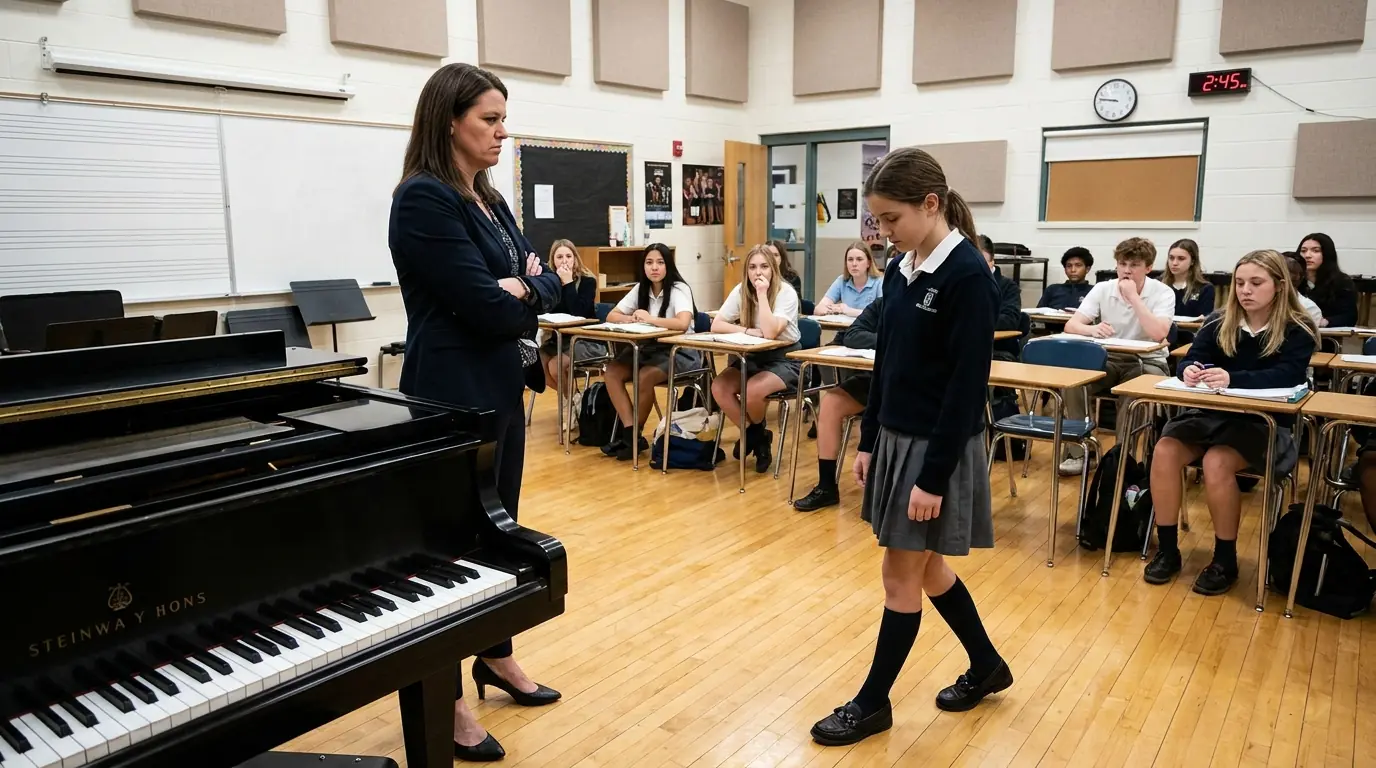
The boy in the middle row, the one Mrs. Patterson had embarrassed weeks ago, felt tears prick his eyes. He didn’t know why. There was just something about the music that reached inside his chest and squeezed his heart.
And still Lily played.
Her whole body moved with the music now. She swayed slightly, leaning into the louder parts, pulling back during the quiet moments. Her eyes were closed, and there was an expression on her face that no one in that classroom had ever seen before. She looked free. She looked like she was somewhere else entirely, somewhere beautiful and safe.
The piece she was playing was Chopin’s Nocturne in E-flat Major. None of the students knew that, but they didn’t need to know the name to understand that they were hearing something special, something that didn’t happen every day in a middle school music classroom.
Mrs. Patterson stood completely still. Her face had gone from smug satisfaction to confusion to something that looked almost like fear. Her hands clutched the edge of her desk so tightly that her knuckles turned white.
This wasn’t supposed to happen. This quiet girl in her worn-out clothes wasn’t supposed to be able to do this.
The music grew more intense. Lily’s fingers moved faster now, cascading up and down the keyboard in runs that sounded like water flowing over rocks. Her right hand played a melody so sweet and sad that several students felt goosebumps rise on their arms. Her left hand provided a foundation underneath, steady and sure.
One girl in the front row had been recording the beginning of class on her phone before Mrs. Patterson had called Lily up. She’d forgotten to stop recording, and now she held her phone perfectly still, barely breathing, capturing every second of this impossible moment.
The piece shifted again. The urgency faded, replaced by a gentler section. Lily’s fingers moved more slowly now, each note given time to breathe, to resonate, to tell its part of the story. This section was almost unbearably tender, like a lullaby or a memory of something precious and lost.
Two minutes passed, then three. The entire class sat motionless, trapped in the spell of Lily’s playing. Nobody coughed. Nobody shifted in their seat. Nobody dared make a sound that might break this moment.
Even the sounds from outside the classroom seemed to fade away. The distant laughter of children at recess, the hum of the heating system, the footsteps in the hallway. Everything disappeared except the music pouring from the piano.
Mrs. Patterson’s face had turned red. Not with anger exactly, though that was part of it, more with the slow, creeping realization that she had made a catastrophic error in judgment. She had tried to humiliate this child, to put her in her place, to prove that she didn’t belong. Instead, she’d given her a stage, and Lily was shining on it so brightly that everyone else in the room looked dim by comparison.
The music built toward its conclusion. Lily’s hands moved with absolute certainty across the keys, playing phrases that required years of practice to master. The melody climbed higher and higher, reaching toward something beautiful and unreachable before finally beginning its descent.
The final section was quiet again, peaceful, like coming home after a long journey. Lily’s fingers moved more slowly, savoring each note. The music grew softer and softer until it was barely louder than a breath. And then, with one last gentle chord, she stopped.
Her hands remained on the keys for a moment, as if saying goodbye. Then she lifted them and placed them in her lap. She opened her eyes slowly, like someone waking up from a dream.
The silence that followed was absolute.
Nobody moved. Nobody spoke. They all just stared at the small girl sitting at the piano, trying to process what they had just heard.
Lily looked confused by the silence. She turned slightly on the bench, glancing back at the class with uncertain eyes. Had she done something wrong? Should she not have played that piece? Her cheeks started to turn pink again, the same way they had on her first day.
Then something happened that no one expected.
The boy in the middle row started clapping. It wasn’t polite, quiet classroom clapping. It was real applause, the kind you hear at concerts. His hands came together hard enough to echo in the room, and he stood up from his desk without even thinking about it.
Then Timothy jumped to his feet, applauding too. His face was full of genuine amazement. All thoughts of competition forgotten.
One by one, like dominoes falling, the other students rose from their desks. They clapped and clapped, some of them whistling, some of them shouting, “Woo!” and “That was amazing!”











