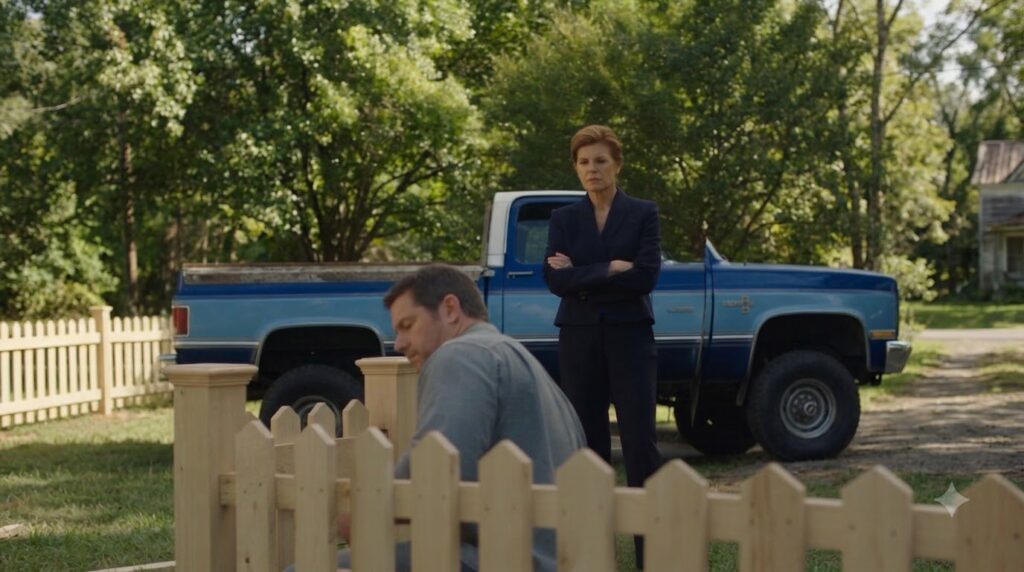
“You think I don’t know what you are?” Catherine Hail asked.
She stood in the middle of her flawless driveway wearing a charcoal blazer that probably cost more than Daniel Mercer earned on an average fence repair, and her voice had the precise, polished cruelty of someone who knew exactly where to aim.
“You’re a handyman. You fix things for people like me. That’s all this is.” Daniel stood beside his open toolbox with dust on his boots and an unfinished stretch of fencing behind him, looking at a woman who had built a company worth forty million dollars and somehow found less time to hold her daughter’s hand than to answer another telephone call.
He could have reminded her that she had called him because three other contractors had failed to understand the problem. He could have told her that knowing how to repair something was not a smaller kind of intelligence than knowing how to purchase it. Instead he looked at her for a long moment and said, “Yes, ma’am. That’s all this is.” He picked up his tools and went back to the broken fence, leaving Catherine standing alone with the words she had chosen.
The strange thing was that he had not said anything unkind. He had not questioned her success or insulted the work that had consumed eleven years of her life. He had simply accepted the boundary she had drawn, and the silence afterward made her realize how different that boundary looked from the outside. Behind the kitchen window her twelve-year-old daughter was watching, and Catherine wished, with an intensity that surprised her, that Lily had not heard.
Two mornings earlier, Daniel had burned his hand on a coffee pot while trying to hold too many things at once. The burn was not serious, but it stung sharply enough to make him hiss and pull back, nearly spilling coffee onto a stack of unpaid invoices. His left hand held Noah’s lunchbox; his right held the thermos, and his phone was balanced against the bread box with three unanswered messages from a contractor who owed him four hundred dollars. It was six minutes after six, and the small kitchen smelled of scrambled eggs, coffee, and the faint metallic heat of an aging radiator.
Daniel set down the pot and ran his hand under cool water while calculating whether he could replace the truck’s rear tire before the next school payment came due. The tire was not unsafe yet, but its tread was getting thin, and he had learned not to confuse “not yet” with “never.” He wrapped his hand in a dish towel, turned off the faucet, and called down the hallway for Noah. The house answered with silence and then a distant thump that suggested his son had fallen out of bed or knocked over the tower of books he kept beside it.
“Noah, breakfast,” Daniel called again. He divided the eggs between two plates, placing the slightly larger portion on the blue one because Noah insisted the blue plate made food taste better. The boy eventually appeared in wrinkled pajamas with his hair pointing in three different directions and his backpack hanging from one shoulder. He looked at his father’s towel-wrapped hand before he looked at his breakfast.
“You burned yourself,” Noah announced. Daniel said it was nothing, but the boy climbed onto his chair without taking his eyes off the towel. “You only use the kitchen towel like that when you don’t want me to see,” he said. Daniel wondered when his son had learned to read the small accommodations adults made around pain, and then remembered that Noah had been five when Sarah died. Four years was enough time to learn a language nobody should have to speak so young.
Sarah Mercer had been the person who made even bad mornings feel as if they had room in them. She used to leave Daniel ridiculous notes inside his lunch bag, tell Noah elaborate stories about the secret lives of ordinary machines, and insist that the house was not a museum where nothing could be touched. When she became ill, she kept doing those things until fatigue made the handwriting on her notes uneven. Daniel still had three of the notes folded in the back of a kitchen drawer, not because he opened them often but because knowing they were there made the drawer feel different.
He and Sarah had inherited the modest house from her grandmother, a woman who had taught Daniel to fix a loose hinge before replacing an entire door. The house needed constant attention, but it was paid for, and that fact had saved him when Sarah’s treatment bills began arriving in envelopes that looked harmless until he opened them. After her death, the insurer disputed three months of care, calling parts of it experimental despite written medical recommendations. Daniel spent four months collecting records, challenging denials, and learning more about administrative appeals than he ever wanted to know.











